Artist
Jean-Jules-Antoine Lecomte du Nouÿ
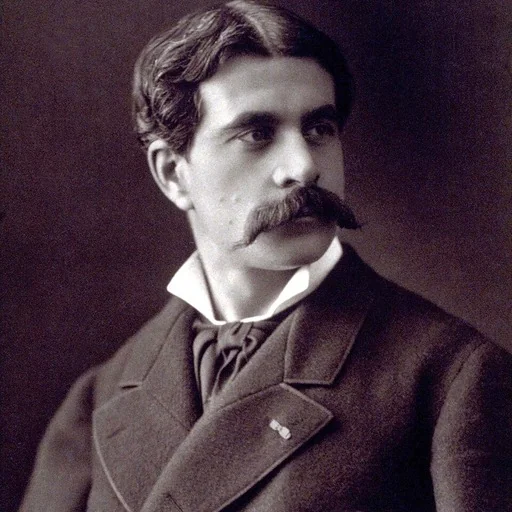
French, 1842–1923
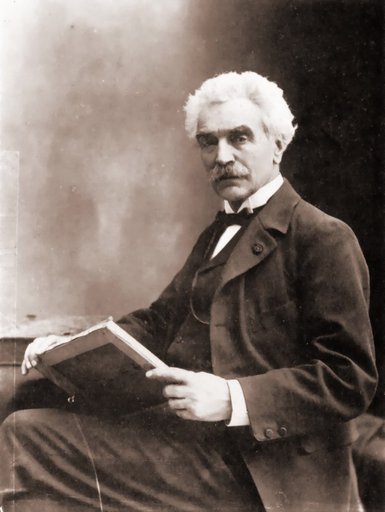
Jean-Jules-Antoine Lecomte du Nouÿ was a French Orientalism painter. 3 works are cataloged here, principally at Cleveland Museum of Art, most of them oil paintings. Jean-Jules-Antoine Lecomte du Nouÿ was born in Paris.
Overview
Jean-Jules-Antoine Lecomte du Nouÿ (10 June 1842 – 19 February 1923) was an Orientalist French painter and sculptor. He was strongly influenced by the works and teachings of Charles Gleyre and Jean-Léon Gérôme. Lecomte du Nouÿ found inspiration for his art through extensive travels to Greece, Turkey, Egypt, Romania and Italy. The thematic content of Lecomte du Nouÿ's work was mainly figural, but also spanned over a vast range of imagery throughout his career, including classical, historical and religious. Lecomte du Nouÿ is known for remaining faithful to his detailed, realistic style throughout the extent of his career, despite the onset of the Impressionist, Fauvist and Constructivist artistic movements during his lifetime. His work is said to have contributed significantly to the establishment of an iconic repertoire representing the Orient in the nineteenth century. A Parisian street was named after him in 1932.
Early life and education
Jean-Jules-Antoine was born on 10 June 1842 in Paris. Originally of a Piedmontese origin, his family had been settled in France since the fourteenth century and by the time of his birth had reached the status of nobility. Lecomte du Nouÿ showed a strong attachment to visual art from a young age and was reported to have painted portraits of his father and uncle by the age of 6. In 1861, at 19 years of age, the artistic talents of young Jean-Jules-Antoine Lecomte du Nouÿ prompted him to become a pupil at the atelier of Swiss artist, Charles Gleyre. Under Gleyre's guidance Jean-Jules-Antoine learned the significance of individualistic style and gained the foundations of creative visual presentation. Later, Lecomte du Nouy further perfected his knowledge of the artistic form under the mentorship of Jean-Léon Gérôme, who was a renowned painter of the Academicism movement. It was at this time that Jean-Jules-Antoine learned the precision required to depict la belle nature—a style of illustration that aims to create the most beautiful representations of the natural form. This later became one of the main techniques employed in Lecomte du Nouÿ's signature artwork.
Maturity and Travels
In 1865, Du Nouÿ accompanied fellow artist, Félix Auguste Clément, on his travels to Cairo, Egypt. It was after this voyage that the young Lecompte du Nouy sought to portray the opulence of the Orient. In later years, he continued his travels, visiting countries like Italy and Greece. Lecompte du Nouy found inspiration in all social, historical and literary facets of foreign culture.
Artistic style
The Orientalist style is largely characterized by its content, but also by its subdued realism and precision allotted towards depicting the human form. The latter is a prominent characteristic of the 19th century methods upheld by the Académie des Beaux-Arts. Du Nouÿ was a prominent figure within the sphere of academic art and thereby adhered to a rule-based artistic style of well-developed skill and formal composition. The artistic composition of his paintings was often complemented by the use of half-light, which added certain dramatic and melancholic qualities to his work. To this day some, like Alan Braddock, consider Du Nouÿ to have been decidedly modern for his time, because his work directly and indirectly broached some of the key issues of his day, albeit from a decidedly conservative perspective: colonialism, international trade, gender, religion, and history.
Later life and death
Du Nouÿ spent most of the later years of his life in Romania. There he painted primarily the royal family and their subjects. However, he returned to Paris right before his death on 19 February 1923.
Selected paintings
1864 : Le Guet-à-pens 1866 : Invocation de Neptune 1869 : Le souper de Beaucaire 1870 : Démosthène s'exerçant à la parole 1871 : Chrétiennes au tombeau de la Vierge 1872 : Les porteurs de mauvaises nouvelles 1874 : Un rêve d'eunuque 1875 : Judith 1878 : Adolphe Crémieux 1882 : The Reading of the Bible by the Rabbis (A Souvenir of Morocco) 1884 : Le Marabout prophète 1888 : L'esclave blanche (The White Slave) 1889 : Le samedi au quartier juif 1890 : Le dimanche à Venise 1899 : Portrait du Roi et de la Reine de Roumanie 1902 : Mademoiselle de Maupin 1904 : La Sorcière 1904 : Rêve d'Orient 1905 : La Péri et le Poète 1913 : La dernière ronde 1919 : Etude pour la Victoire
Paris
The rue Lecomte du Nouÿ runs west from the boulevard Murat in arrondissement 16.
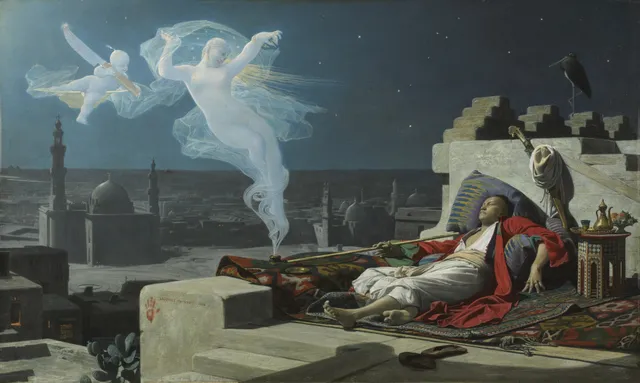
Works by Jean-Jules-Antoine Lecomte du Nouÿ
Collections represented

Museum
Artists in a similar vein