Artist
August Strindberg
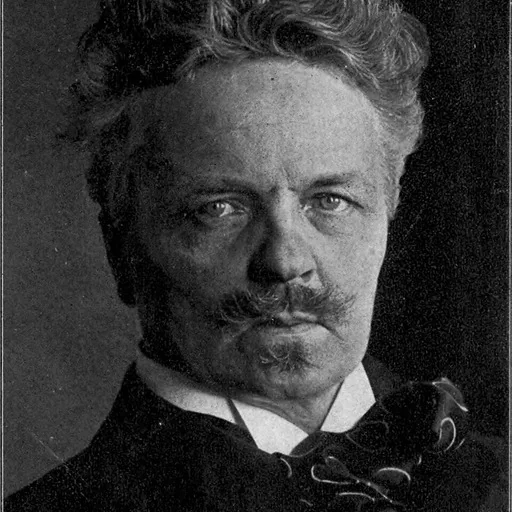
Swedish, 1849–1912
August Strindberg was a Swedish Symbolism artist. 1 work is cataloged here, principally at Statens Museum for Kunst. August Strindberg was born in Stockholm.
Johan August Strindberg (; Swedish: ; 22 January 1849 – 14 May 1912) was a Swedish playwright, novelist, poet, essayist, and painter. A prolific writer who often drew directly on his personal experience, Strindberg wrote more than 60 plays and more than 30 works of fiction, autobiography, history, cultural analysis, and politics during his career, which spanned four decades. A bold experimenter and iconoclast throughout his life, he explored a wide range of dramatic methods and purposes, from naturalistic tragedy, monodrama, and historical plays to his anticipations of expressionist and surrealist dramatic techniques. From his earliest work, Strindberg developed innovative forms of dramatic action, language, and visual composition. He is considered the "father" of modern Swedish literature and his The Red Room (1879) has frequently been described as the first modern Swedish novel. In Sweden, Strindberg is known as an essayist, painter, poet, and especially novelist and playwright, but in other countries he is known mostly as a playwright. The Royal Theatre rejected his first major play, Master Olof, in 1872; it was not until 1881, when he was thirty-two, that its première at the New Theatre gave him his theatrical breakthrough. In his plays The Father (1887), Miss Julie (1888), and Creditors (1889), he created naturalistic dramas that – building on the established accomplishments of Henrik Ibsen's prose problem plays while rejecting their use of the structure of the well-made play – responded to the call-to-arms of Émile Zola's manifesto "Naturalism in the Theatre" (1881) and the example set by André Antoine's newly established Théâtre Libre (opened 1887). In Miss Julie, characterisation replaces plot as the predominant dramatic element (in contrast to melodrama and the well-made play) and the determining role of heredity and the environment on the "vacillating, disintegrated" characters is emphasized. Strindberg modeled his short-lived Scandinavian Experimental Theatre (1889) in Copenhagen on Antoine's theatre and he explored the theory of Naturalism in his essays "On Psychic Murder" (1887), "On Modern Drama and the Modern Theatre" (1889), and a preface to Miss Julie, the last of which is probably the best-known statement of the principles of the theatrical movement. During the 1890s he spent significant time abroad engaged in scientific experiments and studies of the occult. A series of apparent psychotic attacks between 1894 and 1896 (referred to as his "Inferno crisis") led to his hospitalization and return to Sweden. Under the influence of the ideas of Emanuel Swedenborg, he resolved after his recovery to become "the Zola of the Occult". In 1898 he returned to play-writing with To Damascus, which, like The Great Highway (1909), is a dream-play of spiritual pilgrimage. His A Dream Play (1902) – with its radical attempt to dramatize the workings of the unconscious by means of an abolition of conventional dramatic time and space and the splitting, doubling, merging, and multiplication of its characters – was an important precursor to both expressionism and surrealism. He also returned to writing historical drama, the genre with which he had begun his play-writing career. He helped to run the Intimate Theatre from 1907, a small-scale theatre in Stockholm, modeled on Max Reinhardt's Kammerspielhaus, that staged his chamber plays (such as The Ghost Sonata).
Overview
Johan August Strindberg (; Swedish: [ˈǒːɡɵst ˈstrɪ̂nːdbærj] ; 22 January 1849 – 14 May 1912) was a Swedish playwright, novelist, poet, essayist, and painter. A prolific writer who often drew directly on his personal experience, Strindberg wrote more than 60 plays and more than 30 works of fiction, autobiography, history, cultural analysis, and politics during his career, which spanned four decades. A bold experimenter and iconoclast throughout his life, he explored a wide range of dramatic methods and purposes, from naturalistic tragedy, monodrama, and historical plays to his anticipations of expressionist and surrealist dramatic techniques. From his earliest work, Strindberg developed innovative forms of dramatic action, language, and visual composition. He is considered the "father" of modern Swedish literature and his The Red Room (1879) has frequently been described as the first modern Swedish novel. In Sweden, Strindberg is known as an essayist, painter, poet, and especially novelist and playwright, but in other countries he is known mostly as a playwright. The Royal Theatre rejected his first major play, Master Olof, in 1872; it was not until 1881, when he was thirty-two, that its première at the New Theatre gave him his theatrical breakthrough. In his plays The Father (1887), Miss Julie (1888), and Creditors (1889), he created naturalistic dramas that – building on the established accomplishments of Henrik Ibsen's prose problem plays while rejecting their use of the structure of the well-made play – responded to the call-to-arms of Émile Zola's manifesto "Naturalism in the Theatre" (1881) and the example set by André Antoine's newly established Théâtre Libre (opened 1887). In Miss Julie, characterisation replaces plot as the predominant dramatic element (in contrast to melodrama and the well-made play) and the determining role of heredity and the environment on the "vacillating, disintegrated" characters is emphasized. Strindberg modeled his short-lived Scandinavian Experimental Theatre (1889) in Copenhagen on Antoine's theatre and he explored the theory of Naturalism in his essays "On Psychic Murder" (1887), "On Modern Drama and the Modern Theatre" (1889), and a preface to Miss Julie, the last of which is probably the best-known statement of the principles of the theatrical movement. During the 1890s he spent significant time abroad engaged in scientific experiments and studies of the occult. A series of apparent psychotic attacks between 1894 and 1896 (referred to as his "Inferno crisis") led to his hospitalization and return to Sweden. Under the influence of the ideas of Emanuel Swedenborg, he resolved after his recovery to become "the Zola of the Occult". In 1898 he returned to play-writing with To Damascus, which, like The Great Highway (1909), is a dream-play of spiritual pilgrimage. His A Dream Play (1902) – with its radical attempt to dramatize the workings of the unconscious by means of an abolition of conventional dramatic time and space and the splitting, doubling, merging, and multiplication of its characters – was an important precursor to both expressionism and surrealism. He also returned to writing historical drama, the genre with which he had begun his play-writing career. He helped to run the Intimate Theatre from 1907, a small-scale theatre in Stockholm, modeled on Max Reinhardt's Kammerspielhaus, that staged his chamber plays (such as The Ghost Sonata).
Youth
Strindberg was born on 22 January 1849 in Stockholm, Sweden, the third surviving son of Carl Oscar Strindberg (a shipping agent) and Eleonora Ulrika Norling (a serving-maid). In his autobiographical novel The Son of a Servant, Strindberg describes a childhood affected by "emotional insecurity, poverty, religious fanaticism and neglect". When he was seven, the family moved to Norrtullsgatan on the northern, almost-rural, periphery of the city. A year later they moved near Sabbatsberg, where they stayed for three years before returning to Norrtullsgatan. He attended a harsh school in Klara for four years, an experience that haunted him in his adult life. He was moved to the school in Jakob in 1860, which he found far more pleasant, though he remained there for only a year. In the autumn of 1861, he was moved to the Stockholm Lyceum, a progressive private school for middle-class boys, where he remained for six years. As a child he had a keen interest in natural science, photography, and religion (following his mother's Pietism). His mother, Strindberg recalled later with bitterness, always resented her son's intelligence. She died when he was 13, and although his grief lasted for only three months, in later life he came to feel a sense of loss and longing for an idealized maternal figure. Less than a year after her death, his father married the children's governess, Emilia Charlotta Pettersson. According to his sisters, Strindberg came to regard them as his worst enemies. He passed his graduation examination in May 1867 and enrolled at the Uppsala University, where he began on 13 September. Strindberg spent the next few years in Uppsala and Stockholm, alternately studying for examinations and trying his hand at non-academic pursuits. As a young student, Strindberg also worked as an assistant in a pharmacy in the university town of Lund in southern Sweden. He supported himself in between studies as a substitute primary-school teacher and as a tutor for the children of two well-known physicians in Stockholm. He first left Uppsala in 1868 to work as a schoolteacher, but then studied chemistry for some time at the Institute of Technology in Stockholm in preparation for medical studies, later working as a private tutor before becoming an extra at the Royal Theatre in Stockholm. In May 1869, he failed his qualifying chemistry examination which in turn made him uninterested in schooling.
1870s
Strindberg returned to Uppsala University in January 1870 to study aesthetics and modern languages and to work on a number of plays. It was at this time that he first learnt about the ideas of Charles Darwin. He co-founded the Rune Society, a small literary club whose members adopted pseudonyms taken from runes of the ancient Teutonic alphabet – Strindberg called himself Frö (Seed), after the god of fertility. After abandoning a draft of a play about Eric XIV of Sweden halfway through in the face of criticism from the Rune Society, on 30 March he completed a one-act comedy in verse called In Rome about Bertel Thorvaldsen, which he had begun the previous autumn. The play was accepted by the Royal Theatre, where it premièred on 13 September 1870. As he watched it performed, he realised that it was not good and felt like drowning himself, though the reviews published the following day were generally favourable. That year he also first read works of Søren Kierkegaard and Georg Brandes, both of whom influenced him.
Taking his cue from William Shakespeare, he began to use colloquial and realistic speech in his historical dramas, which challenged the convention that they should be written in stately verse. During the Christmas holiday of 1870–71, he rewrote a historical tragedy, Sven the Sacrificer, as a one-act play in prose called The Outlaw. Depressed by Uppsala, he stayed in Stockholm, returning to the university in April to pass an exam in Latin and in June to defend his thesis on Adam Gottlob Oehlenschläger's Romantic tragedy Earl Haakon (1802). Following further revision in the summer, The Outlaw opened at the Royal Theatre on 16 October 1871. Despite hostile reviews, the play earned him an audience with King Charles XV, who supported his studies with a payment of 200 riksdaler. Towards the end of the year Strindberg completed a first draft of his first major work, a play about Olaus Petri called Master Olof. In September 1872, the Royal Theatre rejected it, leading to decades of rewrites, bitterness, and a contempt for official institutions. Returning to the university for what would be his final term in the spring, he left on 2 March 1872, without graduating. In Town and Gown (1877), a collection of short stories describing student life, he ridiculed Uppsala and its professors. Strindberg embarked on his career as a journalist and critic for newspapers in Stockholm. He was particularly excited at this time by Henry Thomas Buckle's History of Civilization and the first volume of Georg Brandes' Main Currents of Nineteenth-Century Literature. From December 1874, Strindberg worked for eight years as an assistant librarian at the Royal Library. That same month, Strindberg offered Master Olof to Edvard Stjernström (the director of the newly built New Theatre in Stockholm), but it was rejected. He socialised with writers, painters, journalists, and other librarians; they often met in the Red Room in Bern's Restaurant. Early in the summer of 1875, he met Siri von Essen, a 24-year-old aspiring actress who, by virtue of her husband, was a baroness – he became infatuated with her. Strindberg described himself as a "failed author" at this time: "I feel like a deaf-mute," he wrote, "as I cannot speak and am not permitted to write; sometimes I stand in the middle of my room that seems like a prison cell, and then I want to scream so that walls and ceilings would fly apart, and I have so much to scream about, and therefore I remain silent." As a re
1880s
Strindberg and Siri's daughter Karin was born on 26 February 1880. Buoyant from the reception of The Red Room, Strindberg swiftly completed The Secret of the Guild ("Gillets hemlighet"), an historical drama set in Uppsala at the beginning of the 15th century about the conflict between two masons over the completion of the city cathedral, which opened at the Royal Theatre on 3 May 1880 (his first première in nine years); Siri played the "staunchly loyal" Margaretha. That spring he formed a friendship with the painter Carl Larsson. A collected edition of all of Strindberg's previous writings was published under the title Spring Harvest. From 1881, at the invitation of Edvard Brandes, Strindberg began to contribute articles to the Morgenbladet, a Copenhagen daily newspaper. In April he began work on The Swedish People, a four-part cultural history of Sweden written as a series of depictions of ordinary people's lives from the 9th century onwards, which he undertook mainly for financial reasons and which absorbed him for the next year; Larsson provided illustrations. At Strindberg's insistence, Siri resigned from the Royal Theatre in the spring, having become pregnant again. Their second daughter, Greta, was born on 9 June 1881, while they were staying on the island of Kymmendö. That month, a collection of essays from the past 10 years, Studies in Cultural History, was published. Ludvig Josephson (the new artistic director of Stockholm's New Theatre) agreed to stage Master Olof, eventually opting for the prose version – the five-hour-long production opened on 30 December 1881 under the direction of August Lindberg to favourable reviews. While this production of Master Olof was his breakthrough in the theatre, Strindberg's five-act fairy-tale play Lucky Peter's Journey, which opened on 22 December 1883, brought him his first significant success, although he dismissed it as a potboiler. In March 1882 he wrote in a letter to Josephson: "My interest in the theatre, I must frankly state, has but one focus and one goal – my wife's career as an actress"; Josephson duly cast her in two roles the following season. Having returned to Kymmendö during the summer of 1882, Strindberg wrote a collection of anti-establishment short stories, The New Kingdom. While there, to provide a lead role for his wife and as a reply to Henrik Ibsen's A Doll's House (1879), he also wrote Sir Bengt's Wife, which opened on 25 November 1882 at the New Theatre. He moved to Grez-sur-Loing, just south of Paris, France, where Larsson was staying. He then moved to Paris, which they found noisy and polluted. Income earned from Lucky Peter's Journey enabled him to move to Switzerland in 1883. He resided in Ouchy, where he stayed for some years. On 3 April 1884, Siri gave birth to their son, Hans.
In 1884 Strindberg wrote a collection of short stories, Getting Married, that presented women in an egalitarian light and for which he was tried for and acquitted of blasphemy in Sweden. Two groups "led by influential members of the upper classes, supported by the right-wing press" probably instigated the prosecution; at the time, most people in Stockholm thought that Queen Sophia was behind it. By the end of that year Strindberg was in a despondent mood: "My view now is," he wrote, "everything is shit. No way out. The skein is too tangled to be unravelled. It can only be sheared. The building is too solid to be pulled down. It can only be blown up." In May 1885 he wrote: "I am on my wa
1890s
On midsummer's day, 1891, while staying with Siri and her close friend, the Danish woman Marie Caroline David, on the island Runmarö, in the Stockholm Archipelago, Strindberg suspected Siri was having a long-term affair with David, and he violently assaulted her, precipitating the end of the marriage. After his disenchantment with naturalism, Strindberg had a growing interest in transcendental matters. Symbolism was just beginning at this time. Verner von Heidenstam and Ola Hanson had dismissed naturalism as "shoemaker realism" that rendered human experience in simplistic terms. This is believed to have stalled Strindberg's creativity, and Strindberg insisted that he was in a rivalry and forced to defend naturalism, even though he had exhausted its literary potential. These works include: Debit and Credit (1892), Facing Death (1892), Motherly Love (1892), and The First Warning (1893). His play The Keys of Heaven (1892) was inspired by the loss of his children in his divorce. He also completed one of his few comedies, Playing with Fire (1893), and the first two parts of his post-inferno trilogy To Damascus (1898–1904). In 1892, he experienced writer's block, which led to a drastic reduction in his income. Depression followed as he was unable to meet his financial obligations and to support his children and former wife. A fund was set up through an appeal in a German magazine. This money allowed him to leave Sweden and he joined artistic circles in Berlin. Otto Brahm's Freie Bühne theatre premiered some of his famous works in Germany, including The Father, Miss Julie, and Creditors.
Similar to 20 years earlier when he frequented The Red Room, he now went to the German tavern The Black Porker. Here he met a diverse group of artists from Scandinavia, Poland, and Germany. His attention turned to Frida Uhl, who was twenty-three years younger than Strindberg. They were married in 1893. Less than a year later, their daughter Kerstin was born and the couple separated, though their marriage was not officially dissolved until 1897. Frida's family, in particular her mother, who was a devout Catholic, had an important influence on Strindberg, and in an 1894 letter he declared "I feel the hand of our Lord resting over me." Some critics think that Strindberg suffered from severe paranoia in the mid-1890s, and perhaps that he temporarily experienced insanity. Others, including Evert Sprinchorn and Olof Lagercrantz, believed that he intentionally turned himself into his own guinea pig by doing psychological and drug-induced self-experimentation. He wrote on subjects such as botany, chemistry, and optics before returning to literature with the publication of Inferno (1897), a (half fictionalized) account of his "wilderness years" in Austria and Paris, then a collection of short stories, Legends, and a semi-dramatic novella, Jacob Wrestling (both printed in the same book 1898). Both volumes aroused curiosity and controversy, not least due to the religious element; earlier, Strindberg had been known to be indifferent or hostile to religion and especially priests, but now he had undergone some sort of conversion to a personal faith. In a postscript, he noted the impact of Emanuel Swedenborg on his current work.
"The Powers" were central to Strindberg's later work. He said that "the Powers" were an outside force that had caused him his physical and mental suffering because they were acting in retribution to humankind for their wrongdoings. As William Blake
1900s
Strindberg was pivotal in the creation of chamber plays. Max Reinhardt was a big supporter of his, staging some of his plays at the Kleines Theatre in 1902 (including The Bond, The Stronger, and The Outlaw). Once Otto Brahm relinquished his role as head as of the Deutsches Theatre, Reinhardt took over and produced Strindberg's plays. In 1903, Strindberg planned to write a grand cycle of plays based on world history, but the idea soon faded. He had completed short plays about Martin Luther, Plato, Moses, Jesus Christ, and Socrates. He wrote another historical drama in 1908 after the Royal Theatre convinced him to put on a new play for its sixtieth birthday. He wrote The Last of the Knights (1908), Earl Birger of Bjälbo (1909), and The Regents (1909).
His other works, such as Days of Loneliness (1903), The Roofing Ceremony (1907), and The Scapegoat (1907), and the novels The Gothic Rooms (1904) and Black Banners Genre Scenes from the Turn of the Century, (1907) have been viewed as precursors to Marcel Proust and Franz Kafka. August Falck, an actor, wanted to put on a production of Miss Julie and wrote to Strindberg for permission. In September 1906 he staged the first Swedish production of Miss Julie. August Falck, played Jean and Manda Bjorling played Julie. In 1909, Strindberg thought he might get the Nobel Prize in Literature, but instead lost to Selma Lagerlöf, the first woman and first Swede to win the award. The leader of the Social Democrat Youth Alliance started a fund-raiser for a special "people's award". Nathan Söderblom (friend of Strindberg since the mid-90s years in Paris, a prominent theologian and later to become archbishop of Sweden) was noted as a donor, and both he and Strindberg came under attack from circles close to the conservative party and the church. In total 45,000 Swedish crowns were collected, by more than 20,000 donors, most of whom were workers. Albert Bonniers förlag, who had already published much of his work over the years, paid him 200,000 Swedish crowns for the publishing rights to his complete works; the first volumes of the edition would appear in print in 1912, a few months before his death. He invited his first three children (now, like their mother, living in Finland) to Stockholm and divided the money into five shares, one for each child, one for Siri (absent), and the last one for himself. In setting apart one share for Siri, Strindberg noted, in a shy voice, "This is for your mother - it's to settle an old debt". When the children returned to Helsinki, Siri was surprised to hear that she had been included, but accepted the money and told them in a voice that was, according to her daughter Karin, both proud and moved, "I shall accept it, receiving it as an old debt". The debt was less financial than mental and emotional; Strindberg knew he had sometimes treated her unfairly during the later years of their marriage and at their divorce trial. In 1912, she would pass away only a few weeks before him. In 1907, Strindberg co-founded The Intimate Theatre in Stockholm, together with the young actor and stage director August Falck. His theatre was modeled after Max Reinhardt's Kammerspiel Haus. Strindberg and Falck had the intention of the theatre being used for his plays and his plays only, Strindberg also wanted to try out a more chamber-oriented and sparse style of dramatic writing and production. In time for the theatre's opening, Strindberg wrote four chamber plays: Thunder in the Air, The Burned
Death and funeral
Strindberg died shortly after the first staging of one of his plays in the United States — The Father opened on 9 April 1912 at the Berkeley Theatre in New York, in a translation by painter and playwright Edith Gardener Shearn Oland and her husband actor Warner Oland. They jointly published their translations of his plays in book form in 1912. During Christmas 1911, Strindberg became sick with pneumonia and he never recovered completely. He also began to suffer more clearly from a stomach cancer (early signs of which had been felt in 1908). The final weeks of his life were painful. He had long since become a national celebrity, even if highly controversial, and when it became clear that he was seriously ill the daily papers in Stockholm began reporting on his health in every edition. He received many letters and telegrams from admirers across the country. He died on 14 May 1912 at the age of 63. Strindberg was interred at Norra begravningsplatsen in Stockholm. He had given strict instructions concerning his funeral and how his body should be treated after death: only members of his immediate family were allowed to view his body, there would be no autopsy, no photographs were taken, and no death mask was made. Strindberg had also requested that his funeral should take place as soon as possible after his death to avoid crowds of onlookers. However, the workers' organisations requested that the funeral should take place on a Sunday to make it possible for working men to pay their respects, and the funeral was postponed for five days, until Sunday, 19 May. According to Strindberg's last wish, the funeral procession was to start at 8am, again to avoid crowds, but large groups of people were nevertheless waiting outside his home as well as at the cemetery, as early as 7am. A short service was conducted by Nathan Söderblom by the bier in Strindberg's home, in the presence of three of Strindberg's children and his housekeeper, after which the coffin was taken outside for the funeral procession. The procession was followed by groups of students, workers, members of Parliament and a couple of cabinet ministers, and it was estimated that up to 60,000 people lined the streets. King Gustaf V sent a wreath for the bier.
Legacy
Tennessee Williams, Edward Albee, Maxim Gorky, John Osborne, and Ingmar Bergman are among the many artists who have cited Strindberg as an influence. Eugene O'Neill, upon receiving the Nobel Prize in Literature, dedicated much of his acceptance speech to describing Strindberg's influence on his work, and referred to him as "that greatest genius of all modern dramatists." Argentinian writer Jorge Luis Borges said of Strindberg: "[he] was, for a time, my god, alongside Nietzsche". A multi-faceted author, Strindberg's novel The Red Room (1879) made him famous. His early plays belong to the Naturalistic movement. His works from this time are often compared with the Norwegian playwright Henrik Ibsen. Strindberg's best-known play from this period is Miss Julie. Among his most widely read works is the novel The People of Hemsö. Strindberg wanted to attain what he called "greater Naturalism". He disliked the expository character backgrounds that characterise the work of Henrik Ibsen and rejected the convention of a dramatic "slice of life" because he felt that the resulting plays were mundane and uninteresting. Strindberg felt that true naturalism was a psychological "battle of brains": two people who hate each other in the immediate moment and strive to drive the other to doom is the type of mental hostility that Strindberg strove to describe. He intended his plays to be impartial and objective, citing a desire to make literature akin to a science. Following the inner turmoil that he experienced during the "Inferno crisis", he wrote an important book in French, Inferno (1896–7), in which he dramatised his experiences. He also exchanged a few cryptic letters with Friedrich Nietzsche. Strindberg subsequently ended his association with Naturalism and began to produce works informed by Symbolism. He is considered one of the pioneers of the modern European stage and Expressionism. The Dance of Death, A Dream Play, and The Ghost Sonata are well-known plays from this period. His most famous and produced plays are Master Olof, Miss Julie, and The Father. Internationally, Strindberg is chiefly remembered as a playwright, but in his native Sweden his name is associated no less with novels and other writings. Röda rummet (The Red Room), Hemsöborna (The People of Hemsö), Giftas (Getting Married), En dåres försvarstal (The Confession of a Fool), and Inferno remain among his most celebrated novels, representing different genres and styles. He is often, though not universally, viewed as Sweden's greatest author, and taught in schools as a key figure of Swedish culture. The most important contemporary literary award in Sweden, Augustpriset, is named for Strindberg. The Swedish composer Ture Rangström dedicated his first Symphony, which was finished in 1914, to August Strindberg in memoriam.
Social criticism
An acerbic polemicist who was often vehemently opposed to conventional authority, Strindberg was difficult to pigeon-hole as a political figure. Through his long career, he penned scathing attacks on the military, the church, and the monarchy. For most of his public life, he was seen as a major figure on the literary left and a standard-bearer of cultural radicalism, but, especially from the 1890s, he espoused conservative and religious views that alienated many former supporters. He resumed his attacks on conservative society with great vigor in the years immediately preceding his death. Strindberg's opinions were typically stated with great force and vitriol, and sometimes humorously over-stated. He was involved in a variety of crises and feuds, skirmishing regularly with the literary and cultural establishment of his day, including erstwhile allies and friends. His youthful reputation as a genial enfant terrible of Swedish literature, transformed, eventually, into the role of a sort of ill-tempered towering giant of Swedish public life. Strindberg was a prolific letter-writer, whose private communications have been collected in several annotated volumes. He often voiced political views privately to friends and literary acquaintances, phrased in a no-holds-barred jargon of scathing attacks, drastic humor, and flippant hyperbole. Many of his most controversial political statements are drawn from this private correspondence. Influenced by the history of the 1871 Paris Commune, the young Strindberg had embraced the view that politics was the art of the upper class to keep the lower class under itself. Early works like the Red Room or Master Olof took aim at public hypocrisy, royalty, and organized religion. He was, at this time, an outspoken socialist, mainly influenced by anarchist or libertarian socialist ideas. However, Strindberg's socialism was undogmatic and rooted in a ruthless critique of state, church, school, press, and economy in which he aimed at pitting the people against kings, economists, priests, and merchants. A small example from this period is his Little Catechism for the Underclass. He read widely among progressive thinkers, including Cabet, Fourier, Babeuf, Saint-Simon, Proudhon, and Owen, whom he referred to as "friends of humanity and sharp thinkers." "Strindberg adopted ideas from everyone," writes Jan Olsson, who notes that Strindberg lived in a period where "terms like anarchism, socialism, and communism were alternately used as synonyms and as different terms." By the early 1880s, many young political and literary radicals in Sweden had come to view Strindberg as a champion of their causes. However, in contrast to the Marxist-influenced socialism then rising within the Swedish labor movement, Strindberg espoused an older type of agrarian radicalism accompanied by spiritual and even mystical ideas. His views remained as fluid and eclectic as they were uncompromising, and on certain issues he could be wildly out of step with the younger generation of socialists. To Martin Kylhammar, the young Strindberg "was a 'reactionary radical' whose writing was populist and democratic but who persisted in an antiquated romanticizing of agrarian life." Although he had been an early proponent of women's rights, calling for women's suffrage in 1884, Strindberg later became disenchanted with what he viewed as an unnatural equation of the sexes. In times of personal conflict and marital trouble (which was much of the time), he co
Painting
Strindberg, something of a polymath, was also a telegrapher, theosophist, painter, photographer and alchemist. Painting and photography offered vehicles for his belief that chance played a crucial part in the creative process. Strindberg's paintings were unique for their time, and went beyond those of his contemporaries for their radical lack of adherence to visual reality. The 117 paintings that are acknowledged as his were mostly painted within the span of a few years, and are now seen by some as among the most original works of 19th-century art. Today, his best-known pieces are stormy, expressionist seascapes, selling at high prices in auction houses. Though Strindberg was friends with Edvard Munch and Paul Gauguin, and was thus familiar with modern trends, the spontaneous and subjective expressiveness of his landscapes and seascapes can be ascribed also to the fact that he painted only in periods of personal crisis. Anders Zorn also did a portrait.
Photography
Strindberg's interest in photography resulted, among other things, in a large number of arranged self-portraits in various environments, which now number among the best-known pictures of him. Strindberg also embarked on a series of camera-less images, using an experimental quasi-scientific approach. He produced a type of photogram that encouraged the development and growth of crystals on the photographic emulsion, sometimes exposed for lengthy periods to heat or cold in the open air or at night facing the stars. The suggestiveness of these, which he called Celestographs, provided an object for contemplation, and he noted;
Today, in these days of x-rays, the miracle was that neither a camera nor a lens was used. For me this means a great opportunity to demonstrate the real circumstances by means of my photographs made without a camera and lens, recording the firmament in early spring 1894. His interest in the occult in the 1890s finds sympathy with the chance quality of these images, but for him they are also scientific. In 1895 Strindberg met Camille Flammarion and became a member of the Société astronomique de France. He gave some of his experimental astronomical photographs to the Society.
Occult studies
Alchemy, occultism, Swedenborgianism, and various other eccentric interests were pursued by Strindberg with some intensity for periods of his life. In the curious and experimental 1897 work Inferno – a dark, paranoid, and confusing tale of his time in Paris, written in French, which takes the form of an autobiographical journal – Strindberg, as the narrator, claims to have successfully performed alchemical experiments and cast black magic spells on his daughter. Much of Inferno indicates that the author suffered from paranoid delusions, as he writes of being stalked through Paris, haunted by evil forces, and targeted with mind-altering electric rays emitted by an "infernal machine" covertly installed in his hotel. It remains unclear to what extent the book represents a genuine attempt at autobiography or exaggerates for literary effect. Olof Lagercrantz has suggested that Strindberg staged and imagined elements of the crisis as material for his literary production.
Personal life
Strindberg was married three times, as follows:
Siri von Essen: married 1877–1891 (14 years), 3 daughters (Karin Smirnov, Greta, and another who died in infancy), 1 son (Hans); Frida Uhl: married 1893–1895 (2 years), 1 daughter (Kerstin); and Harriet Bosse: married 1901–1904 (3 years), 1 daughter (Anne-Marie). Strindberg was age 28 and Siri was 27 at the time of their marriage. He was 44 and Frida was 21 when they married, and he was 52 and Harriet was 23 when they married. Late during his life he met the young actress and painter Fanny Falkner (1890–1963) who was 41 years younger than Strindberg. She wrote a book which illuminates his last years, but the exact nature of their relationship is debated. He had a brief affair in Berlin with Dagny Juel before his marriage to Frida; it has been suggested that the news of her murder in 1901 was the reason he cancelled his honeymoon with his third wife, Harriet. He was related to Nils Strindberg (a son of one of August's cousins). Strindberg's relationships with women were troubled and have often been interpreted as misogynistic by contemporaries and modern readers. Marriage and families were under stress in Strindberg's lifetime as Sweden industrialized and urbanized at a rapid pace. Problems of prostitution and poverty were debated among writers, critics and politicians. His early writing often dealt with the traditional roles of the sexes imposed by society, which he criticized as unjust. Strindberg's last home was Blå tornet in central Stockholm, where he lived from 1908 until 1912. It is now a museum, known as the Strindberg Museum, which is open to visitors. It contains numerous of Strindberg's personal possessions including his piano. Of several statues and busts of him erected in Stockholm, the most prominent is Carl Eldh's, erected in 1942 in Tegnérlunden, a park adjoining this house.
English-language translations in the public domain
Works by or about Johan August Strindberg at Wikisource Works by August Strindberg in eBook form at Standard Ebooks Works by August Strindberg at Project Gutenberg Works by or about August Strindberg at the Internet Archive Works by August Strindberg at LibriVox (public domain audiobooks) Public domain translations of Strindberg's drama The Father, Countess Julie, The Outlaw, The Stronger Comrades, Facing Death, Pariah, Easter Swanwhite, Advent, The Storm There are Crimes and Crimes, Miss Julia, The Stronger, Creditors, and Pariah To Damascus Part 1 Road To Damascus Parts 1, 2, and 3 Public domain translations of Strindberg's novels The Red Room. The Confession of a Fool.
Collections represented

Museum
Artists in a similar vein