Artist
Francis Cleyn
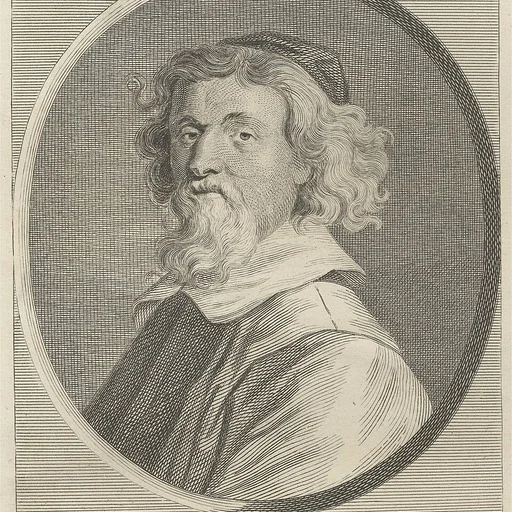
German, 1582–1658
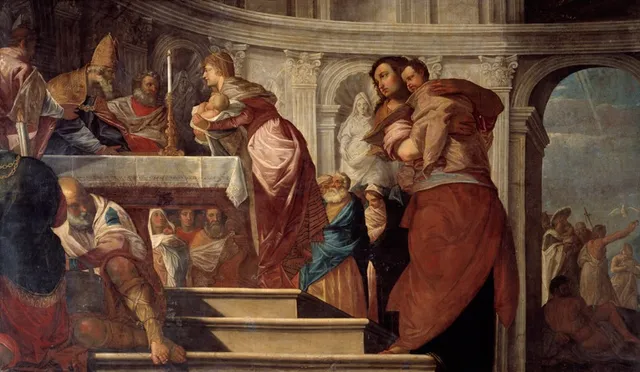
Francis Cleyn was a German Flemish Baroque painting painter. 3 works are cataloged here, principally at Statens Museum for Kunst, most of them oil paintings. Francis Cleyn was born in Rostock.
Overview
Francis Cleyn (or Francesco Cleyn or Clein; also Frantz or Franz Klein; c. 1582 – 1658) was a German-born painter and tapestry designer who lived and worked in England.
Life and career
Francis Cleyn was born in Rostock in Germany, and while a youth displayed such abilities that he was retained in the service of Christian IV of Denmark. During this time he painted, in 1611, a half-length portrait of Christian, now in the gallery of Copenhagen, and executed decorative works in the castle of Rosenborg and other places. Here, too, he met Sir Robert Anstruther, then ambassador extraordinary from England to the court of Denmark. He was sent to Italy to study, and remained there four years, studying at Rome and Venice; at Venice he was introduced to Sir Henry Wotton, then English ambassador to the republic. After returning to Denmark, he proceeded to England with letters of introduction from Anstruther and Wotton to Charles, prince of Wales. He found Charles away on his expedition with Buckingham to Spain, but was warmly received by James I, who saw in him the very man he wanted for the Mortlake Tapestry Works, the new tapestry manufactory which he had recently set up under Sir Francis Crane at Mortlake, London.
So anxious was he to obtain Cleyn's services that he wrote in person to the king of Denmark, requesting that Cleyn, who had to return to Denmark to finish some work for the king, might be allowed to return to England, and offering to pay all expenses. The request was granted, and Cleyn returned to England to enter the service of Prince Charles, and was immediately employed at Mortlake. On the accession of Charles I to the throne in 1625, he rewarded Cleyn by granting him denization and a pension for life of £100 per annum. He also built for him at Mortlake a residence near the tapestry manufactory. Here Cleyn settled with his family, and superintended the copying of cartoons, and designed the frames in which the subjects were enclosed in the tapestry. Charles sent down five out of the seven original cartoons of Raphael from the Acts of the Apostles, then recently acquired, to be copied and reproduced in tapestry under Cleyn's direction. Copies of these were made by Cleyn's sons, Francis and John, and they were worked into tapestry at Mortlake. These and the other productions of the Mortlake manufactory were held in high estimation, especially in France, and dispersed over the continent.
A set of six pieces, representing the history of Hero and Leander from Cleyn's designs were at the Louvre in Paris; and there are some fine pieces of grotesque at Petworth House. The grotesques and other ornaments in these works, a line in which Cleyn appears to have been unrivalled, have always been greatly admired, and some modern authorities have had no hesitation in ascribing them to the hand of Anthony van Dyck or some more famous painter, ignoring the fact that Cleyn was spoken of at the time as a second Titian, and as "il famosissimo pittore, miracolo del secolo". Cleyn was also largely employed by the nobility to decorate their mansions. Samples of his work in this line were to be seen at Somerset House, Carew House, Parson's Green, Hanworth Palace, Wimbledon Palace, Stone Park, Northamptonshire, Bolsover Castle, and the Gilt Room at Holland House, London. Cleyn's name has become attached to the design of chairs with scallop shells backs which furnished these interiors. With the civil war there came a check to Cleyn's prosperity, and he was chiefly employed in etching and designing illustrations for books; in 1632 he had already provided the illustrations (engraved by Pierre Lombart and S. Savery) to Sandys's edition of Ovi
Family
On his death, Cleyn left three sons, Francis, John (both mentioned above), and Charles; and three daughters, Sarah, Magdalen, and Penelope. Francis Cleyn the younger was born in 1625, and was buried at Covent Garden on 21 October 1650. With his brother John he followed his father's profession, and they both attained repute as draughtsmen and miniature painters. It is difficult to distinguish their work from that of their father. A series of drawings of the cartoons of Raphael were found at Kensington Palace; they bear the dates 1640–1646, are executed on a large scale, and highly finished; some are signed by John Cleyn, and were evidently executed by him and his brother at Mortlake. They were seen by John Evelyn, who states that the brothers were then both dead. Penelope Cleyn appears to have been also a miniature painter, and to her have been ascribed two miniatures of Cecil, Lord Roos (1677), and Dorothea, daughter of Richard Cromwell (1668), signed P.C.
Works by Francis Cleyn
Collections represented

Museum
Artists in a similar vein