Artist
Pierre Georges Jeanniot
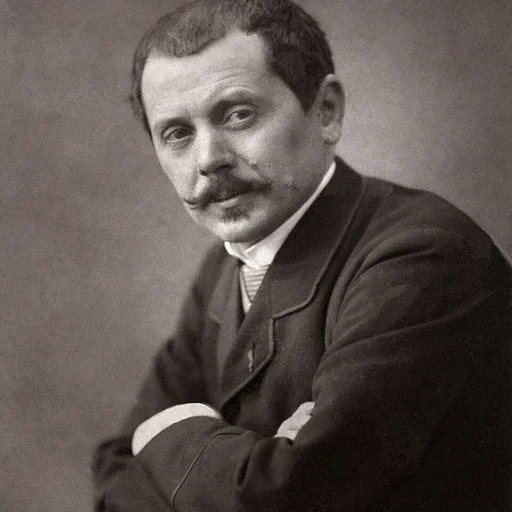
French, 1848–1934
Pierre Georges Jeanniot was a French Realism artist. 1 work is cataloged here, principally at Cleveland Museum of Art. Pierre Georges Jeanniot was born in Geneva.
Overview
Pierre-Georges Jeanniot (1848–1934) was a Swiss-French Impressionist painter, designer, watercolorist, and engraver who was born in Geneva, Switzerland, and died in France. His work often depicts the modern life in Paris.
Biography
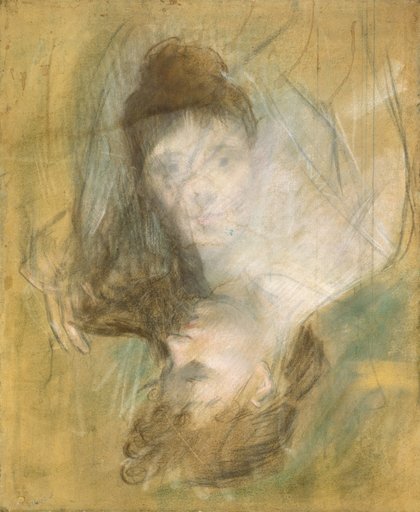
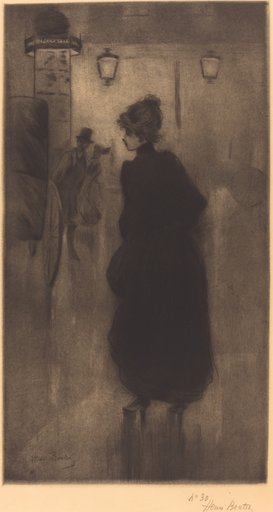
The artistic education of Pierre-Georges Jeanniot began with his father, Pierre-Alexandre Jeanniot (1826–1892), a longtime director of l'École des Beaux-Arts of Dijon, France. Pierre-Georges Jeanniot started out pursuing a military career, as an infantry officer (1866–1881). He was a lieutenant with the Twenty-third Infantry from 1868 to 1870. He fought in the Franco-Prussian War, was wounded at Rezonville, and was awarded the Légion d'Honneur. He subsequently served with the Ninety-fourth Infantry and the Seventy-third Infantry. At the time he left the army he held the rank of major, with the Chasseurs à Pieds. He never ceased drawing. He was known for the first time in 1872 at the art exhibition Salon de Paris, where he presented a watercolor painting called Intérieur de forêt. The next year he presented the painting Le Vernan à Nass-sous-Sainte-Anne. From then on he was a regular contributor to the Salon de Paris, where he presented new works with views of Toulouse, Paris, Troyes, the edges of the Seine, and some portraits. In 1881, after the army offered him the rank of commandant, he resigned to devote himself exclusively to painting. He took up residence in Paris. His works from this period represent mainly scenes of military life that allowed him to forge a reputation. Jeanniot established himself permanently in 1882 and obtained his first award the following year (medal third class of the Salon de Paris) with his les Flanqueurs (1883, Musée du Luxembourg). In 1886, La ligne de feu, souvenirs de la bataille de Rezonville, remembering the Battle of Mars-La-Tour (Museum of Pau), assured his notoriety. From then on, he started to show a certain artistic independence. He then mostly portrayed Parisian women during the "Belle Epoque", women in bathing suits on the beaches (a new phenomenon in those times) or scenes on the race course. These paintings give us a vivid sociological portrayal of his times. But as soon as the Société Nationale des Beaux-Arts was founded in 1899, he rallied to their new painting trend.
In Paris, he secured himself friendships and memories of Édouard Manet, Pierre Puvis de Chavannes, Jean-Louis Carnival, Paul Helleu, and especially with Edgar Degas, whom he revered as a master. He spent much time with Edgar Degas in his family home in Diénay (Côte-d'Or). He was gifted with many talents and also excelled with his drawings. He showed in his drawings his passion and his artistic strength. They are vivacious, expressive and enthusiastic, while at the same time, rendering with a sense of humour the picturesque scenes of daily life. During the next decades he illustrated a large number of literary books, among them Le Voyage à Saint-Cloud, Germinie Lacerteux (1886), Contes choisis" (Guy de Maupassant, 1886), Tartarin de Tarascon (Daudet, 1887), "Les Liaisons dangereuses" (Pierre Choderlos de Laclos, 1917). He was also one of the illustrators of Les Misérables (Victor Hugo, 1887), La Débâcle et La Curée (Émile Zola, 1893–1894), Le Calvaire (Octave Mirbeau, 1901), Le Misanthrope (Molière, 1907), Les Paysans (Honoré de Balzac, 1911), and Candide (Voltaire) and many more. He was one of the first collaborators (together with Théodore de Banville, Alphonse Daudet and Giuseppe De Nittis) of the review La Vie Moderne and also contributed to the review La Lutte Moderne. In a later stage he became the director of Journal amusant, while also offering contributions to Rire and L'Écho de Paris. As an engraver, he
List of honours
1882: Honourable mention, Salon de paris 1884: Third-class medal, Salon de Paris 1889, 1900: Silver medal, Salon de Paris 1906: Chevalier in the Legion of Honour
Recent exhibitions
2015: "Edgar Degas: The Private Impressionist", The Frick Art & Historical Center 2015: "Toulouse-Lautrec and the Post-Impressionists", Arlington Museum of Art, Arlington, Texas 2015: "Toulouse-Lautrec and La Vie Moderne: Paris 1880-1910", Crocker Art Museum, Sacramento 2014: "Toulouse-Lautrec and La Vie Moderne: Paris 1880-1910", Art Gallery of Alberta, Edmonton 2014: "Tea and Morphine. Women in Paris, 1880-1914", Hammer Museum, Los Angeles 2013: "Toulouse-Lautrec and La Vie Moderne: Paris 1880-1910", Nevada Museum of Art, Reno 2012/2013: "Le Nu", Musée d'Orsay, Paris 2012: "Modern Women. Daughters and Lovers 1850-1918", Queensland Art Gallery, Brisbane 2010: "Femmes peintres et salons au temps de Proust", Musée Marmottan Monet, Paris 2010: "The Modern Woman. Drawings by Degas, Renoir, Toulouse-Lautrec and other Masterpieces form the Musée d'Orsay", Musée d'Orsay, Paris and Vancouver Art Gallery, Vancouver 2007: "Des toiles, des voiles, l'île d'Yeu sous le regard des peintres", Historial de la Vendée, Vendée 1996: "Degas beyond Impressionism", National Gallery, London and Art Institute of Chicago 1990: "De Manet à Matisse, 7 ans d'enrichissement au musée d'Orsay", Musée d'Orsay, Paris
Museums
Albertina, Vienna Art Institute of Chicago Clark Art Institute Dahesh Museum of Art, New York Fine Arts Museum of San Francisco Finnish National Gallery, Helsinki Harvard University Art Museums Louvre McNay Art Museum, San Antonio Metropolitan Museum of Art Minneapolis Institute of Arts Musée d'Orsay Museum of Fine Arts, Boston National Gallery of Art Washington Smithsonian American Art Museum The Baltimore Museum of Art
Collections represented

Museum
Artists in a similar vein