Artist
Victor Meirelles
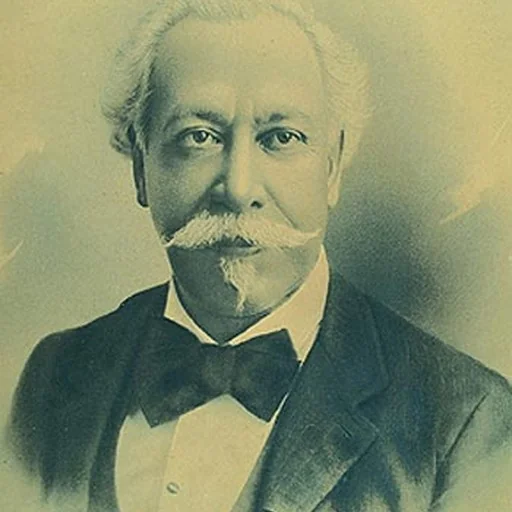
Brazilian, 1832–1903
Victor Meirelles was a Brazilian Romanticism painter. 5 works are cataloged here, principally at São Paulo Museum of Art, most of them oil paintings. Victor Meirelles was born in Florianópolis.
Overview
Victor Meirelles de Lima (18 August 1832 – 22 February 1903) was a Brazilian painter and teacher who is best known for his works relating to his nation's culture and history. From humble origins, his talent was soon recognized, being admitted as a student at the Imperial Academy of Fine Arts. He specialized in the genre of history painting, and upon winning the Academy's Foreign Travel Award, he spent several years training in Europe. There he painted his best-known work, Primeira Missa no Brasil. Returning to Brazil, he became one of emperor Pedro II's favorite painters, joining the monarch's patronage program and aligning himself with his proposal to renew the image of Brazil through the creation of visual symbols of its history. He became an esteemed teacher at the Academy, forming a generation of painters, and continued his personal work by performing other important historical paintings, such as Batalha dos Guararapes, Moema and Combate Naval do Riachuelo, as well as portraits and landscapes, of which the Retrato de Dom Pedro II and his three Panoramas stand out. In his heyday he was considered one of the leading artists of the second reign, often receiving high praise for the perfection of his technique, the nobility of his inspiration and the general quality of his monumental compositions, as well as his unblemished character and tireless dedication to his craft. Meirelles got many admirers both in Brazil and abroad. He received imperial decorations and was the first Brazilian painter to win admission to the Paris Salon, but was also the target of scathing criticism, arousing strong controversies in a period when disputes between academic painters and the early modernists were ignited. With the advent of the Republic in Brazil, for being too linked to the Imperial government, he fell into ostracism, and ended his life in precarious financial conditions, already much forgotten. “Meirelles’ work is rooted in the Brazilianacademic tradition, characterized by an eclectic synthesis of neoclassical, romantic, and realist influences, while also reflecting Baroque and Nazarene elements. After a period of relative obscurity, contemporary criticism has recognized him as a forerunner of modern Brazilian painting and one of the foremost 19th-century Brazilian painters. He is widely regarded as the greatest of his era, creating some of the most celebrated visual interpretations of Brazilian history, which continue to resonate in the country’s culture and are frequently reproduced in school textbooks and other media.
Early life
His early years are obscure and the few sources provide conflicting information. Victor Meirelles de Lima was the son of Portuguese immigrant Antônio Meirelles de Lima and Brazilian Maria da Conceição dos Prazeres, merchants who lived with limited economic resources in the city of Nossa Senhora do Desterro (now Florianópolis). He had a brother, Virgílio. According to records, at the age of five he began to be educated in Latin, Portuguese and arithmetic, but he spent his free time drawing dolls and landscapes from his island of Santa Catarina and copying other people's images that he found in engravings and pamphlets. According to the testimony of José Arthur Boiteux:
"At the age of five, his parents sent him to the Royal School and he was so young that the teacher, to better give him lessons, would sit him on his knees. When he returned home, his hobby was the old Cosmorama that Antônio Meirelles had bought for very cheap, and so curious that he [the boy] was, he [Antônio] always fixed some of the pieces when his son broke them, which was common. At the age of ten, Victor did not escape lithograph prints: as many as he could get his hands on, he copied them all. Whoever passed by Rua da Pedreira, old Quartéis Velhos, on the corner of Rua da Conceição, at late afternoon, would invariably see the little one leaning over the counter making scribbles, if not the caricatures of the customers themselves who at that hour would gather there for the unfailing two prose fingers". In 1843, when he was between 10 and 11 years old, Meirelles began to receive instruction from Father Joaquim Gomes d’Oliveira e Paiva, who taught him French and philosophy and deepened his knowledge of Latin. His precocious talent was noticed and encouraged by his family and local authorities, and in 1845 he began to take regular classes with a professor of geometric design, Argentine engineer Mariano Moreno, who was a doctor of law and theology, as well as a journalist, politician and former secretary of the first Government Board of the United Provinces of the Río de la Plata, playing, according to Teresinha Franz, "an important role in the construction of the Argentine identity". At the same time, Meirelles probably completed his general studies at the Jesuit College, which taught classes in Latin, French, philosophy, elementary history, geography, rhetoric, and geometry, and it is possible that he came into contact with traveling artists who documented nature and the local people. Some of his drawings were seen and appreciated by Jerônimo Coelho, counselor of the Empire of Brazil, who showed them to the then director of the Imperial Academy of Fine Arts, Félix-Émile Taunay. The director immediately accepted Meirelles, then only aged fourteen, as a student at the institution. Moving to Rio de Janeiro in 1847, Meirelles started to attend a drawing course, having the initial expenses financed by a group of patrons and being a student of Manuel Joaquim de Melo Corte Real, Joaquim Inácio da Costa Miranda and José Correia de Lima, who had studied with the classicist Debret. The following year he won a gold medal and a little later he returned to his hometown to visit his parents. The first of his known works date from this period. In 1849 he was back in Rio de Janeiro, studying at the Academy, among others, the discipline of historical painting, a genre in which he had his greatest successes. It is said that Meirelles was a brilliant student, excelling in all subjects. I
Studies in Europe
In June 1853, at the age of 21, Meirelles landed in Le Havre, France. He passed briefly through Paris and then settled in Rome, his original destination. There he met two other students from the Academy who were also improving, Agostinho da Mota and Jean Leon Pallière, who introduced Meirelles to the artistic environment of the city and guided him on which masters he should look for. At first he entered the class of Tommaso Minardi, who, despite his fame, followed an excessively austere method, where the students remained excessively subordinated to the precepts, without the opportunity to develop their own ideas. Then he dropped out of class and enrolled in the atelier of Nicola Consoni, a member of the Accademia di San Luca. Consoni was also rigorous, but Meirelles made good use of the live model sessions, essential for the refinement of anatomical drawing, an essential element in the genre of historical painting, the most prestigious in the academic system. At the same time, he practiced in watercolor and came into contact with the vast collection of ancient art in the Italian capital. In a second stage, he moved to Florence, getting to know the local museums and being strongly impressed by the art of Veronese. As a study, he copied works by the master, as well as other outstanding figures, such as Titian, Tintoretto and Lorenzo Lotto. As required by the Academy, he regularly sent his works and copies to Brazil as proof of his progress. His performance was so good that the Brazilian government decided to renew his scholarship for another three years in 1856, in addition to indicating to the artist a list of new specific studies that he should complete. Thus, in 1856 he went to Milan and soon after to Paris. He tried, on the recommendation of Araújo Porto-Alegre, at the time director of the Academy and his main mentor, to be admitted as a student of Paul Delaroche, but the master suddenly died, so he had to look for another direction, finding it in Léon Cogniet, an equally celebrated romantic painter, member of the École des Beaux-Arts and a reference for foreigners who were going to study in Europe. He then studied with André Gastaldi, who was almost the same age as Meirelles, but who had a more advanced view of art and gave him important instruction in colors. His routine, according to reports, was almost monastic, devoting himself entirely to art, and again his studies were considered so good that his scholarship was extended again for another two years. At that time, his production was numerous, standing out among all his works A Primeira Missa no Brasil, executed between 1858 and 1861, which earned him space and praise at the prestigious Paris Salon of 1861, an unprecedented feat for Brazilian artists that had a very positive impact in his homeland.
Return to Brazil and fame
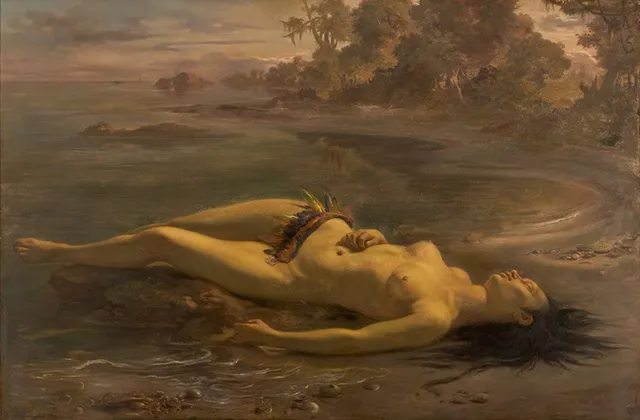
In the same year his scholarship ended and he had to return, already feted like a genius. He exhibited A Primeira Missa no Brasil and, among many honors, received from emperor Pedro II the Imperial Order of the Rose in the rank of knight. Soon after, he traveled to Santa Catarina to visit his mother — his father had died while he was in Europe. He stayed there for some time and returned to Rio de Janeiro, where he was appointed Honorary Professor of the Academy, being promoted shortly after to Interim Professor, and later assuming the chair of historical painting. Testimonies from students declare their respect for Meirelles, attesting to his impeccable character and his dedication to teaching, being considered an attentive, patient teacher and truly interested in the progress of his disciples. His fame was consolidated and from this time dates the work Moema, one of the best known works of Brazilian indianism, but in its first exhibition it did not attract interest. Nevertheless, Meirelles received commissions from the imperial family, painting the Wedding of Princess Isabel and a portrait of the emperor in 1864, as well as portraits of members of the nobility and politicians. In 1864 he received the habit of the Order of Christ. He also became known for his devotion to national causes, which is why he was hired in 1868 by the imperial government to paint about the Paraguayan War, which was in full swing, in a contract that both honored him and gave him good remuneration.
Immediately Meirelles moved to the conflict region to gather impressions of the landscape and the military environment. He set up a workshop aboard the ship Brasil, the flagship of the Brazilian fleet, and spent months there drawing up sketches for his works. Returning to Rio de Janeiro, he took up a space at the Santo Antônio Convent, which he turned into a studio, and put himself to work diligently, isolating himself from the world. This effort resulted in two of his most important works, both of great dimensions: Passagem de Humaitá and Combate Naval de Riachuelo. While he was working on these paintings, he received a visit from the imperial family, with whom he had contact, which resulted in new paintings and the sending of Combate Naval de Riachuelo to represent Brazil at an international fair held in the United States. Upon returning from the exhibition, the work was damaged. In 1871 he painted Juramento da Princesa Regente, the following year he was appointed commander of the Order of the Rose, and in 1875 he began the sketches for another great historical work, Batalha dos Guararapes, accepting a project that had been refused by Pedro Américo, who preferred work on his Batalha de Avaí. As he had done before, Meirelles went to the region where the conflict had taken place to conceive the composition with greater historical accuracy. The two battle paintings were exhibited at the Salon of 1879 and both artists received the Grand Prix and the title of dignitaries of the Order of the Rose, but it triggered the greatest aesthetic controversy that had hitherto taken place in Brazil. While some recognized their superlative abilities, hailing them as geniuses and heroes, others accused them of plagiarism and passé. At the same time, two parties were formed, one supporting Meirelles and the other Américo, in the dispute over which of the battle painting was more perfect. The lay public also got involved and the discussion took over the newspapers and magazines for mon
Last years
In 1889, with the Proclamation of the Republic in Brazil, the official artists of the monarchy were politically persecuted and in 1890 Meirelles was early dismissed from the Imperial Academy, now transformed into the National School of Fine Arts. At just 57 years old, it was claimed he was too old. For a year he managed to get a position as a teacher at the Lyceum of Arts and Crafts, but from 1891, once again unemployed, he installed his Panorama do Rio in a rotunda specially built for him in the square of the Imperial Palace, where he charged a thousand réis per visitor. According to reports of the time, in its first year of exhibition, the work was visited by about 70,000 people, but this may be advertising exaggeration. A little later, Meirelles gave free access to schoolchildren and offered detailed teaching materials to complement the work. In 1893 the government sent a representation to the World's Columbian Exposition, where Primeira Missa no Brasil and the Panorama of Rio were exhibited with great success. In the same year he founded a painting school with Décio Villares and Eduardo de Sá, but classes ended after a few months. His second panoramic composition appeared in 1896, a vast landscape measuring 115 meters wide by 14.5 meters high, depicting the entrance of the loyalist fleet in Guanabara Bay, an episode of the Armada Revolt of 1894, which he carried out practically without any assistance both in the painting and in the administrative tasks of the exposition, contacts and sponsorship searches. Without a steady job, tired and living basically on the income from visits to his panoramas, Meirelles got into serious financial difficulties when the government demanded, in 1898, that he dismantle the rotunda, after which he survived on the help of friends. In 1900, his Panorama do Descobrimento do Brasil, still unfinished, was shown in the exhibition of the Fourth Centenary of Brazil's Discovery, as the last attempt to revive his career, as mentioned by Mário Coelho. The exhibition was inaugurated in the presence of president Campos Sales, who described the work as extraordinary. He set up another exhibition pavilion on a farm in the former São José Seminary, at the back of the Carmo Convent, but the panoramas were no longer new and attracted fewer and fewer people. Meirelles still had the idea of exhibiting them in Europe again, trying to gain the government's interest, but the plan came to nothing. The artist ended up donating the paintings to the National Museum, as well as many drawings and studies, but they were damaged and lost years later through the institution's negligence. Disappointed, poor and abandoned, on the morning of a Carnival Sunday, on 22 February 1903, Victor Meirelles died at the age of 71, in the simple house where he lived. The artist was married to Rosália Fraga, who already had a son from a previous marriage, whom Meirelles adopted, but he left no direct descendants and nothing is known about his private life. His widow donated her estate to the National School of Fine Arts, which held a posthumous exhibition in Meirelles honor. The widow died shortly afterwards, in the same year. According to Carlos Rubens, his biographer, shortly before Meirelles death he would have told a friend and former disciple that if he had another chance he would make his life take other paths, to which the friend replied: "And what other paths would take you to the First Mass?" As history shows, Meirelles current fame rests
Context and style
Victor Meirelles flourished at a critical moment in Brazilian history. Independent for few years, the country sought to consolidate its position among the great nations through a modernization program, in which a nationalist motivation was obvious and where support for the arts was indispensable as a proof and propaganda of the progress achieved as a cultured civilization and as a regional military power. But at the time, a symbolic imagery capable of bringing together the forces of the people and the elites around a sense of national identity had not yet been formed. In this construction, which was orchestrated by the government, the role of painters such as Victor Meirelles was essential. The Imperial Academy, where Meirelles was educated, was one of the executive arms of this civilizing program, which also sought to move away from the memory of colonial times under Portuguese rule through affiliation to other models of culture, such as France and Italy, where many painters were sent to improve their skills. At the same time that, in cultural terms, dependence on foreign inspiration remained inescapable, typically Brazilian elements that had previously been disowned, such as the indigenous peoples, began to be reintegrated, praised and merged with European references as part of the local roots necessary for the legitimation of national culture, in a synthesis not devoid of contradictions. Teresa Franz wrote that:
"There was no clear awareness of the difficulties of transposing to Brazil, a country in formation, models imported from countries like France. Brazil was made up of a society little culturally and artistically complex, whose intellectual elite, seduced by European culture, could not see at which point it became problematic for this culture to take root and develop freely in a still growing society."
Symptomatic of the intentionality and, in a certain way, artificiality of this nationalism invented by the elites, were the circumstances of the elaboration of the first masterpiece by Victor Meirelles, Primeira Missa no Brasil. During its creation Meirelles kept in contact by correspondence with the then director of the Academy, Manuel de Araújo Porto-Alegre, who served as spokesperson for the official ideology and led the painter's work in various aspects, which happened throughout his entire student period. It was in the Sainte-Geneviève Library, in Paris, that Meirelles found material for studying Brazilian amerindians, and not in Brazil, where the indigenous peoples had long been driven to remote regions, decimated or acculturated. There he studied the documentation and ethnographic records about the natives left by naturalists, and it was there that he came into contact with the letter of Pero Vaz de Caminha, which would inspire the backdrop for his creation. Victor Meirelles developed an eclectic style, and it has been difficult for recent critics to agree on his exact characterization. During his period of study, he came into contact with the entire tradition of Western painting, absorbing references from the Renaissance, which included, for example, Raphael and Giuseppe Cesari, from the Baroque of Titian and Tintoretto and from neoclassicals and romantics such as Cogniet, Vernet, Delaroche and Delacroix. From all these schools Meirelles collected subsidies for the formation of his personal style. An especially significant influence in the idealist sense, in his formative period, was the contact with the production of
Critical reception and legacy
Victor Meirelles was one of the most brilliant graduates of the Imperial Academy and one of the first Brazilian painters to receive recognition abroad. During his heyday he was one of the most respected artists of the Empire of Brazil and one of the most esteemed by the officialdom. For critics attuned to the civilizing program of emperor Pedro II, the Meirelles' generation, in which he and Pedro Américo came out as the greatest, was the founder of the national school of modern painting, therefore being considered the true avant-garde of the time. Meirelles was the teacher of many painters who would later make a name for themselves, among them Antônio Parreiras, Belmiro de Almeida, Décio Villares, Eliseu Visconti, Oscar Pereira da Silva, João Zeferino da Costa, Modesto Brocos y Gómez, Rafael Frederico, Rodolfo Amoedo, Pedro Peres and Almeida Júnior. His most important production, recognized during his lifetime, is the one he left in historical painting, and although his portraits and landscapes were also praised in his time, today they are largely forgotten by critics. Among his historical paintings, the most important work is undoubtedly A Primeira Missa no Brasil, for which he became best known and celebrated to this day. In 1861, just completed, the painting was accepted with praise by the Paris Salon jury, an unprecedented achievement for a Brazilian artist. The richness of the painting's details, representing multiple expressions and situations, its evocative, technical and aesthetic qualities, immortalized the official narrative of the Discovery of Brazil as a heroic and peaceful act, celebrated in ecumenism by colonizers and indigenous people. Jorge Coli, reflecting on the critical consensus, wrote that: "Meirelles has reached the rare convergence of forms, intentions and meanings that make a painting powerfully enter a culture. This image of discovery can hardly be erased, or replaced. It is the first mass in Brazil. It is the powers of art making history." His panoramas, in turn, were received with great enthusiasm, but today, with only preparatory sketches remaining, one can only conjecture about their real appearance and quality.
Meirelles also made many opponents, who considered him outdated and saw in academic conventions nothing but artificiality and empty rhetoric of meaning for the changing times. If, on the one hand, the Primeira Missa no Brasil got him homages and decorations such as the Order of the Rose, it also gave rise to the first criticisms, precisely because of what would be "excessive imagination" and infidelity to reality. The exhibition of another of his great compositions, Batalha dos Guararapes, alongside the Batalha do Avaí by Pedro Américo, at the Salon of 1879, gave rise to an unprecedented public debate in the Brazilian art scene. It is estimated that around 80 articles have been published on the event, inaugurating a fertile period for the formation of a body of criticism on aesthetics and ideology in Brazil, addressing controversial topics at the time such as nationalism, the role of criticism and the opposition between the avant-gardes and academic tradition. This exhibition also became memorable because it managed to mobilize virtually the entire population of Rio de Janeiro, with 292,286 visits being recorded over a period of 62 days, demonstrating the enormous interest of the general population in the artistic agitation of those days and in nationalist themes. At the time Meirelles heard it all,
Works by Victor Meirelles
Collections represented

Museum

Museum
Artists in a similar vein