Artist
Feliks Topolski
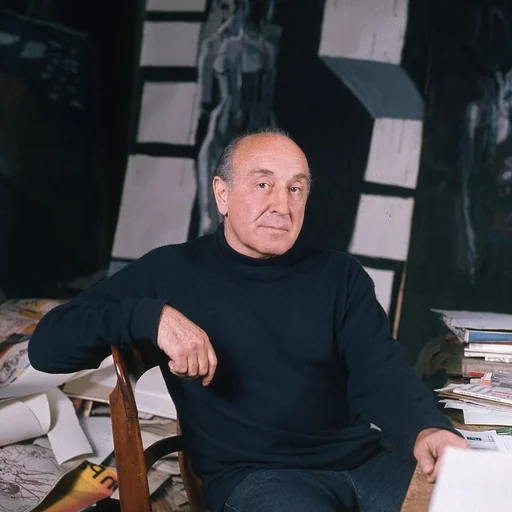
British, 1907–1989
Feliks Topolski was a British artist. 5 works are cataloged here, principally at Victoria and Albert Museum. Feliks Topolski was born in Warsaw.
Overview
Feliks Topolski (14 August 1907 – 24 August 1989) was a Polish expressionist painter and draughtsman working primarily in the United Kingdom.
Biography
Feliks Topolski was born on 14 August 1907 in Warsaw, Poland. He studied in the Academy of Fine Arts in Warsaw, and trained as an artillery officer. Later he studied and worked in Italy and France, and eventually he moved to Britain in 1935 after being commissioned to record King George V's silver jubilee. He opened a studio near Waterloo station, which later became an exhibition and then a café-bar featuring his art. He married twice, first to Marian Everall and then Caryl J. Stanley. In 1939 the George Bernard Shaw plays In Good King Charles's Golden Days and Geneva were published with illustrations by Topolski, bringing his work to a wider audience in the United Kingdom.
During the Second World War, Topolski became an official war artist and painted scenes of the Battle of Britain and other battles. In 1941, he travelled to Russia alongside the men of 151 Wing RAF on board RMS Llanstephan Castle, which was sailing to the port Arkhangelsk as part of Operation Benedict, a mission to provide air support in defence of the port of Murmansk. He was travelling as an accredited War Artist for both Polish and British governments. He was also under contract to Picture Post magazine, which published many of his drawings after his return. At the Phillips & Powis – later Miles Aircraft – factory at Woodley Aerodrome near Reading, Berkshire, he produced a series of more than 40 sketches of wartime aircraft workers, including chief test pilot 'Tommy' Rose, and factory scenes, particularly the assembly line for the Miles Master. After the war he made a celebrated painting about the first meeting of the United Nations. In 1947, he gained British citizenship. His work was also part of the painting event in the art competition at the 1948 Summer Olympics.
Topolski's experiences were initially captured in pencil and ink drawings. These were the first stage of his prolific Chronicles, which appeared fortnightly from 1953 to 1979, interrupted only to accommodate his exploratory investigations across the globe. The Chronicles communicated his art and observations to a wider audience. They were independently published, without advertisements or subsidies. Since his death, Topolski's Chronicles have retained respect as a pictorial and political record spanning nearly 30 years of world history. The Chronicles contain 3,000 drawings, and were exhibited in New York City, Moscow, Cologne, Hamburg, Hawaii, Tel Aviv and serialised in the United States, Poland, Italy, Denmark and Switzerland. Joyce Cary wrote, it is "the most brilliant record we have of the contemporary scene as seized by a contemporary mind." In 1951, Topolski was provided with a studio under one of the arches of Hungerford Bridge, where he worked consistently until his death in 1989. He was commissioned to produce a 60 feet (18 m) by 20 feet (6.1 m) mural under the arch over Belvedere Road for the Festival of Britain, unknowingly painting only two arches away from his eventual studio. Offered to him by David Eccles, the windows from the dismantled annex to Westminster Abbey were repurposed to fit Topolski's studio at the time of Queen Elizabeth II's coronation in 1953. Over the years the studio became a central feature of the South Bank, hosting countless people at his 'Open Studio' Fridays from 3 pm, with an open door to whomsoever wished to pop their head in. Now the Studio functions as an archive and exhibition space operated by Topolski Memoir, the charity set up to preserve the artist's
Books illustrated
Bernard Shaw, Geneva, London: Constable & Co. Ltd, 1939. Britain in Peace and War. London: Methuen, 1941. Bernard Shaw, Pygmalion, Harmondsworth: Penguin, 1941. Russia in War: London, summer 1941; Russia-bound convoy; a British cruiser; Iceland. London: Methuen, 1942. Jozef H. Retinger, Conrad and his contemporaries, New York: Roy Publishers, 1943. Three Continents, 1944–45: England, Mediterranean convoy, Egypt, East Africa, Palestine, Lebanon, Syria, Iraq, India, Burma front, China, Italian campaign, Germany defeated. London: Methuen, 1946. Face to Face, 1964. Richard J. Whalen, A City Destroying Itself: An Angry View of New York, New York: William Morrow and Co., 1965. Tony Palmer, The Trials of Oz London, Blond and Briggs, 1971.
Collections represented

Museum
Artists in a similar vein