Artist
Theodor de Bry
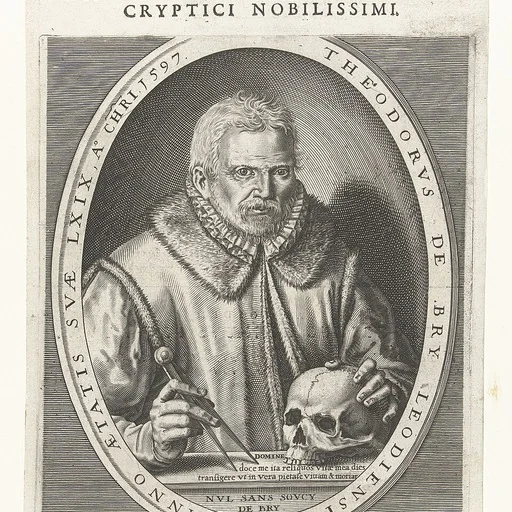
Flemish, 1528–1598
Theodor de Bry was a Flemish Renaissance artist. 36 works are cataloged here, principally at National Gallery of Art. Theodor de Bry was born in Liège.
Overview
Theodor de Bry (also Theodorus de Bry; 1528 – 27 March 1598) was a Walloon engraver, goldsmith, editor and publisher, famous for his depictions of early European expeditions to the Americas. The Spanish Inquisition forced de Bry, a Protestant, to flee his native, Spanish-controlled Southern Netherlands. He moved around Europe, starting from his birth on the city of Liège in the Prince-Bishopric of Liège, then to Strasbourg, Antwerp, London and Frankfurt, where he settled. De Bry created a large number of engraved illustrations for his books. Most of his books were based on first-hand observations by explorers, even if De Bry himself, acting as a recorder of information, never visited the Americas. To modern eyes, many of the illustrations seem formal but detailed.
Biography
Theodorus de Bry was born in 1528 in Liège, Prince-Bishopric of Liège (in modern Belgium), to a family which had escaped the destruction of the city of Dinant in 1466 during the Wars of Liège by the Duke of Burgundy, Philip the Good and his son Charles the Bold. As a man he trained under his grandfather, Thiry de Bry the Elder (died 1528), and under his father, Thiry de Bry the Younger (1495–1590), who were jewellers and engravers, engraving copper plates. The art of copper plate engraving was the technology required at that time for printing images and drawings as part of books. In 1524 Thiry de Bry the Younger married Catherine le Blavier, daughter of Conrad le Blavier de Jemeppe. Their son, Theodore de Bry, also became a jeweller and engraver. Theodore de Bry became a Protestant, and in 1570 was sentenced to perpetual banishment and his goods were confiscated. He moved to Strasbourg, along the west bank of the Rhine. In 1577, he moved to Antwerp in the Duchy of Brabant, which was part of the Spanish Netherlands or Southern Netherlands and Low Countries of that time (16th century), where he further developed and used his skills as a copper engraver. Between 1585 and 1588 he lived in London, where he met the geographer Richard Hakluyt and began to collect stories and illustrations of various European explorations, most notably from Jacques Le Moyne de Morgues.
In 1588, Theodorus and his family moved permanently to Frankfurt-am-Main, where he became a citizen and began to plan his first publications. The most famous one is known as Les Grands Voyages, i.e., "The Great Travels", or "The Discovery of America". He also published the largely identical India Orientalis series, as well as many other illustrated works on a wide range of subjects. His books were published in Latin, and were also translated into German, English and French to reach a wider reading public. In 1590 Theodorus de Bry and his sons published a new, illustrated edition of Thomas Harriot's A Briefe and True Report of the New Found Land of Virginia about the first English settlements in North America (in modern-day North Carolina). His illustrations were based on the watercolor paintings of colonist John White. The book sold well, and the next year de Bry published a new one about the first French attempts to colonize Florida: Fort Caroline, founded by Jean Ribault and René de Laudonnière. It featured 43 illustrations based on paintings of Jacques Le Moyne de Morgues, one of the few survivors of Fort Caroline. The images and descriptions feature the Timucuans. Jacques de Moyne had planned to publish his account of his expeditions but died in 1587. According to de Bry's account, he had bought de Moyne's paintings from his widow in London and used them as a basis for the engravings.
He and his son John-Theodore made adjustments to both the texts and the illustrations of the original accounts, on the one hand in function of his own understanding of Le Moyne's paintings, and, most importantly, to please potential buyers. The Latin and German editions varied markedly, in accordance with the differences in estimated readership. The verisimilitude of many of de Bry's illustrations is questionable; not least because he never crossed the Atlantic. Amerindians look like Mediterranean Europeans, and illustrations mix different tribal customs and artifacts. In addition to day-to-day life of the American natives, Theodore de Bry even included a few depictions of cannibalism; largely
Collections represented

Museum

Museum
Artists in a similar vein