Artist
Charles Verlat
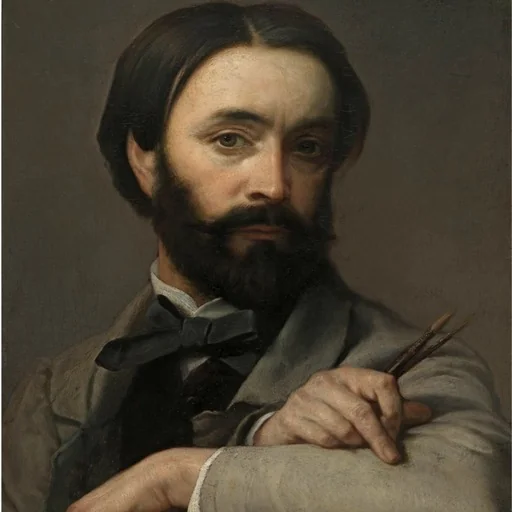
Belgian, 1824–1890
Charles Verlat was a Belgian Realism painter. 29 works are cataloged here, principally at Royal Museum of Fine Arts Antwerp, most of them oil paintings. Charles Verlat was born in Antwerp.
Overview
Charles Verlat or Karel Verlat (25 November 1824 – 23 October 1890) was a Belgian painter, watercolorist, engraver (printmaker), art educator and director of the Antwerp Academy. He painted many subjects and was particularly known as an animalier and portrait painter. He also created Orientalist works, genre scenes, including a number of singeries, religious compositions and still lifes. He was a professor of drawing and director of the Antwerp Academy when Vincent van Gogh spent a brief period as a student at the Academy in 1886. The two men got into arguments about van Gogh's unconventional style of drawing.
Life
He was born in Antwerp as the son of a manufacturer of soap, oil and soda. His mother arranged for the young Charles to get his first drawing classes from the Dutch sculptor Johannes Antonius van der Ven, who was then studying at the Antwerp Academy. From an early age he lived for art. He left formal school education at the early age of fourteen and was accepted together with Godfried Guffens to take lessons at the private studio located in the Vleeshuis of Nicaise de Keyser. De Keyser was one of the key figures in the Belgian Romantic-historical school of painting. At the time de Keyser had about 30 pupils including some who came to prominence such as Edouard Hamman, Jan Swerts, Joseph Lies and Johan Bernard Wittkamp. At the same time Verlat followed courses at the Antwerp Academy where he studied, among others, with Gustave Wappers and Josephus Laurentius Dyckmans.
He started participating in the salons of his time and in 1843 sent his first important picture, Pippin the Short Killing a Lion to the Antwerp triennial salon. His first paintings were inspired by the Belgian Romantic school and dealt with important events from Belgian history. He also gradually started to paint animal scenes as well as genre scenes. In 1849, he painted his first religious composition which was intended for the St Gummarus church in Lier. He participated in the Prix de Rome of Belgium in 1847 but was not successful, possible as the result of his partial incapacitation due to a broken arm. Fortunately, a wealthy relative called Albert Marnef van Wespelaer provided him in 1849 with a stipend that allowed him to continue his studies for four years.
He left for Paris in 1850 and studied there first in the studio of the Dutch painter Ary Scheffer. Later he studied with Jean-Hippolyte Flandrin at the Académie des Beaux-Arts. From 1852 he had his own studio in Paris. He gained commissions from religious and official institutions in Belgium including the commission from the Antwerp city government for the large historical composition Godefroid de Bouillon during the assault on Jerusalem (1854, Royal Museums of Fine Arts of Belgium). In 1855 he won a gold medal at the Exposition Universelle at Paris with his Tiger Attacking a Herd of Buffaloes. He gradually came under the influence of the Realism of Gustave Courbet. This resulted in his 1857 work Coup de collier (now in the Royal Museum of Fine Arts in Antwerp) showing two horses struggling to pull a heavy cart loaded with bricks while being whipped by their handlers. Despite its vivid depiction and dynamic form, the large-scale work failed to achieve the success its creator had hoped for. When he exhibited it at the 1857 Paris Salon the work was mocked in the French magazine Le Charivari with a cartoon showing men helping to push a very heavy cart out of the Salon and the text "Le public poussant à la roue pour aider la charrette à sortir de l’Exposition de peinture" (The public pushing the wheel to help the cart leave the painting exhibition). The work was also sharply criticized by Le Figaro's art critic Jean Rousseau who wrote that the work only was good enough for use as a shop sign for a removal company. Verlat took revenge by painting a monkey shaving itself while wiping its feet on the copy of the newspaper in which the criticism had been published. He returned for a year to Antwerp to return the next year to work in his studio in Paris. During this time he started to establish a reputation as an
Work
Verlat was a versatile artist who practised painting, watercolor and etching. He also was an avid draughtsman. His subject matter was wide-ranging and included animal paintings, portraits, religious compositions, Orientalist works, genre scenes, including a number of singeries, and some still lifes. He was initially influenced by the professors of the Antwerp Academy who were important proponents of the Belgian Romantic school and preached a return to the glorious Flemish Baroque style to treat important events in Belgium's history. He was later influenced by other contemporary art movements: the German Idealists whom he knew through Ary Scheffer in Paris and the Realism of Gustave Courbet. During his stay in Palestine his palette became muted and lost its Flemish bluster. Despite these many influences, his main inspiration was the work of the Flemish Baroque masters Rubens, van Dyck and Jordaens. He regained his more colorful palette after his return to Antwerp.
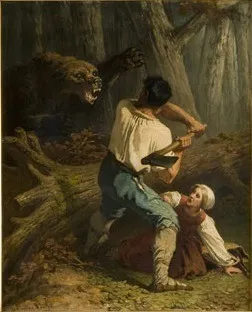
During his lifetime he was recognised as an important animal painter. He was able to render animals in a lively and realistic manner. One of his early animal works was acquired by the English animal painter Edwin Landseer. One of the best known examples of his art in this area is The defense of the herd (1878, Royal Museum of Fine Arts Antwerp). Painted during his Palestine residence it has the muted palette that he adopted during this period. It shows the kind of dynamic representation of animals only interactions that can be seen in the animal paintings of earlier Flemish animaliers such as Frans Snyders. Verlat painted many works in the genre of the singeries, i.e. humoristic renderings of monkeys engaging in human activities. The monkeys in the scenes are often dressed in costumes which adds comedy to their 'aping' of a specific human action (often a vice such as smoking or gambling) or occupation such as art critic, dentist, painter, musician etc. He created some original etchings in the early 1880s, including a self-portrait. He worked directly on the plate without other preparation which gives these works a spontaneous feel.
Works by Charles Verlat
Collections represented


Museum
Artists in a similar vein