Artist
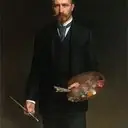
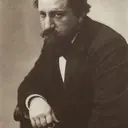
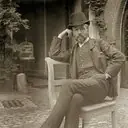
Gustaaf Vanaise
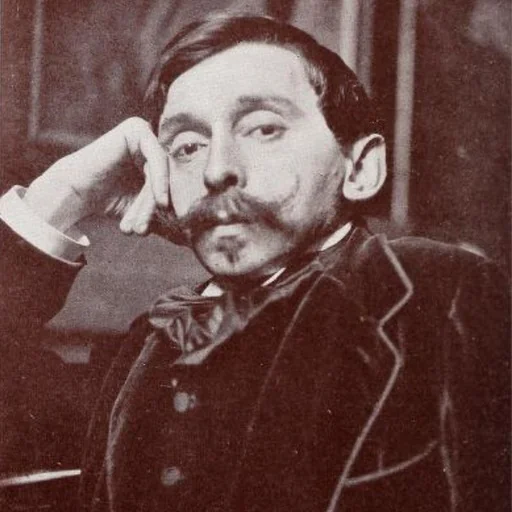
Belgian, 1854–1902
Gustaaf Vanaise was a Belgian Post-Impressionism artist. 5 works are cataloged here, principally at Royal Museum of Fine Arts Antwerp. Gustaaf Vanaise was born in Ghent.
Overview
Gustave Vanaise (birthname: Gustavus Antonius Maria Vanaise) (4 October 1854 in Ghent - 2 July 1902 in Saint-Gilles/Sint-Gillis) was a Belgian historical, portrait, genre, nude, landscape and still life painter. He set as his goal the revival of history painting in Belgium by creating large canvases depicting glorious scenes from national history. He also painted some Orientalist scenes. Despite his commercial success, his academic and realistic style had started to fall out of favor during his lifetime even as his later works became brighter in color and looser in touch under the influence of contemporary art trends.
Life
Vanaise was the son of Nicolaus Josephus (1821–1876), a pastry chef originally from Marche-lez-Écaussinnes, and Seraphina Antonia Vlieghe (1822–1860). He was the fourth of six children. The artist suffered from a physical deformity, which had stunted his growth, and struggled with poor health throughout his life. While attending elementary school, he assisted his father who wished to train him in the pastry business. When he was 13 years old, his father agreed to abandon his succession plan for his son and let Gustave attend the drawing classes at the Academy of Fine Arts in Ghent, whose director was Théodore-Joseph Canneel. He learned to draw after Antique statues under the strict guidance of Canneel. He attended the academy's painting classes from 12 May 1872. After his father died in 1876, his brothers provided him with the financial means to continue his studies. On 4 March 1877, he exhibited for the first time in his hometown and sold his first painting, a landscape. The buyer was the painter Auguste Dael who would become his patron.
In March 1877, he traveled to Paris with Jules Van Syngel. He worked tirelessly at the Louvre and in Cluny. In October of that same year, he returned to Ghent with a great number of studies. He rented a studio in the premises of the Vrouwenbroeders (Carmelites) where he painted studies and portraits. The portraits of Mr. M. Em. Van Swieten and Van Hyfte date from this period. He had a great interest in the Dutch masters with which he had become familiar in the Louvre. In early 1878, accompanied by the Dutch artist Louis Ludwig, he traveled to the Netherlands where he painted sketches after works by Frans Hals and others. In August 1878, he went for a second time to Paris, where he stayed for more than two years. He initially shared a studio with the Belgian painter Jan Van Beers, who at the time was trying to make a name as a history painter but later became the painter of the Parisian demi-monde.
Later, he shared a studio with Jef Lambeaux. In Paris, he painted large canvases in the tradition of Belgian historical painting which focused on important events and persons in the national history: Louis XI and Olivier le Daim (which was placed on the ramp at the 1879 Paris Art Exhibition, later destroyed during the German bombardment of Louvain in 1914) and Quentin Massys as a Child drawing a portrait of his Mother. These works show the influence of Jules Bastien-Lepage, the founder of the French naturalist school, and Jan Van Beers and are painted in light tones with soft brushstrokes. In October 1880, he returned to Belgium and set up a studio with Jef Lambeaux in Saint-Gilles/Sint-Gillis. He painted for the 1881 Brussels Salon the Lady with a Parrot, a composition executed in raw, brutal colors. He often returned to Ghent, where he worked in the spacious studio that his patron Auguste Dael, had built. It was there that he created the large-scale painting Saint Livinus in Flanders, a work that, after receiving an honorable mention in Paris and a gold medal in Ghent (1883), was acquired for the city's museum. In honor of his patron, Gustave Vanaise depicted Auguste Dael as Saint Livinus.
The year 1882 was marked by a trip to Italy, which he undertook together with Jef Lambeaux and Rodolphe Wytsman. In Rome, he made copies of numerous works of art, including frescoes by Raphael and works by Velazquez. They also travelled to Venice. Rome, and Venice in particular, inspired him to create many works,
Works
Vanaise was a prolific painter whose subjects range from history, portraiture, genre painting, marine painting, landscape, Orientalism, nudes and allegories. He was trained in the academic and realist traditions and in the style of the Romantic School of Belgian painting which was established by Gustaaf Wappers in the 1830s. He was the creator of large-scale works in the tradition of the Belgian school of history painting. Examples include Willem Key painting the portrait of the Duke of Alva ordering the beheading of the Counts of Egmont and Hoorne and Jacob Van Artevelde – Celebrated, Murdered, and Glorified, which show his admiration for Flemish masters such as Rubens. He was known for his nudes which were very accurate in the drawing and natural in colour. Under the influence of contemporary art movements, with which he came into contact as a member of Les XX his solid painting style became more fluid and his traditional color palette brighter.
Collections represented


Museum
Artists in a similar vein