Artist
Victor Lagye
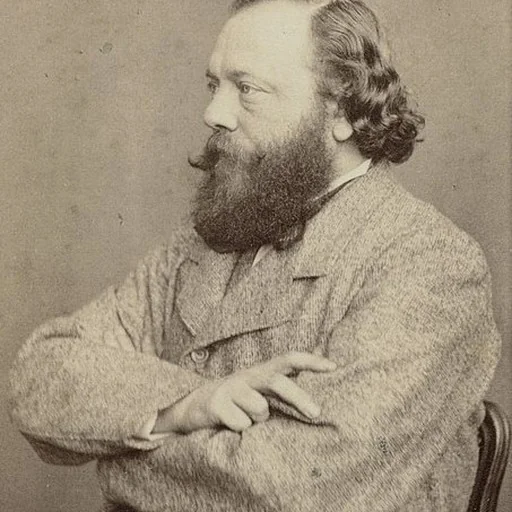
Belgian, 1825–1896
Victor Lagye was a Belgian Realism artist. 3 works are cataloged here, principally at Royal Museum of Fine Arts Antwerp. Victor Lagye was born in Ghent.
Overview
Victor Lagye (20 June 1825, in Ghent – 2 September 1896, in Antwerp) was a Belgian painter and illustrator best known for his genre paintings and history scenes. He participated in various decorative programs commissioned by the Belgian government. In his later years he was active in art education.
Life
Victor Lagye studied at the Ghent Academy, where one of his teachers was Théodore-Joseph Canneel. He won the Prix de Rome in 1843. The prize allowed him to travel to Italy. At the time, Italy was in turmoil. According to some sources he was a member of the 'university bataillon' under the command of Charles Albert of Sardinia and afterwards acted as volunteer in Garibaldi's Army during the revolt in Rome at the end of 1848, which led to the foundation of the Roman Republic. When the French retook Rome Lagye escaped to avoid a death sentence. The artist went first to Brussels in 1849 and in 1850 he moved to Antwerp.
In Antwerp he forged a friendship with Jan August Hendrik Leys. Leys was a leading representative of the historical or Romantic school and a pioneer of the Realist movement in Belgium. Leys had distanced himself from the pathos and historical anecdotes of the Romantic school and the Rubens' influenced style of de Keyser. Instead, Leys had begun painting scenes set in 16th-century Antwerp, combining details studied from life with a deliberately archaising style reminiscent of 15th and 16th-century Flemish and German painting. Lagye became an enthusiastic and devoted disciple of Leys and started to paint the same subjects as Leys. From the mid-1850s the Belgian government commenced to promote monumental art in Belgium. It provided financial assistance to artists on various projects. The artists Jean Baptiste van Eycken and Jean-François Portaels, both pupils of François-Joseph Navez, were the two artists who had launched the monumentalist movement. It was then taken up by artists such as Jan Swerts and Godfried Guffens who had learned about the movement in Germany. The promotion of monumental art dealing with episodes from the Belgian national history was regarded by the government of the young Belgian state as an important means of creating a national identity. The Belgian prime minister Charles Rogier was in particular in support of this movement.
Lagye was able to obtain various public commissions for monumental decorations in churches and public buildings. He also lobbied the Belgian government for funds for these projects. He worked around 1850 with Jean-François Portaels on 20 murals in the chapel of the Brothers of the Christian Doctrine in Brussels. The artists used a new process, which is referred to as 'water-glass painting'. Water-glass painting is a technique of mural painting, intended to resist the effects of damp and pollution, that was invented and popular in the 19th century. It is a form of fresco painting. In 1855 he collaborated with Lucas Victor Schaefels on the decorations in the St Anthony Church in Antwerp. The artists again used the water-glass painting process. Lagye also worked in 1859 on decorations in Gaasbeek Castle depicting various episodes from Belgian history such as The burning of Gaasbeek by the French. Lagye further worked on decorative projects on the occasion of various national celebrations. For the national celebrations of 1856 he produced a large canvas depicting the Apotheosis of the Queen for the triumphal arch. For the celebrations on the occasion of the 50th anniversary of the founding of the Belgian state, Lagye designed the floats for the parade in Brussels together with Joseph Gerard and Gustaaf den Duyts.
He designed the title pages and illustrations for several Flemish authors. He also designed the illustrations for an edition of the Belgian Constitution
Work
Victor Lagye was a painter whose main subject matter was portraits and genre paintings. He started as a typical representative of the late-Romantic style as developed in Belgium by pupils and teachers of the Antwerp Academy. In particular, the influence of Lagye's teacher Henri Leys remained paramount at the academy throughout the second half of the 19th century in style as well as subject matter. The teachers at the academy encouraged their students to study the antique, draw precisely and stick to the sober and somber palette typical of 19th century academic painting. Lagye became an enthusiastic and devoted disciple of Leys and started to paint subjects similar to the subjects favored by Leys and Leys' pupils such as Eugène Siberdt. His subject included genre scenes often of a sentimental nature set in the 16th and 17th century such as A maiden feeding squirrels, stories from the glorious national history such as The girlfriend of Emperor Charles V at the cradle of her child and stories from Goethe's Faust. He also often depicted Roma women. Lagye was criticized by some art historians for being a slavish follower of Leys but with less imagination and technical skill. He initially used the sober color palette favored by Leys. He later abandoned Leys' themes in search of a warmer, more modern range, often more daring in its presentation.
Lagye also painted some portraits of fashionable women such as the Young woman resting on a park bench (Hôtel de Ventes Horta Brussels auction of February 2018 lot 213). Lagye also flirted with Orientalism and created various compositions depicting scenes from old Egypt such as The lyre (Sotheby's New York auction of 1 February 2018 lot 863). Eugène Verboeckhoven filled out some of his pictures.
Collections represented


Museum
Artists in a similar vein