Artist
Taras Shevchenko
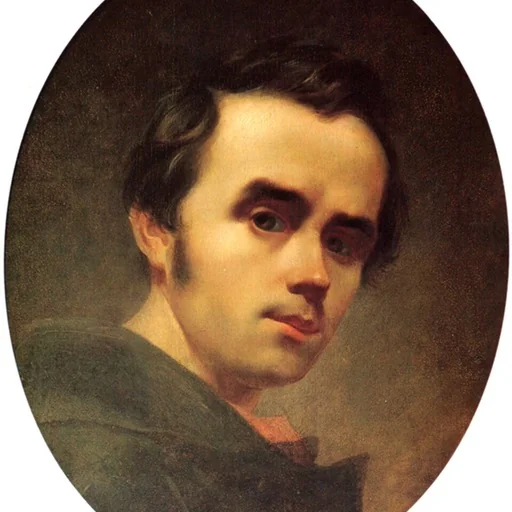
Russian, 1814–1861
Taras Shevchenko was a Russian artist. 1 work is cataloged here, principally at National Art Museum of Ukraine. Taras Shevchenko was born in Moryntsi.
Taras Hryhorovych Shevchenko (Ukrainian: Тарас Григорович Шевченко, Ukrainian pronunciation: ; Russian: Тарас Григорьевич Шевченко, romanized: Taras Grigoryevich Shevchenko; 9 March 1814 – 10 March 1861) was a Ukrainian poet, writer, artist, public and political figure, folklorist and ethnographer. His literary heritage, in particular the poetry collection Kobzar, is regarded to be the foundation of modern Ukrainian literature and to some degree also of the modern Ukrainian language. The significance of Shevchenko's creative genius for the Ukrainian and wider Slavic culture has led some to compare his figure to that of Robert Burns. Shevchenko was born into a poor family of serfs during the period of Russian rule over Ukraine. In his youth, he demonstrated a talent for art and become a fellow of the Imperial Academy of Arts in Saint Petersburg. After his return to Ukraine, he joined the emerging national movement. Exiled to Central Asia due to his association with the Brotherhood of Saints Cyril and Methodius, Shevchenko continued to create art and poetry despite prohibitions, and his figure attained fame among the liberal-minded circles of the Russian Empire. He wrote poetry in Ukrainian and prose (nine novellas, a diary and his autobiography) in Russian. Freed from exile after the onset of liberal reforms of Alexander II, he was barred from settling in Ukraine and died in Saint Petersburg.
Overview
Taras Hryhorovych Shevchenko (Ukrainian: Тарас Григорович Шевченко, Ukrainian pronunciation: [tɐˈraz‿ɦrɪˈɦɔrowɪt͡ʃ ʃeu̯t͡ʃɛnko]; Russian: Тарас Григорьевич Шевченко, romanized: Taras Grigoryevich Shevchenko; 9 March 1814 – 10 March 1861) was a Ukrainian poet, writer, artist, public and political figure, folklorist and ethnographer. His literary heritage, in particular the poetry collection Kobzar, is regarded to be the foundation of modern Ukrainian literature and to some degree also of the modern Ukrainian language. The significance of Shevchenko's creative genius for the Ukrainian and wider Slavic culture has led some to compare his figure to that of Robert Burns. Shevchenko was born into a poor family of serfs during the period of Russian rule over Ukraine. In his youth, he demonstrated a talent for art and become a fellow of the Imperial Academy of Arts in Saint Petersburg. After his return to Ukraine, he joined the emerging national movement. Exiled to Central Asia due to his association with the Brotherhood of Saints Cyril and Methodius, Shevchenko continued to create art and poetry despite prohibitions, and his figure attained fame among the liberal-minded circles of the Russian Empire. He wrote poetry in Ukrainian and prose (nine novellas, a diary and his autobiography) in Russian. Freed from exile after the onset of liberal reforms of Alexander II, he was barred from settling in Ukraine and died in Saint Petersburg.
Childhood and youth
Taras Hryhorovych Shevchenko was born on 9 March [O.S. 25 February] 1814 in Morintsy, a village in the Zvenigorodka uezd of Kiev Governorate, about 20 years after the third partition of Poland, wherein the territory of Ukraine where he was born was annexed by the Russian Empire. He was the third child after his sister Kateryna and brother Mykyta; his younger siblings were a brother, Yosyp, and a sister, Maria, who was born blind. Their parents were Kateryna Shevchenko (née Boiko) and Hryhoriy Ivanovych Shevchenko, former subjects of the Polish-Lithuanian Commonwealth who became serf peasants, working the land owned by Vasily Engelhardt, a nephew of Russian statesman Grigory Potemkin. According to Shevchenko's biographer Oleksandr Konysky, Hryhoriy's original surname had been Hrushivskyi (Ukrainian: Грушівський), and the name Shevchenko (denoting descent from a shoemaker, Ukrainian: Швець, Shvets) was applied to the family due to one of their ancestors being active in the trade. Hryhoriy and his father themselves worked as wheelwrights.
In 1816, the family moved to Kyrylivka (modern Shevchenkove), another village owned by Engelhardt, where Taras's father and grandfather had been born. The boy grew up in the village. Once, he went looking for "the pillars that prop up the sky" and got lost. Chumaks (travelling merchants) who met the boy took him back to the village. From 1822, Shevchenko was sent to a school, where he was taught to read and write. His teacher was the precentor of the village church, whose nickname was "Sovhyr". He was a harsh disciplinarian, who had a tradition of birching the children in his class every Saturday. On 1 September [O.S. 20 August] 1823 Kateryna Shevchenko died. The widowed Hryhoriy, left to look after six children aged from thirteen to four, had little choice but to remarry. He was married to Oksana Tereshchenko, a widow from Morintsy, who had three children of her own. As a child, Shevchenko was cared for by his elder sister Kateryna, who had a great influence on him.
When Hryhoriy Shevchenko became a chumak, Taras travelled twice with his father and his older brother away from his neighbourhood and, for the first time in his life, on to the open steppe. Hryhoriy died from a chill on 2 April [O.S. 21 March] 1825, and for a period the children's stepmother ruled the family, treating Taras and those siblings still at the family home with great cruelty, until she was expelled by their grandfather, Ivan Shevchenko. The only family member to stand for him during that time was his sister Iryna, who was two years younger. For a period Taras lived with his grandfather and his father's brother Pavlo, and was made to work as a swineherd and a groom's assistant. At the age of 12, Taras left home to work as a student assistant and a servant for a drunkard named Bohorsky, who had replaced Sovhyr as the village precentor and teacher and was even more violent than his predecessor. One of Shevchenko's duties was to read psalms over the dead. He was treated still more violently by Bohorsky once the boy's stepmother became his mistress. In February 1827, the 13-year-old Shevchenko escaped from the village and worked for a few days for a deacon in Lysianka, before moving on to Tarasivka. Frustrated in his attempts to become an artist, he returned to his home village. There Taras found employment as a shepherd. At around this time, Shevchenko met Oksana Kovalenko, a "curly" girl, who became his first love. Their acquain
Life as a servant of Pavel Engelhardt
In 1828, Engelhardt died, and one of his sons, Pavel Engelhardt, became the Shevchenko family's new landlord. Taras Shevchenko, then aged 14, was trained to become a kitchen servant and the kozachok (court servant) of his new master at the Vilshana estates. There he saw for the first time the luxuries of the Russian nobility. In 1829, Shevchenko was part of Engelhardt's retinue that travelled to Warsaw, where his regiment was based. By the end of 1829 they had reached Vilno (modern Vilnius). On 18 December [O.S. 6 December] 1829, Engelhardt caught Shevchenko at night painting a portrait of the Cossack general Matvei Platov. He boxed the boy's ears and ordered him to be whipped. When the party reached Warsaw, Engelhardt arranged for his servant to be apprenticed to a painter-decorator, who, recognising the boy's artistic talents, recommended he receive lessons from the Polish painter and professional artist, Franciszek Ksawery Lampi. While studying art in Vilno and Warsaw, the 16-year old Taras, still a serf, fell in love with Dunia Gusikowska, a Polish noble girl. According to his later confession, that love affair for the first time awoke in him the idea of equality between people from different social classes. When the November Uprising broke out in 1830, Engelhardt and his regiment were forced to leave Warsaw. His servants, including Shevchenko, were later expelled from the city, forced to leave Polish territory under armed guard, and then made their way to St. Petersburg. Upon arriving there, Shevchenko returned to the life of being a page-boy. His artistic training was delayed for a year, after which he was permitted to study for four years with the painter Vasiliy Shiriayev, a man who proved to be much more cruel and controlling than his master in Warsaw. The summer nights were light enough for Shevchenko to visit the city's Summer Garden, where he drew the statues. In his novel Artist, Shevchenko described that during the pre-academical period he painted such works as Apollo Belvedere, Fraklete, Heraclitus, Architectural barelief, and Mask of Fortune. He participated in the painting of the Bolshoi Theatre as an apprentice. The composition Alexander of Macedon shows trust towards his doctor Philip was created for a contest of the Imperial Academy of Arts in 1830.
Liberation from serfdom
During one of his copying sessions in the city's Summer Gardens, Shevchenko made the acquaintance of a young Ukrainian artist, Ivan Soshenko, a painter and a student of the Imperial Academy of Arts, who came from Bohuslav, close to Shevchenko's home village. Soshenko showed an interest in Shevchenko's drawings, and recognised the young man's talent. He was allowed to receive drawing and watercolour painting lessons from Soshenko on weekends, and when he had spare time during the week. Shevchenko made such progress as a portraitist that Engelhardt asked him to portray several of his mistresses. Soshenko took Shevchenko to Saint Petersburg's art galleries, including the Hermitage. He introduced him to other compatriots, such as the writer and poet Yevhen Hrebinka, the art historian Vasyl Hryhorovych, and the Russian painter Alexey Venetsianov. Through these men, around June 1832, Shevchenko was introduced to the most fashionable painter of the day, the artist Karl Briullov. Briullov took an interest in Shevchenko, praising his work and indicating a willingness to take him on as a student. However, as a serf, Shevchenko was ineligible to study under Briullov at the Academy, who requested his freedom from Engelhardt. The request was met with a refusal, which enraged Briullov. Engelhardt was persuaded to release his servant on condition that a fee of 2500 rubles was paid. To raise this sum, Briullov painted a portrait of the Russian poet Vasily Zhukovsky as a lottery prize for the imperial family; the winning lottery ticket was drawn by the tsarina. Engelhardt signed the paperwork that released Shevchenko from serfdom on 5 May [O.S. 22 April] 1838.
Paintings and drawings
After he became a student of the Imperial Academy of Arts, with Briullov as his mentor, Shevchenko spent most of his time at the academy and in Briullov's studio. Together they attended literary and musical evenings, and visited writers and artists. Shevchenko's social life enriched and expanded his horizons and stimulated his creativity. His friends during this period included Yakov Kuharenko, a writer and officer of the Black Sea Cossack Host who was to become his friend for life, and the artist Karl Joachim, From June to November 1838, Shevchenko's examination marks improved enough to allow him to join a compositional drawings class. An early drawing from this class, Cossack Banquet, was completed in December that year. The following month his work was recognised by the Imperial Society for the Encouragement of the Arts, who agreed to pay him a monthly maintenance fee of 30 rubles. After his liberation from serfdom in 1838, Shevchenko shared a flat in St. Petersburg with Soshenko, and both fell in love with Mania, a niece of their landlord. This caused a conflict between the two friends, as a result of which Shevchenko had to move. Mania continued to date Taras at the new location, but the relationship didn't end happily, and he and Soshenko soon reconciled. In April 1839, Shevchenko was awarded a silver medal by the Council of the Academy. He began to master the technique of oil painting, with The Model in the Pose of St. Sebastian being among his earliest attempts. From November, he became seriously ill with typhus. That year, he received another silver medal, this time for his oil painting The Beggar Boy Giving Bread to a Dog. In September 1841, the Academy of Arts awarded Shevchenko his third silver medal, for the painting The Gypsy Fortune Teller. The following May, continual absenteeism from classes forced the Society for the Encouragement of Artists to exclude him from among its free boarders. To earn an income he produced book illustrations, such as for Nikolai Nadezhdin's story The Power of Will, Oleksandr Bashutskyi's publication Ours, written off from nature by the Russians, an edition of Wolfgang Franz von Kobell's Galvanography (1843), and a book by Nikolai Polevoy, Russian Generals (1845). In the autumn of 1842, Shevchenko planned a sea trip to Sweden and Denmark, but due to illness, he returned home after reaching Reval (modern Tallinn).
Early poetry
At the end of 1839, Shevchenko met the sculptor and art teacher Ivan Martos, who showed great interest in his poems. He offered to publish them, but Shevchenko did not immediately agree. Hrebinka took an active and direct part in the publication of Kobzar (1840); it was he who submitted the manuscript to the St. Petersburg censorship committee. Kobzar sold out. It did not openly call for revolutionary actions, but it expressed a protest against social injustice and a desire for a free life. In March 1840, Hrebinka submitted the manuscript of the almanac Lastivka to the censors, which also included Shevchenko's Prychynna and the poems The wind is raging, the wind is raging! and Water flows into the blue sea. In 1841, Shevchenko paid for his epic poem Haidamaky. The poem was met with sharp criticism by the literary critic Vissarion Belinsky; in the magazine Otechestvennye Zapiski he criticized Shevchenko's "inclination to romantic pompous ingenuity". Other poems produced by Shevchenko during this period include "Maryana the Nun", "Drowned", and "Blind Man".
Plays
Shevchenko's play Blind Beauty, written c. 1841, has not survived. In 1842, he released a part of the tragedy Mykyta Haidai and, in 1843 he completed the drama Nazar Stodolia.
Trips to Ukraine
While residing in Saint Petersburg, Shevchenko made three trips to Ukraine: in 1843, 1845, and 1846. The difficult conditions Ukrainians endured had a profound impact on the poet-painter. Shevchenko visited his siblings, still enserfed, and other relatives. He met with prominent Ukrainian writers and intellectuals Yevhen Hrebinka, Panteleimon Kulish, and Mykhaylo Maksymovych, and was befriended by the princely Repnin family, especially Varvara, the daughter of Little Russian governor-general Nikolai Repnin. The princess especially adored Shevchenko's singing, and the two developed an intimate friendship. In a dedication to one of his poems Shevchenko compared Varvara to an angel, and there were rumours that some of his Russian-language works were composed specifically for her. In May 1843, Shevchenko travelled to Ukraine, where he met as many intellectuals, poets, and artists as possible, including the future Brotherhood of Saints Cyril and Methodius member Vasyl Bilozersky. During his stay in Kyiv, Shevchenko sketched the city's historical sights and landscapes. After a month he went to Yahotyn, where he befriended the Repnin family. In October 1843, he wrote his poem "The Dug Grave", after visiting recent excavations of burial mounds that many Ukrainians considered to be symbolic of the heroic past of the Cossacks. During the same year Shevchenko was introduced to members of the informal "Mug-Watering Society" (Russian: Общество мочемордия) organized by Pyriatyn landowner Viktor Zakrevsky, a former hussar. The society's participants competed in their drinking abilities and developed an entire system of titles and awards provided to its members depending on the amount of alcohol they were able to consume. Varvara Repnina strongly warned Shevchenko against associating with Zakrevsky and his circle. In autumn of 1843 Taras visited Kyrylivka, seeing his brothers and sisters for the first time in 14 years. During his stay in the village he met Fedosia, a 16-year old daughter of the local priest Hryhoriy Koshytsia. Next year he returned to Kyrylivka, planning to get engaged with her. However, Fedosia's parents opposed the marriage due to Shevchenko being their former servant. Fedosia later suffered from mental illness and died unmarried.
In 1844, distressed by the condition of Ukrainian regions in the Russian Empire, Shevchenko decided to capture some of his homeland's historical ruins and cultural monuments in an album of etchings, which he called Picturesque Ukraine. Shevchenko planned the album to consist of his annotated etchings of places and events connected with Ukraine and its past, and use the proceeds to buy his family their freedom. The Society for the Encouragement of Artists gave him 300 rubles to help produce Picturesque Ukraine, but due to his poor planning and lack of business skills, few of the intended etchings with their accompanying text were published, and not enough money was generated from sales to fulfill his dream of buying his siblings' freedom. Only the first six etchings were printed because of the lack of means to continue. An album of watercolors from historical places and pencil drawings was compiled in 1845.
Arrest and investigation
On 22 March 1845, the Council of the Academy of Arts granted Shevchenko the title of a non-classed artist. He again traveled to Ukraine, where he was appointed teacher of drawing at Kiev University, and met historian Mykola Kostomarov and other members of the Brotherhood of Saints Cyril and Methodius, a clandestine society also known as Ukrainian-Slavic society and dedicated to the political liberalization of the Empire and its transformation into a federation-like polity of Slavic nations. In January 1847 Shevchenko was an usher at the wedding of Panteleimon Kulish and Olena Bilozerska. His arrest on 5 April 1847 took place when he was travelling to Kiev in order to attend the wedding of Kostomarov, who, unknowingly to him, had himself been put under arrest along with other members of the Brotherhood of Sts. Cyril and Methodius.
Shevchenko's 1844 poem Dream, which described the social and national oppression of Ukrainians by the Russian upper classes, became subject of a scandal after its copies had been confiscated from the Brotherhood's members. Tsar Nicholas I personally read the poem; according to Vissarion Belinsky, the tsar, who was reported to know Ukrainian very well, laughed and chuckled whilst reading the section of Shevchenko's text dedicated to himself, but his mood quickly turned to bitter hatred when he read the part describing his wife, as Shevchenko had mocked her frumpy appearance and facial tics, which she had developed fearing the Decembrist uprising and its plans to kill her family. After reading the section, the Tsar indignantly stated "I suppose he had reasons not to be on terms with me, but what has she done to deserve this?" In the official report of Orlov Shevchenko was accused of composing poetry in "Little-Russian language" (an archaic Russian name for the Ukrainian language) of outrageous content, instead of being grateful to be redeemed out of serfdom. In the report, Orlov listed his supposed crimes as advocating and inspiring Ukrainian nationalists, alleging enslavement and misfortune of Ukraine, glorifying the Hetman Administration (Cossack Hetmanate) and Cossack liberties and that he "with incredible audacity poured slander and bile on persons of Imperial House". While under investigation, Shevchenko was imprisoned in Saint Petersburg in casemates of the 3rd Department of Imperial Chancellery on Panteleimonovskaya Street (today Pestelia str., 9).
Arrival to Central Asia
After being convicted, Shevchenko was exiled as a private to the Russian military garrison in Orenburg at Orsk, near the Ural Mountains. Tsar Nicholas I personally confirmed his sentence, and added to it, "Under the strictest surveillance, without the right to write or paint." He was subsequently sent on a forced march from Saint Petersburg to Orenburg and Orsk. According to data from the registry of Orsk fortress, where Shevchenko was sent to undergo military service as part of his sentence, he had a height of 2 arshin and 5 vershoks (164,5 cm), had dark straw hair and dark grey eyes. Having previously survived typhus, in exile Shevchenko started suffering from rheumatism and scurvy. The illness, exacerbated by poor living conditions and harsh military service, contributed to the decline of his psychological condition. During that period Shevchenko found his joy in reading letters sent to him by his old friends and acquaintances. He was eventually permitted to make drawings, which along with poetry allowed him to improve his moral state.
Aral expedition
The following year, 1848, Shevchenko was assigned to undertake the first Russian naval expedition of the Aral Sea on the ship "Konstantin", under the command of Lieutenant Butakov. Although officially a common private, he was effectively treated as an equal by the other members of the expedition. He was tasked to sketch various landscapes around the coast of the Aral Sea. After an 18-month voyage (1848–49), Shevchenko returned with his album of drawings and paintings to Orenburg. Most of those drawings were created for a detailed account of the expedition. Nevertheless, he created many unique works of art about the Aral Sea nature and Kazakh people at a time when Russian conquest of Central Asia had begun in the middle of the nineteenth century. During the Aral expedition, Shevchenko, like other of its participants, suffered from heat, thirst and lack of food. After crossing the Karakum desert on foot, his party arrived to Kosaral fortress. Shevchenko was met by Ural Cossacks, who served in the local garrison, with great reverence, as his thick beard grown during the campaign caused him to be mistaken for an Old Believer priest. The lack of post deliveries to the fortress caused him great discomfort, which he overcame by writing new poetry. By the end of 1849 Shevchenko was allowed to visit Orenburg, where he met a number of friends, getting inspiration for new poetic works. However, news about Shevchenko's planned involvement into a new expedition to the Aral Sea, as well as a new ban on drawing, once again led him to fall into despair. In a letter to Varvara Repnina dated with 1 January 1850, he doubted that he would ever see Ukraine once again.
Imprisonment at Novopetrovsk
Following a conflict with one of officers serving in Orenburg, in April 1850 Shevchenko was arrested and sent to Orsk on accusations of wearing civilian clothes and violating the ban on drawing, despite drawing having been one of his tasks during the Aral expedition. The new arrest resulted in his eventual transportation to one of the worst penal settlements, the remote fortress of Novopetrovsk at Mangyshlak Peninsula on the Caspian Sea, where he arrived in October 1850. Qualified as a political prisoner, Shevchenko was subjected to strict drills and abuse by officers, which caused him great moral pain. To make matters worse, strict censorship prevented him from exchanging letters with his friends.
In 1851, at the suggestion of fellow serviceman Bronisław Zaleski, lieutenant colonel Mayevsky assigned Shevchenko to the Mangyshlak (Karatau) geological expedition. In order to overcome the bans on artistic creativity, in 1853 Shevchenko worked on clay sculptures, creating a low relief and many statuettes, which didn't survive during transportation. In 1854 he volunteered to paint an icon for the local church, but was denied permission by military authorities. One of the few positive experiences Shevchenko could enjoy during his time at Novopetrovsk was his acquaintance with Agata Uskova, the wife of the fortress commandant, to whom he developed romantic feelings.
Release from exile
In 1857, Shevchenko finally returned from exile after receiving amnesty from the new emperor, though he was not permitted to return to St. Petersburg and was forced to stay in Nizhniy Novgorod. There he started courting young actress Ekaterina Piunova, getting her acquainted with his friends and giving her lessons of Ukrainian language for her roles. However, Piunova's parents opposed the relationship due to the big age difference between the two, and she herself rejected the marriage proposal. On his birthday, 25 February 1858, Shevchenko received the news, that he had been permitted by authorities to return to St. Petersburg. After arriving to Moscow in March, he met his old friend Varvara Repnina, who would in her memoirs note Shevchenko's "apathetic" look and described him as "ruined" both physically and morally. Following his return to St. Petersburg after 11 years of exile, Shevchenko was received by the educated classes as a celebrity. At a dinner in the house of Counts Tolstoy, he was praised by the hosts and guests for his great love to his native Ukraine and for not breaking in face of difficult life circumstances. Such praise from members of the high society surprised Shevchenko. Following his arrival to the capital, he would be regularly invited as a guest to homes of influential people, and got acquainted with a number of prominent artistic figures, among others Mikhail Mikeshin and Ivan Turgenev. Planning to continue his career in art, soon after returning to St. Petersburg Shevchenko visited the Hermitage in order to choose a painting for his first aquatint reproduction. In June 1858 he was provided two small rooms at the Arts Academy, which he used as a residence and a workshop. In order to finance his daily expenses, Shevchenko gave art lessons to children of his friends. He also reestablished contacts with Kostomarov, who visited St. Petersburg from Saratov. In the winter of 1858, Shevchenko saw African-American Shakespearean actor Ira Aldridge perform with his troupe. Using translators, the two became good friends over discussions of art and music and their shared experiences of oppression. Shevchenko drew Aldridge's portrait. Aldridge was later gifted a portrait of Shevchenko by Mikhail Mikeshin. In late 1858 or early 1859 Shevchenko met Marko Vovchok, the wife of Opanas Markovych, a former member of the Society of Sts. Cyril and Methodius. Impressed by Vovchok's works, the poet soon developed warm feelings for her, and dedicated one of his poems to the author. Through his contacts in St. Petersburg, Shevchenko lobbied the liberation of his remaining family in Ukraine from serfdom, but Florowski, the landlord of Kyrylivka, issued a condition, according to which they had to leave the village in exchange for their freedom. The planned expulsion was eventually prevented by the Polish Rebellion of 1863, which forced imperial authorities to issue a number of concessions to recently liberated peasants.
Last visit to Ukraine
After receiving permission to travel to Ukraine, in June 1859 Shevchenko left St. Petersburg. After spending some time at the manor of Khrushchov family near Lebedyn, Shevchenko paid a visit to his old friend Mykhailo Maksymovych, who lived in the vicinity of Kaniv. From there he arrived to Horodyshche, visiting the sugar factory operated by industrialist Platon Semerenko, and then moved on to Kyrylivka, where he met his elder brother Mykyta and sister Iryna. Shevchenko then moved to Korsun, staying with Varfolomey, the brother of his sister-in-law. The two men surveyed land along the Dnieper, looking for a possible location for a house, where Taras planned to reside in the future. However, in July Shevchenko was arrested following a report to the local police, which accused him of blasphemy, and transported to Kyiv via Cherkasy. After being released, Shevchenko stayed in Kyiv, renting a house at Priorka and visiting Soshenko, his old friend, before departing for St. Petersburg. On his way back he paid a visit to the Tarnovsky family at their residence at Kachanivka.
Collections represented

Artists in a similar vein
Artist