Artist
Wilhelm Busch
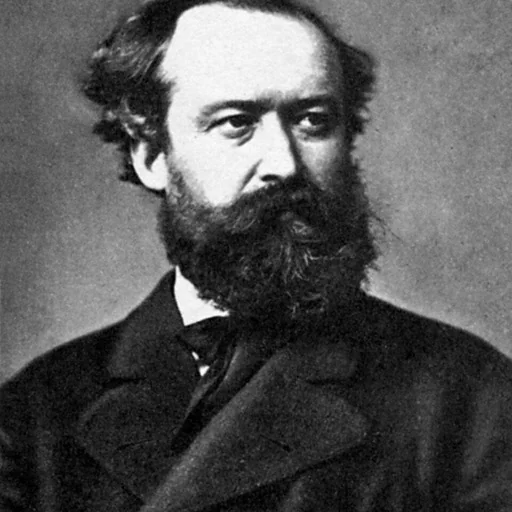
1832–1908
Wilhelm Busch was a Realism artist. 4 works are cataloged here, principally at Städel Museum. Wilhelm Busch was born in Wiedensahl.
Overview
Heinrich Christian Wilhelm Busch (14 April 1832 – 9 January 1908) was a German humorist, poet, illustrator, and painter. He published wildly innovative illustrated tales that remain influential to this day. Busch drew on the tropes of folk humour as well as a profound knowledge of German literature and art to satirize contemporary life, any kind of piety, Catholicism, Philistinism, religious morality, bigotry, and moral uplift. His mastery of drawing and verse became deeply influential for future generations of comic artists and vernacular poets. Among many notable influences, The Katzenjammer Kids was inspired by Busch's Max and Moritz. Today, the Wilhelm Busch Prize and the Wilhelm Busch Museum help maintain his legacy. The 175th anniversary of his birth in 2007 was celebrated throughout Germany. Busch remains one of the most influential poets and artists in Western Europe, being called the "Forefather of Comics".
Family background
Johann Georg Kleine, Wilhelm Busch's maternal grandfather, settled in the small village of Wiedensahl, where in 1817 he bought a thatched half-timbered house where Wilhelm Busch was to be born 15 years later. Amalie Kleine, Johann's wife and Wilhelm Busch's grandmother, kept a shop where Busch's mother Henriette assisted while her two brothers attended high school. When Johann Georg Kleine died in 1820, his widow continued to run the shop with Henriette. At the age of 19 Henriette Kleine married surgeon Friedrich Wilhelm Stümpe. Henriette became widowed at the age of 26, with her three children to Stümpe dying as infants. About 1830 Friedrich Wilhelm Busch, the illegitimate son of a farmer, settled in Wiedensahl after completing a business apprenticeship in the nearby village of Loccum. He took over the Kleine shop in Wiedensahl, which he completely modernised. He married Henriette Kleine Stümpe.
Childhood
Wilhelm Busch was born on 14 April 1832, the first of seven children to Henriette Kleine Stümpe and Friedrich Wilhelm Busch. His six siblings followed shortly after: Fanny (1834), Gustav (1836), Adolf (1838), Otto (1841), Anna (1843), and Hermann (1845); all survived childhood. His parents were ambitious, hard-working and devout Protestants who later, despite becoming relatively prosperous, could not afford to educate all three sons. Busch's biographer Berndt W. Wessling suggested that Friedrich Wilhelm Busch invested heavily in the education of his sons partly because his own illegitimacy held significant stigma in rural areas. The young Wilhelm Busch was a tall child, with a delicate physique. The coarse boyishness of his later protagonists, "Max and Moritz" was not his own. He described himself in autobiographical sketches and letters as sensitive and timid, someone who "carefully studied fear", and who reacted with fascination, compassion, and distress when animals were killed in the autumn. He described the "transformation to sausage" as "dreadfully compelling", leaving a lasting impression; pork nauseated him throughout his life. In the autumn of 1841, after the birth of his brother Otto, Busch's education was entrusted to the 35-year-old clergyman, Georg Kleine, his maternal uncle at Ebergötzen, where 100 children were taught within a space of 66 m2 (710 sq ft). This probably through lack of space in the Busch family home, and his father's desire for a better education than the small local school could provide. The nearest convenient school was located in Bückeburg, 20 km (12 mi) from Wiedensahl. Kleine, with his wife Fanny Petri, lived in a rectory at Ebergötzen, while Busch was lodged with an unrelated family. Kleine and his wife were responsible and caring, exercised a substitute parental role, and provided refuge for him in future unsuccessful times.
Kleine's private lessons for Busch also were attended by Erich Bachmann, the son of a wealthy Ebergötzen miller. Both became friends, according to Busch the strongest friendship of his childhood. This friendship was echoed in the 1865 story, Max and Moritz. A small pencil portrait by the 14-year-old Busch depicted Bachmann as a chubby, confident boy, and showed similarities with Max. Busch portrayed himself with a "cowlick", in the later "Moritzian" perky style. Kleine was a philologist, his lessons not held in contemporary language, and it is not known for certain all subjects Busch and his friend were taught. Busch did learn elementary arithmetic from his uncle, although science lessons might have been more comprehensive, as Kleine, like many other clergymen, was a beekeeper, and published essays and textbooks on the subject, – Busch demonstrated his knowledge of bee-keeping in his future stories. Drawing, and German and English poetry, were also taught by Kleine. Busch had little contact with his natural parents during this period. At the time, the 165 km (103 mi) journey between Wiedensahl and Ebergötzen took three days by horse. His father visited Ebergötzen two to three times a year, while his mother stayed in Wiedensahl to look after the other children. The 12-year-old Busch visited his family once; his mother at first did not recognize him. Some Busch biographers think that this early separation from his parents, especially from his mother, resulted in his eccentric bachelorhood. In the autumn of 1846, Busch moved with the Kleines to Lüthorst, where, on 11 April 1847, he
Study
In September 1847 Busch began studying mechanical engineering at Hannover Polytechnic. Busch's biographers are not in agreement as to why his Hanover education ended; most believe that his father had little appreciation of his son's artistic inclination. Biographer Eva Weissweiler suspects that Kleine played a major role, and that other possible causes were Busch's friendship with an innkeeper, Brümmer, political debates in Brümmer's tavern, and Busch's reluctance to believe every word of the Bible and catechism. Busch studied for nearly four years at Hanover, despite initial difficulties in understanding the subject matter. A few months before graduation he confronted his parents with his aspiration to study at the Düsseldorf Art Academy. According to Bush's nephew Hermann Nöldeke, his mother supported this inclination. His father eventually acquiesced and Busch moved to Düsseldorf in June 1851, where, to his disappointment at not being admitted to the advanced class, he entered preparatory classes. Busch's parents had his tuition fees paid for one year, so in May 1852 he traveled to Antwerp to continue study at the Royal Academy of Fine Arts under Josephus Laurentius Dyckmans. He led his parents to believe that the academy was less regimented than Düsseldorf, and had the opportunity to study Old Masters. At Antwerp he saw for the first time paintings by Peter Paul Rubens, Adriaen Brouwer, David Teniers, and Frans Hals. The pictures aroused his interest, but made him doubt his own skills. Eventually, in 1853, after suffering heavily from typhus, he abandoned his Antwerp studies and returned penniless to Wiedensahl.
Munich
Busch was ravaged by disease, and for five months spent time painting and collecting folk tales, legends, songs, ballads, rhymes, and fragments of regional superstitions. Busch's biographer, Joseph Kraus, saw these collections as useful additions to folklore, as Busch noted the narrative background to tales and the idiosyncrasies of storytellers. Busch tried to release the collections, but as a publisher could not be found at the time, they were issued after his death. During the Nazi era Busch was known as an "ethnic seer".
After Busch had spent six months with his uncle Kleine at Lüthorst, he expressed a desire to continue to study in Munich. This request caused a rift with his father who, however, eventually funded this move; – see for comparison Busch's illustrated story of Painter Klecksel. Busch's expectations of the Munich Academy of Fine Arts were not met. His life became aimless; there were occasional return visits to Lüthorst, but contact with his parents had been broken off. In 1857 and 1858, as his position seemed to be without prospects, he contemplated emigration to Brazil to keep bees. He also spearheaded the 1862 Fairytale Maskenfest, a fairytale-themed masquerade ball attended by future king Ludwig II. Busch made contact with the artist association, Jung München (Young Munich), met several notable Munich artists, and wrote and provided cartoons for the Jung München newspaper. Kaspar Braun, who published the satirical newspapers, Münchener Bilderbogen (Picture Sheets from Munich) and Fliegende Blätter (Flying Leaves), proposed a collaboration with Busch. This association provided Busch with sufficient funds to live. An existing self-caricature suggests that at this time he had an intense relationship with a woman from Ammerland. His courtship with a seventeen-year-old merchant's daughter, Anna Richter, whom Busch met through his brother Gustav, ended in 1862. Busch's biographer, Diers, suggests that her father probably refused to entrust his daughter to an almost unknown artist without regular income. In his early Munich years Busch's attempts to write libretti, which are almost forgotten today, were unsuccessful. Up to 1863 he worked on two or three major works; the third was composed by Georg Kremplsetzer. Busch's Liebestreu und Grausamkeit, a romantic opera in three acts, Hansel und Gretel, and Der Vetter auf Besuch, an opera buffa of sorts, were not particularly successful. There was a dispute between Busch and Kremplsetzer during the staging of Der Vetter auf Besuch, leading to the removal of Busch's name from the production; the piece was renamed, Singspiel von Georg Kremplsetzer. However, German composer Elsa Laura Wolzogen set several of his poems to music. In 1873 Busch returned several times to Munich, and took part in the intense life of the Munich Art Society as an escape from provincial life. In 1877, in a last attempt to be a serious artist, he took a studio in Munich. He left Munich abruptly in 1881, after he disrupted a variety show and subsequently made a scene through the effects of alcohol. The 1878 nine episode illustrated tale Eight Sheets in the Wind describes how humans behave like animals when drunk. Busch's biographer Weissweiler felt the story was only superficially funny and harmless, but was a study on addiction and its induced state of delusion.
Publication of Max and Moritz
Between 1860 and 1863 Busch wrote more than one hundred articles for the Münchener Bilderbogen and Fliegende Blätter, but he felt his dependence on publisher Kaspar Braun had become constricting. Busch appointed Dresden publisher Heinrich Richter, the son of Saxon painter Ludwig Richter, as his new publisher – Richter's press up to that time was producing children's books and religious Christian devotional literature. Busch could choose themes, although Richter raised some concerns regarding four suggested illustrated tales that were proposed. However, some were published in the 1864 as Bilderpossen, proving a failure. Busch then offered Richter the manuscripts of Max and Moritz, waiving any fees. Richter rejected the manuscript as sales prospects seemed poor. Busch's former publisher, Braun, purchased the right to Max and Moritz for 1,000 gulden, corresponding to approximately double the annual wage of a craftsman. For Braun the manuscript was fortuitous. Initially the sales of Max and Moritz were slow, but sales figures improved after the 1868 second edition. Overall there were 56 editions and more than 430,000 copies sold up to Busch's death in 1908. Despite at first being ignored by critics, teachers in the 1870s described Max and Moritz as frivolous and an undesirable influence on the moral development of young people.
Frankfurt
Increasing economic success allowed Busch to visit Wiedensahl more frequently. Busch had decided to leave Munich, as only few relatives lived there and the artist association was temporarily disbanded. In June 1867 Busch met his brother Otto for the first time, in Frankfurt. Otto was working as a tutor to the family of a wealthy banker and industrialist, Kessler. Busch became friends with Kessler's wife, Johanna, a mother of seven and an influential art and music patron of Frankfurt. She regularly opened salons at her villa, frequented by artists, musicians, and philosophers. She believed Busch to be a great painter, a view supported by Anton Burger, a leading painter of the Kronberger Malerkolonie, the Kronberg-based group of painters. While his humorous drawings did not appeal to her, she supported his painting career. At first she established an apartment and studio for Busch in her villa, later providing him with an apartment nearby. Motivated by Kessler's support and admiration, and introduction to the cultural life of Frankfurt, the 'Frankfurter Years' were the most artistically productive for Busch. At this time he and Otto discovered the philosophical works of Arthur Schopenhauer. Busch did not remain in Frankfurt. Toward the end of the 1860s he alternated between Wiedensahl and Lüthorst, and Wolfenbüttel where his brother Gustav lived. The association with Johanna Kessler lasted five years, and after his return to Wiedensahl in 1872 they communicated by letter. This contact was interrupted between 1877 and 1891, after which it was revived with the help of Kessler's daughters.
Later life
Biographer Weissweiler does not dismiss the possibility that Busch's increasing alcohol dependence hindered self-criticism. He refused invitations to parties, and publisher Otto Bassermann sent him to Wiedensahl to keep his alcohol problem undetected from those around him. Busch was also a heavy smoker, resulting in symptoms of severe nicotine poisoning in 1874. He began to illustrate drunkards more often. Dutch writer Marie Anderson corresponded with Busch. More than fifty letters were exchanged between January and October 1875 in which they discussed philosophy, religion, and ethics. Although only one Anderson letter survives, Busch's letters are in manuscripts. They met in Mainz in October 1875, after which he returned to Bassermann at Heidelberg in a "horrible mood". According to several people at the time, Busch's failure to find a wife was responsible for his conspicuous behaviour. There is no evidence that Busch had a close relationship with any woman after that with Anderson. Busch lived with his sister Fanny's family after her husband Pastor Hermann Nöldeke's death in 1879. His nephew Adolf Nöldeke remembers that Busch wanted to move back to Wiedensahl with the family. Busch renovated the house, which Fanny looked after even though Busch was a rich man, and became "father" to his three young nephews. She would, however, have preferred to live in a more urban area for the education of her sons. For Fanny and her three sons, Busch could not replace their former idyllic life. The years around 1880 were psychically and emotionally exhausting for Busch, who was still reliant on alcohol. He would not invite visitors to Wiedensahl; because of this Fanny lost contact with her friends in the village, and whenever she questioned his wishes, Busch became furious. Even his friends Otto Friedrich Bassermann, Franz von Lenbach, Hermann Levi and Wilhelm von Kaulbach were not welcome at the house; he would meet them in Kassel or Hanover. Busch stopped painting in 1896 and signed over all publication rights to Bassermann Verlag for 50,000 gold marks. Busch, now aged 64, felt old. He needed spectacles for writing and painting, and his hands trembled slightly. In 1898, together with his aging sister Fanny Nöldeke, he accepted Bassermann's suggestion to move into a large parsonage in Mechtshausen. Busch read biographies, novels and stories in German, English and French. He organized his works and wrote letters and poems. Most of the poems from the collections Schein und Sein and Zu guter Letzt were written in 1899. The following years were eventless for Busch. He developed a sore throat in early January 1908, and his doctor detected a weak heart. During the night of 8–9 January 1908 Busch slept uneasily, taking camphor, and a few drops of morphine as a tranquilizer. Busch died the following morning before his physician, called by Otto Nöldeke, came to assist.
Work
During the Frankfurt period Busch published three self-contained illustrated satires. Their anti-clerical themes proved popular during the Kulturkampf. Busch's satires typically did not address political questions, but exaggerated churchiness, superstition, and philistine double standards. This exaggeration made at least two of the works historically erroneous. The third illustrated satire, Father Filucius (Pater Filucius), described by Busch as an "allegorical mayfly", has greater historical context.
Max and Moritz
In German, Eine Bubengeschichte in sieben Streichen, Max and Moritz is a series of seven illustrated stories concerning the mischievous antics of two boys, who are eventually ground up and fed to ducks.
Saint Antonius of Padua and Helen Who Couldn't Help It
In Saint Antonius of Padua (Der Heilige Antonius von Padua) Busch challenges Catholic belief. It was released by the publisher Moritz Schauenburg at the time Pope Pius IX proclaimed the dogma of papal infallibility that was harshly criticized by Protestants. The publisher's works were heavily scrutinized or censored, and the state's attorney in Offenburg charged Schauenberg with "vilification of religion and offending public decency through indecent writings" – a decision which affected Busch. Scenes of Antonius accompanied by a pig being admitted to heaven, and the devil being shown as a half-naked ballet dancer seducing Antonius, were deemed controversial. The district court of Düsseldorf subsequently banned Saint Antonius. Schauenburg was acquitted on 27 March 1871 in Offenburg, but in Austria distribution of the satire was prohibited until 1902. Schauenburg refused to publish further Busch satires to avoid future accusations. Busch's following work, Helen Who Couldn't Help It (Die fromme Helene), was published by Otto Friedrich Bassermann, a friend whom Busch met in Munich. Helen Who Couldn't Help It, which was soon translated into other European languages, satirizes religious hypocrisy and dubious morality:
Many details from Helen Who Couldn't Help It criticize the way of life of the Kesslers. Johanna Kessler was married to a much older man and entrusted her children to governesses and tutors, while she played an active role in the social life of Frankfurt.
The character of Mr. Schmock – the name based on the Yiddish insult "schmuck" – shows similarities with Johanna Kessler's husband, who was uninterested in art and culture. In the second part of Helen Who Couldn't Help It Busch attacks Catholic pilgrimages. The childless Helen goes on a pilgrimage, accompanied by her cousin and Catholic priest Franz. The pilgrimage is successful, as later Helen gives birth to twins, who resemble Helen and Franz. Franz is later killed by a jealous valet, Jean, for his interest in female kitchen staff. The now widowed Helen is left with only a rosary, prayer book, and alcohol. Drunk, she falls into a burning oil lamp. Finally, Nolte coins a moral phrase, echoing the philosophy of Schopenhauer:
Pater Filucius (Father Filucius) is the only illustrated satire of this period suggested by the publisher. Also aimed at anti-Catholic taste and buyers, it criticizes the Jesuit Order. Kraus felt it was the weakest of all three anti-clerical works. Some satires refer to contemporary events, such as Monsieur Jacques à Paris during the Siege of 1870 (Monsieur Jacques à Paris während der Belagerung von 1870). Busch biographer Michaela Diers declares the story "tasteless work, drawing on anti-French emotions and mocking the misery of French people in Paris, which is occupied by Prussian troops". It depicts an increasingly desperate French citizen who at first eats a mouse during the German siege, then amputates his dog's tail to cook it, and finally invents an explosion pill which kills his dog and two fellow citizens. Weissweiler believes that Busch wrote with irony. In Eginhard and Emma (1864), a fictional family story that takes place in the Charlemagne era, he criticizes the Holy Roman Empire and calls for a German empire in its place; in The Birthday or the Particularists (Der Geburtstag oder die Partikularisten) he satirizes the anti-Prussian sentiments of his Hanover countrymen.
Critique of the Heart
Busch did not write illustrated tales for a while, but focused on the literary Kritik des Herzens (Critique of the Heart), wanting to appear more serious to his readers. Contemporary reception for the collection of 81 poems was mainly poor; it was criticized for its focus on marriage and sexuality. His long-time friend Paul Lindau called it "very serious, heartfelt, charming poems". Dutch writer Marie Anderson was one of few people who enjoyed his Kritik des Herzens, and she even planned to publish it in a Dutch newspaper.
Adventures of a Bachelor
Notwithstanding the hiatus after moving from Frankfurt, the 1870s were one of Busch's most productive decades. In 1874 he produced the short illustrated tale, Diddle-Boom! (Dideldum!). Following in 1875, was the Knopp Trilogy, about the life of Tobias Knopp: Adventures of a Bachelor (Abenteuer eines Junggesellen), Mr. and Mrs. Knopp (Herr und Frau Knopp) (1876), and "Julie" (Julchen) (1877). The antagonists of the trilogy are not pairs of nuisances as with Max and Moritz or Jack Crook, Bird of Evil (Hans Huckebein, der Unglücksrabe). Without pathos, Busch makes Knopp become aware of his mortality:
In the first part of the trilogy, Knopp is depressed and will look for a wife. He visits his old friends and their wives, whom he finds in unenviable relationships. Still not convinced that the life of a bachelor is one for him, he returns home, and without further ado proposes to his housekeeper. The following marriage proposal is, according to Busch biographer Joseph Kraus, one of the shortest in the history of German literature:
According to Wessling, Busch became skeptical of marriage after writing the story. To Marie Anderson he wrote: "I will never marry(...) I am already in good hands with my sister".
Last works
Among Busch's last works were the stories, Clement Dove, the Poet Thwarted (Balduin Bählamm, der verhinderte Dichter) (1883) and Painter Squirtle (Maler Klecksel) (1884), both of which focus on artistic failure, and indirectly his own failure. Both stories begin with a preface, which, for biographer Joseph Kraus, were bravura pieces of "Komische Lyrik" — German comic poetry. Clement Dove ridicules the bourgeois amateur poet circle of Munich, "The Crocodiles" (Die Krokodile), and their prominent members Emanuel Geibel, Paul von Heyse, and Adolf Wilbrandt. Painter Squirtle criticizes the bourgeois art connoisseur who believes the worth of art is gauged by its price.
The prose play Edwards Dream (Eduards Traum) was released in 1891, composed of several small grouped episodes, rather than one linear storyline. The work received mixed reception. Joseph Kraus felt it was the peak of the life works by Busch, his nephews called it a masterwork of world literature, and the publisher of a critical collective edition spoke of a narrative style that is not found in contemporary literature. Eva Weissweiler saw in the play Busch's attempt to prove himself in the novella genre, believing that everything that angered or insulted him, and his accompanying emotional depths, are apparent in the story. The 1895 story The Butterfly (Der Schmetterling) parodies themes and motifs and ridicules the religious optimism of a German romanticism that contradicted Busch's realistic anthropology influenced by Schopenhauer and Charles Darwin. Its prose is more stringent in narrative style when compared to Edwards Dream. Both were not popular amongst readers, because of their unfamiliar style.
Collections represented


Artists in a similar vein