Artist
Richard Buckner
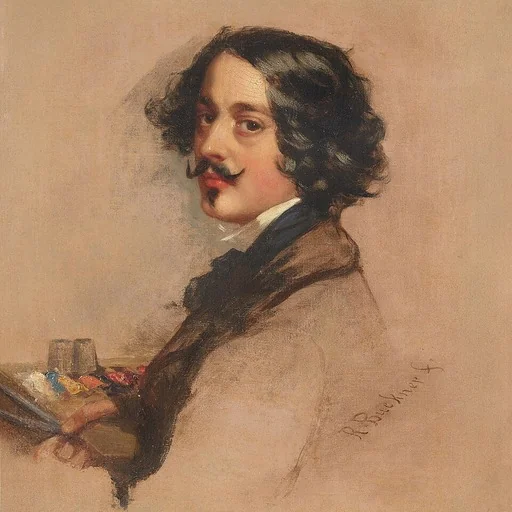
British, 1812–1883
Richard Buckner was a British Realism artist. 5 works are cataloged here, principally at Victoria and Albert Museum. Richard Buckner was born in Woolwich.
Overview
Richard Buckner (1812–1883) of Cleveland Row in St James's, London was an English painter best known for his prolific portraiture, particularly of Victorian society ladies (1840–1877).
Early Life
Richard Buckner was born in Woolwich in 1812, son of Lieutenant-Colonel Richard Buckner (1772–1837) and Mary Marsh Pierce (ca. 1778 – 1852). In 1812, Colonel Buckner was on assignment at the Woolwich arsenal with the Royal Regiment of Artillery, but the main family home was Whyke House, Rumboldswhyke, Chichester where Buckner was raised. Buckner showed an interest in art growing up, establishing his own painting studio at home where he experimented with limning. In 1831, Buckner was granted a commission in the British Army with the 60th Regiment of Foot, which was achieved by purchase the following year. In 1837, his father died and by 1840, Buckner had left the Army and had moved to Rome, where he studied painting under Giovanni Battista Cassevari.
Career
Buckner set up his own studios in Rome facing Bernini’s Triton fountain and in London at Cleveland Row, opposite St James's Palace. During the sixteen years that he alternated between working in Rome and London, Buckner became friends with other expatriates in Rome like John Gibson, Penry Williams and the young Frederick Leighton, who later painted his portrait in The Death of Brunelleschi, 1852. When in Rome, Buckner painted Italian figurative subjects, the best of which were exhibited at the British Institution and when in England, he painted commissioned portraits, which were exhibited at the Royal Academy of Arts and the Society of British Artists. Buckner first exhibited his work in 1840, showing in total around one hundred and sixty works of art over the next thirty-seven years. His best executed commissions were exhibited at the Royal Academy from 1842 and then every year thereafter from 1846 to 1877. The Royal Academy hung seventy-seven of Buckner's paintings, almost all portraits. Thirty-two of his paintings paintings were also exhibited at the British Institution, all of them Italian figures, and a further forty-four paintings at the Royal Society of British Artists. As little as 16% of his work was publicly exhibited, most of which was not for sale because they were commissioned works, but they still provided Buckner with visibility for future commissions and for publishers to establish his potential for mass reproductions of his work. That same visibility attracted the patronage of many important and wealthy clients including Queen Victoria, the Prince of Wales, and the Duke of Hamilton. The popularity of Buckner's particular style of portraiture evidently had mass appeal, although dismissed by some contemporary art critics as commercial art.
A Popular artist
Buckner's commercial success was facilitated by the same great art institutions that refused to admit him as a member, despite his being nominated for each. Many of the reviews of the time offered both high praise and none. The more expansive critiques pointed to Buckner's work as being "too sentimental" or just too large, and for using "unnaturally vivid colours", the same criticisms levelled at the Pre-Raphaelites from the same institutions expressing similar reservations about membership. The Victorian art elite accused him of selling out to fashion and commercialisation. Bad reviews did little to dent Buckner's popularity, despite being described as both "cheap" and tawdry. The prices he commanded were not cheap however.
Legacy
Buckner stopped painting in 1877 and appears to have moved from his studio at 3A Cleveland Row to lodging next door at No.2 in the house of a Mr. William Woodward. Following Buckner's death in 1883, a society columnist wrote:
"Of late years one had seen but little of his work in exhibitions or of the painter in society, where at one time he was often beheld, a dainty jaunty little gentleman, much be-ringed and be-ringletted, and with a sweet smile for everybody" Buckner's commission book lists 989 works over his professional career from 1840 to 1877, with a small number of commissions not executed. His portraits hung in royal and stately homes alongside Holbeins and Gainsboroughs, where some still hang today, including National Trust properties, as well as the National Portrait Gallery, London, the Victoria and Albert Museum, and the British Museum. His work continues to attract the interest of art critics and public alike.
Collections represented

Museum

Museum
Artists in a similar vein
Artist
Artist