Artist
Eugene von Guerard
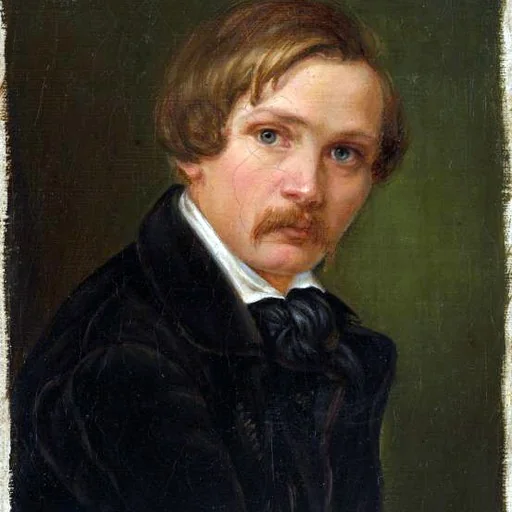
Australian, 1811–1901
Eugene von Guerard was an Australian artist. 1 work is cataloged here, principally at National Gallery of Victoria. Eugene von Guerard was born in Vienna.
Overview
Johann Joseph Eugene von Guérard (17 November 1811 – 17 April 1901) was an Austrian-born artist, active in Australia from 1852 until 1882. Known for his finely detailed landscapes in the tradition of the Düsseldorf school of painting, he is represented in Australia's major public galleries, and is referred to in the country as Eugene von Guerard.
Early life
Born in Vienna, Austria, von Guerard toured Italy with his father (a painter of miniatures at the court of Emperor Francis I of Austria) from 1826, and between 1830 and 1832 resided in Rome, where he became involved with a number of German artists. The foremost landscape painter amongst these so-called "Deutsch Römer" was Johann Anton Koch, but he also met there members of the Lukasbund, a group of young German breakaway artists known as the Nazarenes, From 1841 he studied landscape painting in Germany at the Kunstakademie Düsseldorf and travelled widely. Von Guerard's personal artistic style was formed by his first teacher, his miniaturist father with whom he travelled throughout Italy. Other influences ascribed to von Guerard are Claude Lorrain, Nicolas Poussin and Salvator Rosa. During his studies at the Düsseldorf Academy he absorbed the new criterion for German art promoted by his landscape lecturer Johann Wilhelm Schirmer under the directorship of ex-Nazarenes member Wilhelm von Schadow: to present "elevated" subject matter in the style of a new "truthful"' realism. The Düsseldorf style of painting combined concepts of prevailing trends: Historicism, a lingering Romanticism and a new visually based Realism that required taking observations from nature. Von Guerard's Australian landscapes show his sensitive perception of the Australian landscape, whilst his stylistic methodology exemplifies the confluence of various styles derived from his European artistic heritage.
Australia
In 1852 von Guerard arrived in Victoria, Australia, determined to try his luck on the Victorian goldfields. As a gold-digger he was unsuccessful, but he did produce a large number of intimate studies of goldfields life, quite different from the deliberately awe-inspiring landscapes for which he was later to become famous.
He was one of a number of influential German-speaking residents — such as Ludwig Becker, Hermann Beckler, William Blandowski, Amalie Dietrich, Wilhelm Haacke, Diedrich Henne, Gerard Krefft, Johann Luehmann, Johann Menge, Carl Mücke (a.k.a. Muecke), Ludwig Preiss, Carl Ludwig Christian Rümker (a.k.a. Ruemker), Moritz Richard Schomburgk, Richard Wolfgang Semon, Karl Theodor Staiger, George Ulrich, Robert von Lendenfeld, Ferdinand von Mueller, Georg von Neumayer, and Carl Wilhelmi — who brought their "epistemic traditions" to Australia, and not only became "deeply entangled with the Australian colonial project", but also were "intricately involved in imagining, knowing and shaping colonial Australia" (Barrett, et al., 2018, p.2). By the early 1860s von Guerard was recognised as the foremost landscape artist in the colonies, touring Southeast Australia and New Zealand in pursuit of the sublime and the picturesque. He is most known for the wilderness paintings produced during this time, which are remarkable for their shadowy lighting and fastidious detail. Indeed, his view of Tower Hill in south-western Victoria was used as a botanical template over a century later when the land, which had been laid waste and polluted by agriculture, was systematically reclaimed, forested with native flora and made a state park. The scientific accuracy of such work has led to a reassessment of von Guerard's approach to wilderness painting, and some historians believe it likely that the landscapist was strongly influenced by the environmental theories of the leading scientist Alexander von Humboldt. Others attribute his 'truthful representation' of nature to the criterion for figure and landscape painting set by the Düsseldorf Academy. In 1866 his Valley of the Mitta Mitta was presented to the National Gallery of Victoria in Melbourne; in 1870 the trustees purchased his Mount Kosciusko. In 2006, the City of Greater Geelong purchased his 1856 painting View of Geelong for A$3.8M. His painting, Yalla-y-Poora, is in the Joseph Brown Collection on display at the National Gallery of Victoria. In 2018 another painting, Stoneleigh, Beaufort near Ararat, Victoria (1866) was put on permanent display in the Galleries of the State Library of New South Wales. Von Guerard's paintings were also purchased by the Art Gallery of New South Wales including Waterfall, Strath Creek (1862), Sydney Heads (1865) and Milford Sound, New Zealand (1877–1879) among many others. The State Library of New South Wales in Sydney holds 32 sketchbooks which cover von Guerard’s twenty-eight years in Australia and also the period of his early travels in the Rhineland and Italy and his return to Europe after 1881. The drawings include pencil sketches, detailed pen and ink or pencil drawings, and a few with colour added and include works done on scientific expeditions with Alfred William Howitt and Georg von Neumayer, the meteorologist. The sketchbooks cover Italy and Germany, 1835–1852, Australia, 1854–1891, and the English sketchbook, 1891–1900. The only known copy of von Guerard's 1852–1854 diary of his time on the goldfields is held in England. But a typescript translation mad
Archives At
Eugene von Guerard albums of original drawings - includes: Station Peak, Geelong, 1855; The Dandenong Ranges, 1855-1858; The Glenelg and Mt Gambier, 1857; Apollo Bay and Cape Otway, 1859 - 1862; Goulburn, 1862; Sketches in Victoria, 1862; Cape Schanck and Phillip Island, 1863-1869; Sketches 1863-1866, 1870, 1877; Wimmera; Ballarat - digitised copies online at State Library of New South Wales, 1LjRBy39
Collections represented

Museum
Artists in a similar vein
Artist