Artist
Pietro della Vecchia
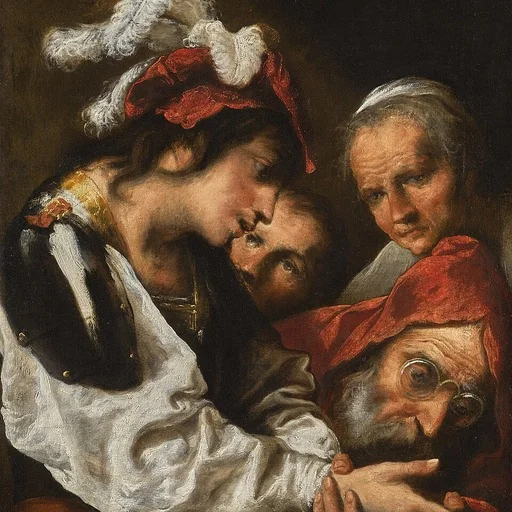
Italian, 1603–1678
Pietro della Vecchia was an Italian Early Baroque Italian painter. 15 works are cataloged here, principally at Bavarian State Painting Collections, most of them oil paintings. Pietro della Vecchia was born in Venice.
Overview
Pietro della Vecchia, Pietro della Vècchia or Pietro Vècchia, formerly incorrectly called Pietro Muttoni (1603 – 8 September 1678) was a versatile Venetian artist between late Mannerism and early Baroque, who worked in many genres and created altarpieces, portraits, genre scenes and grotesques. He also created pastiches of the work of leading Italian painters of the 16th century. He designed cartoons for mosaics and worked as an art restorer. Della Vecchia was also sought after as an art expert and did expert valuations of artworks. He worked most of his life in Venice and its environs except for a brief stay in Rome.
Life
The life of Pietro della Vecchia is not very well documented and the information available is not always reliable. He is believed to have been born in Vicenza in 1603 as the son of Gasparo della Vecchia, who was a painter admitted to the Venetian painters' guild. Some art historians place the artist's place of birth in Venice. Pietro della Vecchia was erroneously called Pietro Muttoni after Luigi Lanzi in the first edition of his Storia pittorica della Italia (1796), mixed up the artist's name with that of a Muttoni collection, which kept one of his paintings. Later authors interpreted de la Vecchia (meaning 'of the old') as a nickname as the artist liked to imitate the old masters of the previous century. Pietro was in fact a scion of a well-known Venetian family called 'Dalla Vecchia'.
Early sources describe Alessandro Varotari, called il Padovanino, as his teacher. On stylistic grounds some art historians have expressed doubt on this traineeship in his early years. The influence of the works of Padovanino is only visible after 1635. So he may have worked with Padovanino at a later stage. His earliest known work show a strong influence by Carlo Saraceni and Saraceni's pupil and collaborator Jean Leclerc. This is an important indication that della Vecchia trained with them. As his work displayed for some time certain Caravaggesque characteristics it is believed that he spent time in Rome after the departure of Leclerc from Venice in 1621 or 1622. Della Vecchia probably worked in Padovanino's workshop after his return from Rome in 1625 or 1626. Padovanino, whose style was strongly rooted in early-16th-century Venetian art, likely played an important role in instilling in della Vecchia a great interest in 16th-century painting in Venice and the Veneto. The first documents in which the name of della Vecchia appears date back to the period from December 1626 to January 1628. The documents deal with the payment for a banner the artist had made for the Confraternity of the Carmelites in the church of S. Marco in Pordenone. From 1629 to 1640 he was a member of the guild of painters in Venice. In 1649 he married Clorinda Régnier (or Clorinda Renieri), a daughter of the Flemish painter Nicolas Régnier (or Renieri). It has previously been believed that he married her in 1626 but the recent finding of their marriage license and Clorinda's testament by Annick Lemoine who specializes in the life of Nicolas Régnier reveals that they got married in 1649 and Clorinda was actually born around 1629. Clorinda Régnier was a painter in her own right and has been described as "a woman of great spirit, of great stature and of great adherence" (Tommaso Temanza, 1738). Lucrezia Régnier, the elder sister of della Vecchia's wife was married to Daniel van den Dyck, a Flemish painter active in Northern Italy. Della Vecchia, together with his brother-in-law Daniel van den Dyck and their respective spouses, painted wall decorations in the Palazzo Pesaro in Preganziol.
Towards the end of the 1630s della Vecchia had established his name as one of the leading painters of Venice, especially of religious works. In January 1640 the procurators of S. Marco de Supra, responsible for the decoration of St Mark's Basilica, commissioned from him two cartoons for mosaics. These appear to have been well received as della Vecchia was subsequently appointed Venice's "pitor ducal" (painter to the duke), a position he held until 1674, that is, until four years befo
Work
Della Vecchia was a versatile and prolific painter who worked in many genres and created altarpieces, portraits, genre scenes and grotesques. He relied on the assistance of a large workshop, which explains his large output as well as the fact that many of his works are known in multiple versions. He dated his religious paintings but not his other works, which makes it difficult to understand the evolution of the artist in these other genres. During his career the artist worked in a variety of artistic styles and absorbed many influences including from contemporary artists as well as artists from the previous century. He combined in his work the monumentality of the 16th century Venetian art of artists such as Titian and Tintoretto with the dramatic effects of the style of the Caravaggisti. In line with the Venetian Baroque his works tend to push the sentiments of the depicted figures to the extreme. This penchant for exaggeration, even the grotesque, was central to della Vecchia's mature style and was influential on other artists. The artist developed a unique style, which was characterised by its pursuit of artistic virtuosity, and often depicted subject matter which was unusual and esoteric. These features explain the high demand for his work by the more discerning Venetian collectors of his time.
His earliest known works include two representations of Saint Francis, which display clear Caravaggesque tendencies. Some paintings of this early period show an affinity with those of an anonymous artist likely of French origin, the so-called Candelight Master, who can perhaps be identified with Trophime Bigot. It is assumed that during his presumed stay in Rome from 1621/2 to 1626 he may have been in contact with French followers of Caravaggio active in Rome such as Trophime Bigot and Claude Vignon. The first dated work by della Vecchia is the Calvary in the church of San Lio in Venice, and is dated 1633: It still shows the influence of Carlo Saraceni and Jean Leclerc, his presumed masters. The influence of Bernardo Strozzi becomes noticeable in his work after 1630. This is apparent in the Angel Offering a Skull to St Giustina, who stands between St Joseph and St John (1640, Accademia, Venice) painted for the church of San Giustina. From 1640 to 1673 he painted designs for some the mosaic depictions inside the St. Mark's Basilica. A development towards greater drama was visible after 1650. The works of that time draw again on the Caravaggesque models he followed at the start of his career. The apex of this evolution is apparent in the two remaining works of the cycle of seven paintings that the artist executed between 1664 and 1674 for the second cloister of the Jesuit church in Venice. The paintings represent the Conversion of Francis Borgia (Musée des beaux-arts de Brest) and Marco Gussoni in the Ferrara lazaretto (location unknown). The macabre themes, the effects of spectral lights and the suffocating lack of space in the compositions are unique in Venetian painting of the seventeenth century, comparable only with the morbid paintings of the Milanese or Neapolitan schools. After this cycle his later paintings appear without inspiration and derivative from the painter's earlier works. Of greater interest are some historical paintings of this period, which show in the bold brushstrokes and the bright and dazzling palette the influence of the leading 17th-century Venetian painter Francesco Maffei, who died in 1660. Other
Works by Pietro della Vecchia
Collections represented


Museum

Museum

Museum
Artists in a similar vein