Artist
Oleksandr Murashko
Russian, 1875–1919
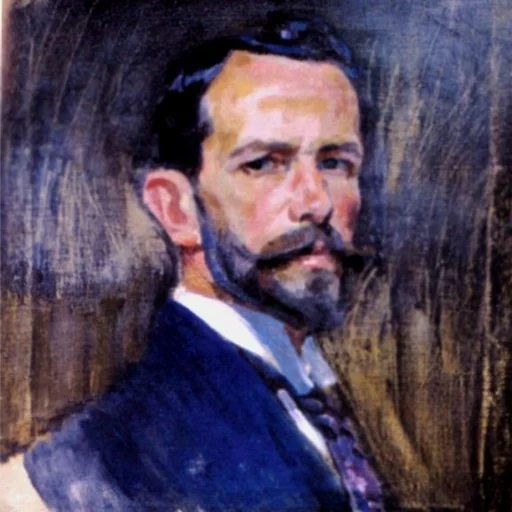
Oleksandr Murashko was a Russian Post-Impressionism artist. 10 works are cataloged here, principally at National Art Museum of Ukraine. Oleksandr Murashko was born in Kyiv.
Oleksandr Oleksandrovych Murashko (Ukrainian: Олександр Олександрович Мурашко; September 7 1875 – June 14, 1919) was a prominent Ukrainian artist, widely known for his unusually expressive paintings.
Overview
Oleksandr Oleksandrovych Murashko (Ukrainian: Олександр Олександрович Мурашко; September 7 [O.S. August 26] 1875 – June 14, 1919) was a prominent Ukrainian artist, widely known for his unusually expressive paintings.
Life and career
Murashko was born in Kyiv. His stepfather, Oleksandr Ivanovych Murashko, had an icon-painting workshop and worked on the interior of St Volodymyr's Cathedral. The future painter's uncle Mykola Murashko was the founder of Kyiv Painting School, which produced a number of notable painters including Mykhailo Zhuk, Ivan Yizhakevych, Petro Kholodnyi, Valentin Serov, Kazimir Malevich and Vassili Kandinsky. In 1894, with recommendations from several prominent artists, he entered the Imperial Academy of Arts in St Petersburg. In 1896, he became a student of Ilya Repin; he is one of those depicted in Yelena Makovskaya-Luksch's group portrait, Repin's Students. In 1901, he travelled abroad, visiting Germany, where he studied with Anton Ažbe in Munich, Italy, and France, where he was greatly influenced. Murashko became a successful artist; he has been called "the most important Ukrainian artist of the turn of the century". His painting Carousel won the gold medal at the Munich Exposition in 1909, and he exhibited in Venice, Rome, Amsterdam, Berlin, Cologne, and Düsseldorf. From 1909 to 1912, Murashko taught at the Kyiv Art School. In 1913, he opened his own studio in the Ginsburg skyscraper, where many young Jewish artists were trained, including Mark Epstein. He had a great influence on Kazimir Malevich.
He was a patriotic Ukrainian, one of the adherents of the "Young Muse" movement which was started in 1906 by Modernists who drew on developments elsewhere in Europe to make Ukrainian art more progressive. He founded the Association of Kyiv Artists in 1916 and the following year co-founded the Ukrainian State Academy of Arts. In 1909, Murashko married Marguerite Kruger, a notary's daughter. In 1910, after his father's death, he bought a small house in the Kyiv suburb of Lukyanivka. He was taken away from the house, apparently by a street gang, and shot from behind on June 14, 1919. His funeral was well attended and he was buried in the Lukyanivsky Cemetery.
Works
Originally a realist in the style of the Peredvizhniki, Murashko later painted in a "refined", Impressionist style influenced by his time in Munich and Paris. His Modernism in turn influenced later Ukrainian artists in the Socialist Realist period. His works are less often narrative and unusually expressive for Ukrainian paintings of the time.
Selected list of paintings
Portrait of Nikolai Petrov, 1897–98 Portrait of Helen Murashko, 1898–99 Portrait of Olga Nesterov, 1900 The Funeral of the Chieftain, 1900 Parisian. At the Cafe, 1902–03 Girl in a Red Hat, 1902–03 A Girl with a Dog. Portrait of T. Yazevoyi, 1903–04 Portrait of Professor Adrian Prahova, 1904 Winter, 1905 At the Embroidery Frame. Portrait of Helena Prahova, 1905 Carousel, 1906 In the Stern. Portrait of George Murashko, 1906 Sunspots. Portrait of George Murashko, 1908 Portrait of Marguerite Murashko, 1909 The Annunciation, 1909 Portrait of Ludmilla Kuksin, 1910 Portrait of Vera Dytyatinoyi, 1910 Portrait of Vera Yepanchin, 1910 By the Pond. Portrait of Marguerite Murashko, 1913 Peasant Family, 1914 Washerwoman, 1914 Portrait of an Old Woman, 1916 Woman with Flowers, 1918 Self Portrait, 1918
Collections represented

Artists in a similar vein
Artist