Artwork
Vejby with the Church seen from the North. Evening Light. Zealand
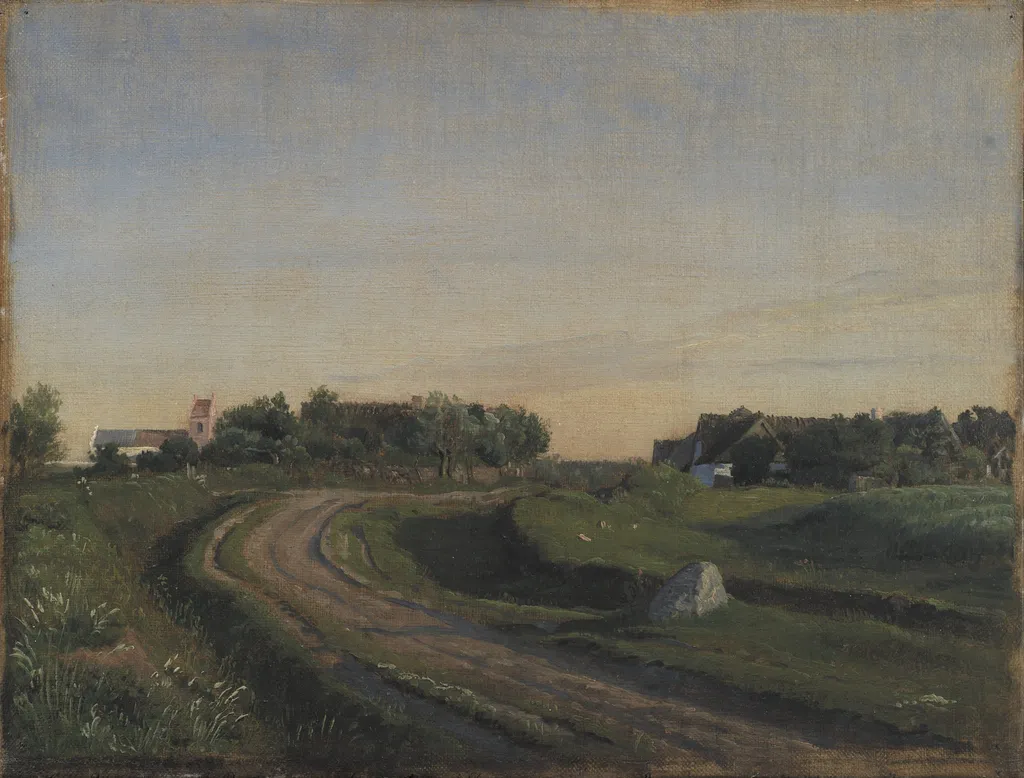
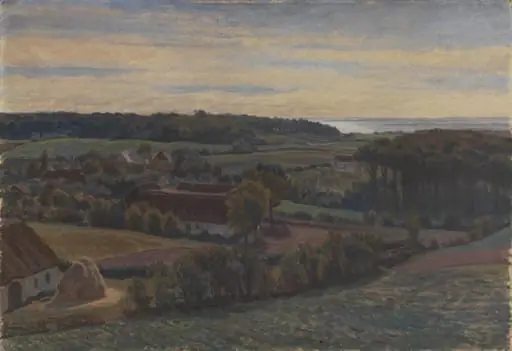
Vejby with the Church seen from the North. Evening Light. Zealand is a photography by the Romanticist artist Unknown. It dates from 1843 and is held in the collection of the Statens Museum for Kunst. Painted in 1843, this landscape depicts the Danish village of Vejby on the island of Zealand, viewed from the north at twilight.
About this work
Overview
The scene captures a quiet rural moment, with a narrow path winding through open fields toward a modest church and clustered dwellings.
Painted in 1843, this landscape depicts the Danish village of Vejby on the island of Zealand, viewed from the north at twilight. The scene captures a quiet rural moment, with a narrow path winding through open fields toward a modest church and clustered dwellings. The work is held in the collection of the Museum of Ethnography, though its thematic focus aligns more closely with 19th-century Danish landscape traditions than ethnographic study.
Subject & Meaning
The painting presents a serene, unpopulated countryside at day’s end, emphasizing stillness and the passage of time. The church, positioned at the horizon, serves as a quiet anchor amid the landscape, suggesting spiritual or communal continuity. No human figures appear, reinforcing a contemplative mood, where nature and architecture coexist without disruption.
Technique & Style
The artist employed soft, blended brushwork to render the fading evening light, with muted tones of green, gold, and pale blue dominating the palette. The church’s red roof provides a subtle contrast against the surrounding foliage, drawing the eye without disrupting the harmony. Light is rendered diffusely, suggesting the gentle transition from day to night through atmospheric gradation rather than sharp detail.
History & Provenance
Created in 1843, the painting entered the Museum of Ethnography’s collection, though its subject matter is not ethnographic in nature. Its acquisition likely reflects broader 19th-century institutional interests in documenting regional Danish life. No record of prior ownership or exhibition history is widely documented, suggesting it remained within local or private circles before institutional acquisition.
Context
This work emerged during a period when Danish artists increasingly turned to domestic landscapes as subjects of quiet reverence. Influenced by Romantic ideals, painters sought to evoke emotional resonance through natural light and rural scenes. Vejby’s depiction aligns with a national trend of valuing the ordinary countryside as worthy of artistic attention, distinct from grand historical or mythological themes.
Legacy
Though not widely exhibited or reproduced, the painting contributes to a body of Danish landscape art that emphasized tranquility and local identity. It reflects a shift in artistic focus from idealized scenery to intimate, observed moments in the Danish countryside. Its preservation in a museum with ethnographic aims underscores the blurred boundaries between cultural documentation and aesthetic practice in the 19th century.
Artist & collection

 Domestic Scene
 Giacomo and Cardinal Marco, investing Andrea, Abbot of San Zeno, with his Benefice
 The Nymph of Fontainebleau
 Portrait of a Woman
 Madonna and Child with Saints in the Enclosed Garden
 Venus and Minerva
 Family Group of Four on Sofa
 Wall painting from Room H of the Villa of P. Fannius Synistor at Boscoreale
 A Croft at Lodskov near Vognserup Manor. Study
 A Croft at Lodskov near Vognserup Manor. Study
 Landscape with a Cottage beside a Pond
 Landscape with a Cottage beside a Pond
 A Croft at Lodskov near Vognserup Manor, Zealand
 The Road Leading past "Store Godthaab", a Country House near Copenhagen
 Praderas (Villerville)
 Autumn Landscape