Artwork
A Farm on Fire
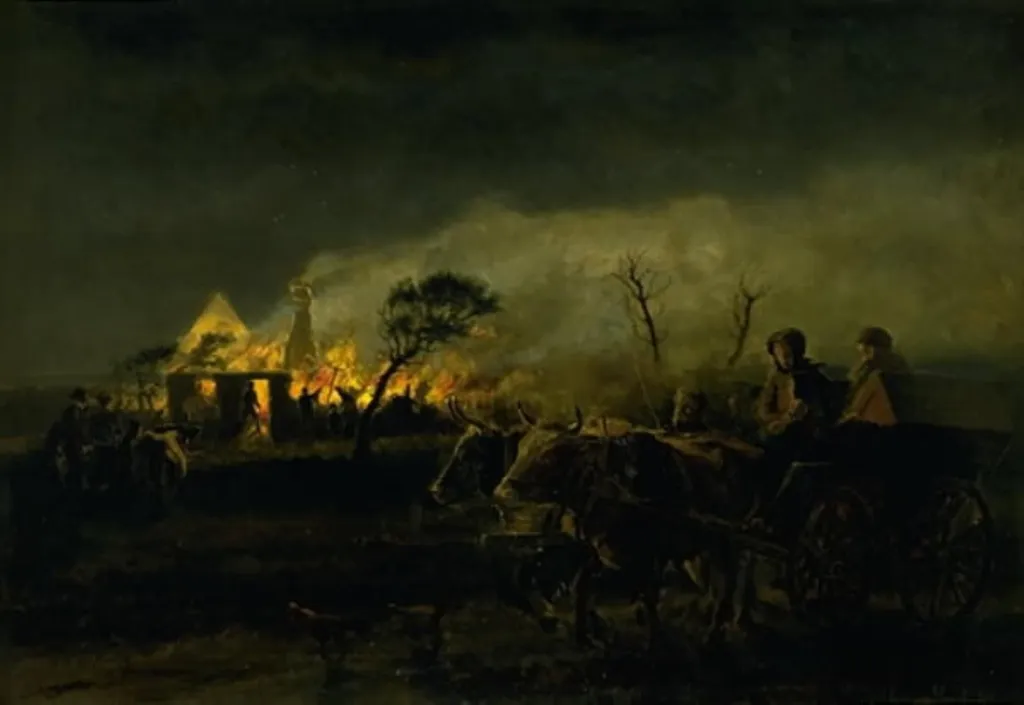
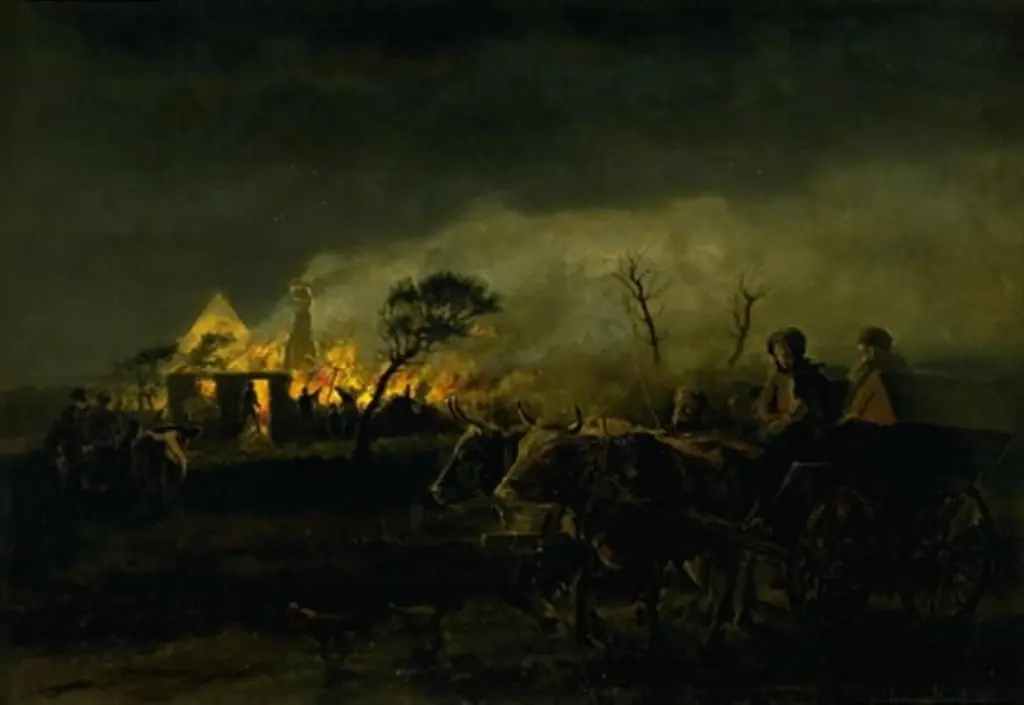
A Farm on Fire is a photography by Unknown. It dates from 1850 and is held in the collection of the Statens Museum for Kunst. Created around 1850 by 1010_person, this painting depicts a rural homestead engulfed in flames under a night sky.
About this work
Overview
Created around 1850 by 1010_person, this painting depicts a rural homestead engulfed in flames under a night sky. The scene is held in the Museum of Ethnography and is rendered in a style that emphasizes emotional tension through dramatic lighting. The composition centers on the burning structure, with minimal figures and a subdued landscape reinforcing isolation and urgency.
Subject & Meaning
The painting portrays a moment of sudden disaster: a farmhouse ablaze while two individuals observe from a wagon laden with livestock. Their stillness contrasts with the chaos behind them, suggesting helplessness or resignation. The absence of other figures or signs of rescue implies a private tragedy, possibly reflecting broader anxieties about rural vulnerability in the mid-nineteenth century.
Technique & Style
The artist employs chiaroscuro to heighten emotional impact, using stark contrasts between the fiery glow and deep shadows. Warm hues of orange and yellow dominate the center, while the surrounding terrain recedes into near-black tones. Brushwork is restrained, favoring atmospheric effect over detail, directing focus to the interplay of light and darkness rather than narrative precision.
History & Provenance
The work entered the Museum of Ethnography’s collection in the late nineteenth century, though its earlier ownership remains undocumented.
The work entered the Museum of Ethnography’s collection in the late nineteenth century, though its earlier ownership remains undocumented. Its attribution to 1010_person is based on stylistic analysis and archival references, as no signed or dated versions are known. The painting’s origins in a rural context suggest it may have been commissioned or created locally before entering institutional care.
Context
In the mid-1800s, rural fires were common due to wooden construction, open hearths, and limited firefighting infrastructure. This image may reflect everyday fears in agrarian communities, where loss of a homestead meant economic and social collapse. The painting’s quiet tone aligns with regional visual traditions that favored understated realism over melodrama.
Legacy
Though not widely exhibited, the painting remains a quiet example of 19th-century vernacular art that captures domestic peril through minimal means. Its preservation in an ethnographic context underscores its value as a cultural artifact rather than a fine art novelty, offering insight into how ordinary people perceived and responded to disaster in their daily lives.
Artist & collection

 Domestic Scene
 Giacomo and Cardinal Marco, investing Andrea, Abbot of San Zeno, with his Benefice
 The Nymph of Fontainebleau
 Portrait of a Woman
 Madonna and Child with Saints in the Enclosed Garden
 Venus and Minerva
 Family Group of Four on Sofa
 Wall painting from Room H of the Villa of P. Fannius Synistor at Boscoreale