Artwork
Marketplace at Haarlem, Looking towards the Town Hall
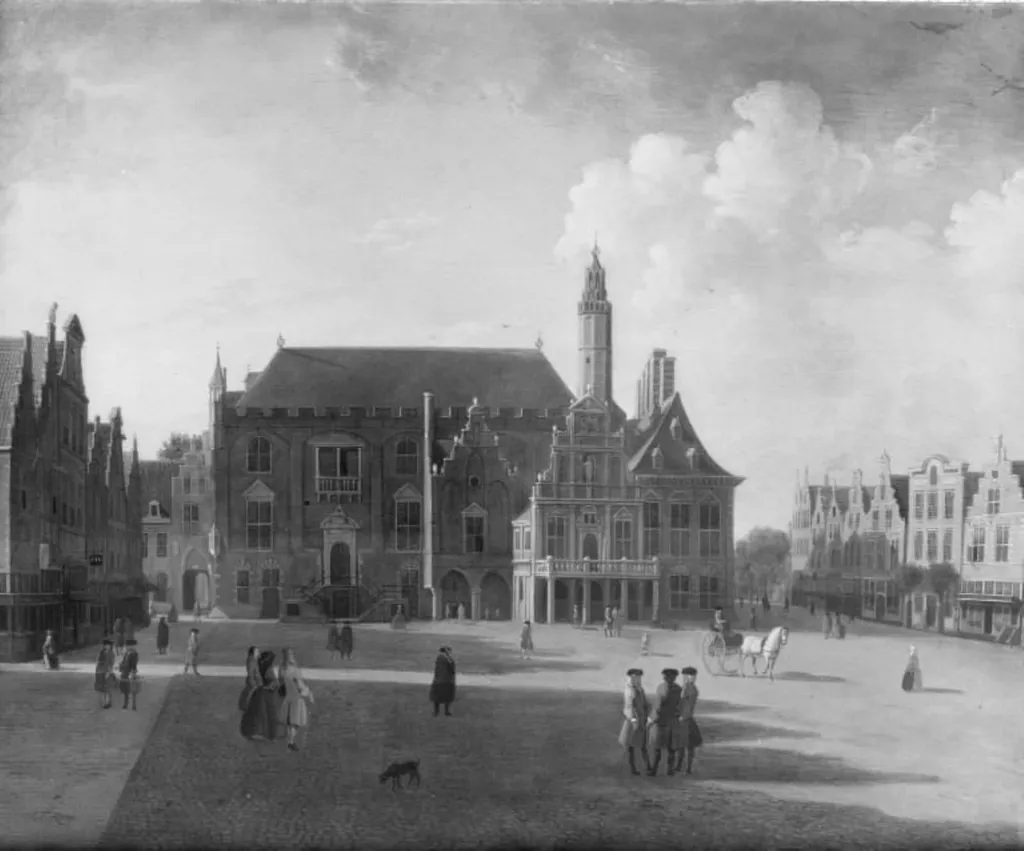
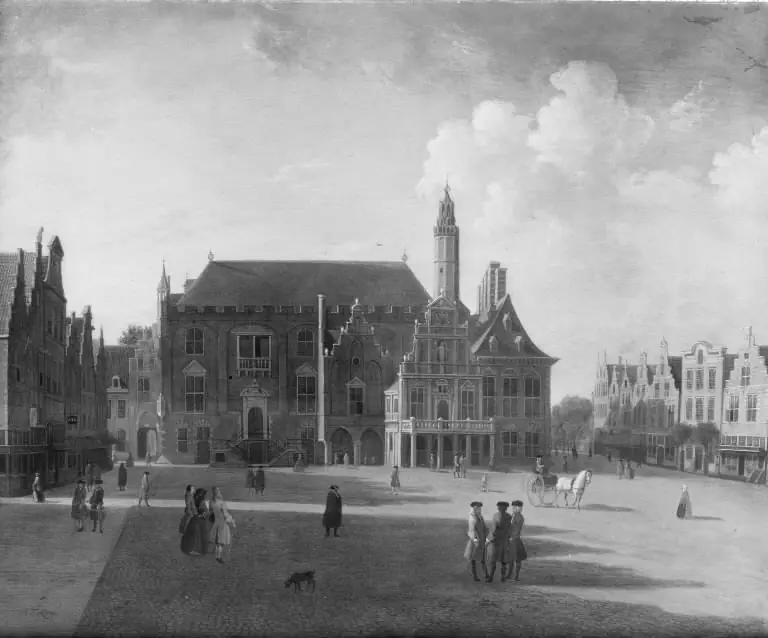
Marketplace at Haarlem, Looking towards the Town Hall is a photography by Unknown. It dates from 1750 and is held in the collection of the Statens Museum for Kunst. This black-and-white image depicts a quiet urban square in Haarlem, capturing daily life in the mid-18th century.
About this work
Overview
The composition centers on a prominent civic building with a clock tower, flanked by modest structures and figures engaged in routine activities.
This black-and-white image depicts a quiet urban square in Haarlem, capturing daily life in the mid-18th century. The composition centers on a prominent civic building with a clock tower, flanked by modest structures and figures engaged in routine activities. A horse-drawn carriage passes through the scene, while a dog moves independently near pedestrians. The absence of color and the emphasis on light and shadow suggest a focus on form and atmosphere rather than spectacle.
Subject & Meaning
The scene presents an unidealized view of public life in a Dutch town, emphasizing ordinary moments over dramatic events. The presence of townspeople, a carriage, and a stray dog conveys a sense of quiet continuity. The town hall, as the dominant architectural feature, implies civic order and communal identity. The image does not romanticize the setting but instead records its rhythm, suggesting value in the mundane fabric of urban existence.
Technique & Style
The artist employs chiaroscuro to define architectural forms and spatial depth, using subtle gradations of gray to model surfaces and suggest natural light. Details in brickwork, window frames, and clothing are rendered with precision, indicating close observation. The composition is balanced and restrained, avoiding theatricality. The monochrome palette enhances the sense of timelessness and reinforces the documentary character of the scene.
History & Provenance
The work is attributed to an artist active around 1750, though the creator’s identity remains unconfirmed. It entered the collection of the Museum of Ethnography, where it is preserved as a record of 18th-century urban life. Its classification as an image rather than a painting suggests it may have originated as a print, drawing, or early photographic study. The museum’s acquisition reflects an interest in ethnographic documentation of everyday environments.
Context
In mid-18th century Haarlem, public markets and town squares were centers of commerce and social interaction. While many artists of the period focused on grand historical or religious themes, this image aligns with a growing trend toward depicting ordinary civic spaces with observational accuracy. The calm, uneventful tone reflects broader cultural shifts toward valuing realism and quiet domesticity in urban settings.
Legacy
This image contributes to a body of 18th-century visual records that prioritize authenticity over idealization. Its preservation in an ethnographic collection underscores its value as a historical document rather than a work of fine art. It offers insight into how ordinary spaces were perceived and recorded before the advent of photography, serving as a quiet precursor to later documentary traditions in visual culture.
Artist & collection

 Domestic Scene
 Giacomo and Cardinal Marco, investing Andrea, Abbot of San Zeno, with his Benefice
 The Nymph of Fontainebleau
 Portrait of a Woman
 Madonna and Child with Saints in the Enclosed Garden
 Venus and Minerva
 Family Group of Four on Sofa
 Wall painting from Room H of the Villa of P. Fannius Synistor at Boscoreale