Artwork
The Scene-Painter Troels Lund
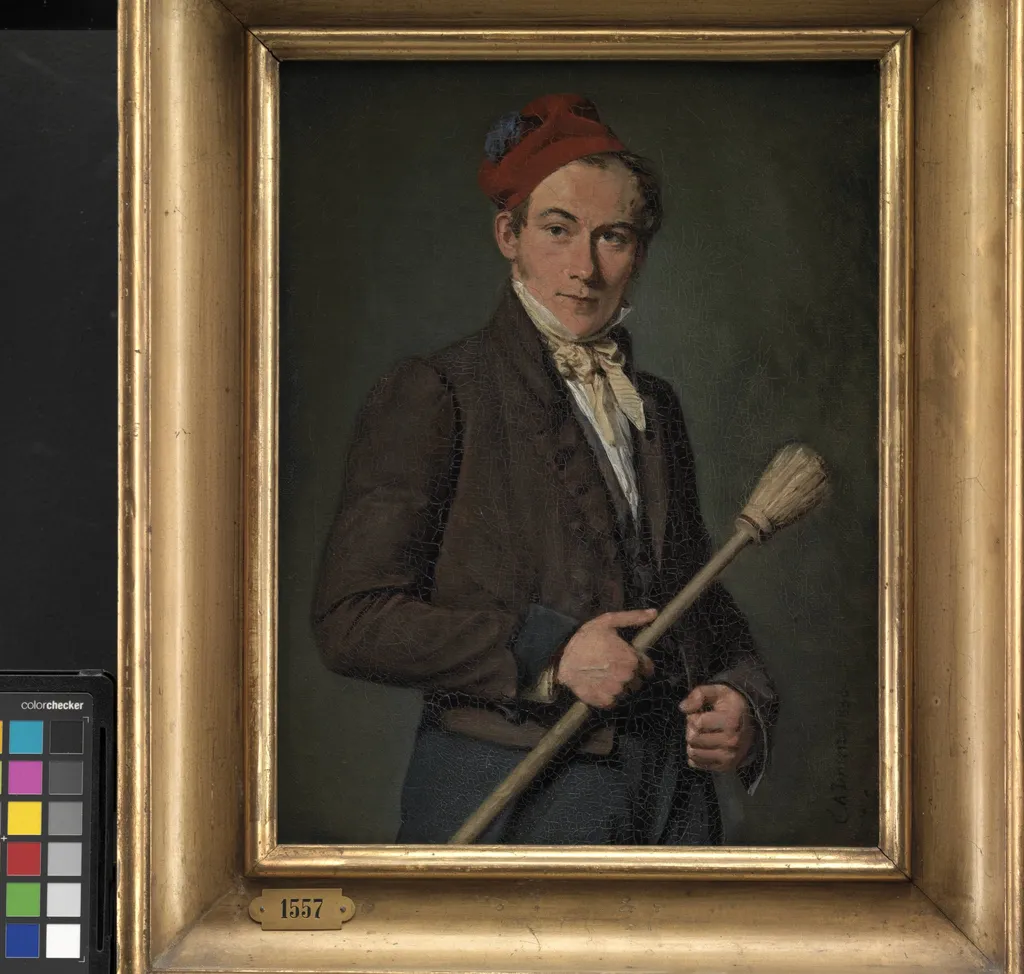
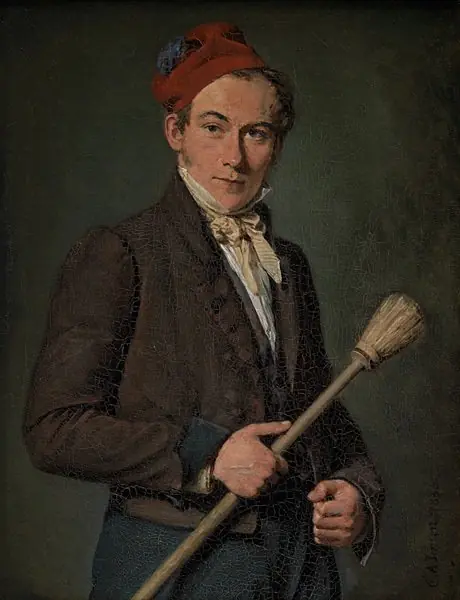
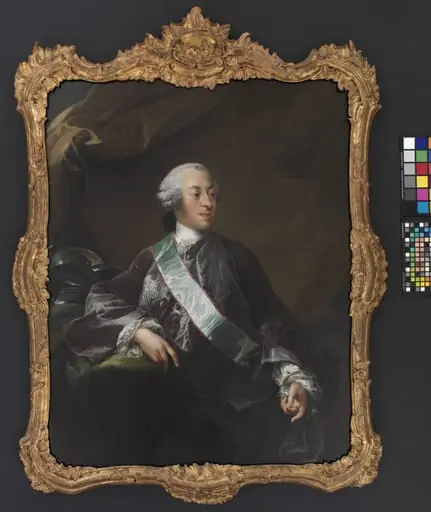
The Scene-Painter Troels Lund is a photography by the Romanticist artist Unknown. It dates from 1836 and is held in the collection of the Statens Museum for Kunst. Painted in 1836, this portrait depicts Troels Lund, a scene-painter by profession.
About this work
Overview
Painted in 1836, this portrait depicts Troels Lund, a scene-painter by profession. The work is attributed to an artist whose name is recorded as 231_person, though further biographical details about the painter remain limited. It is currently housed in the Museum of Ethnography, where it serves as a record of a skilled artisan within the theatrical arts of early 19th-century Denmark.
Subject & Meaning
Troels Lund is portrayed in the act of his trade, holding a long brush as if mid-task. His serious expression and focused gaze convey the gravity of his craft. The attire—dark coat, white cravat, and red hat—suggests both professional dignity and the modest status of a stage technician. The image does not idealize but rather observes, honoring the quiet labor behind theatrical spectacle.
Technique & Style
The painting employs chiaroscuro to model the face with strong contrasts between light and shadow, drawing attention to Lund’s features. The dark, unbroken background isolates the figure, enhancing the three-dimensionality of his form. Brushwork is restrained, favoring tonal precision over decorative detail, aligning with the sober realism common in Danish portraiture of the period.
History & Provenance
No significant changes in ownership or restoration are documented, and it has remained in the museum’s care since the 19th century.
The painting entered the collection of the Museum of Ethnography shortly after its creation, likely acquired as part of a broader effort to document Danish trades and cultural practices. Its preservation suggests early recognition of the cultural value of artisanal labor. No significant changes in ownership or restoration are documented, and it has remained in the museum’s care since the 19th century.
Context
In the 1830s, Denmark saw growing interest in documenting everyday professions, especially those tied to the arts. Scene-painters like Lund were essential to theater but rarely celebrated in public memory. This portrait reflects a shift toward recognizing such figures not merely as craftsmen, but as contributors to national cultural life.
Legacy
The portrait endures as a quiet testament to the unseen labor underpinning theatrical performance. While not widely exhibited, it remains a key example of how 19th-century Danish art began to elevate ordinary workers into subjects worthy of formal representation. Its presence in an ethnographic museum underscores its role as a cultural artifact beyond mere likeness.
Artist & collection

 Domestic Scene
 Giacomo and Cardinal Marco, investing Andrea, Abbot of San Zeno, with his Benefice
 The Nymph of Fontainebleau
 Portrait of a Woman
 Madonna and Child with Saints in the Enclosed Garden
 Venus and Minerva
 Family Group of Four on Sofa
 Wall painting from Room H of the Villa of P. Fannius Synistor at Boscoreale
 Gottlieb Bindesbøll, Danish Architect
 Twm o'r Nant
 Portrait of Johanne Pløyen, née Bachmann
 A Painter in his Studio. The Artist Himself (?)
 Jacob Sandberg, lasimestari
 Ole Jørgen Rawert, Director of Industrial Affairs
 Portrait of the Artist´s Mother, Cecilia Margrethe Købke, née Petersen
 Self-portrait
 Sketch for The Knight with the Falcon, known as "The Crusader"
 The Miser
 The Scene-Painter Troels Lund
 Mogens Scheel von Plessen of Fussingø and Selsø