Artwork
The Life Class at the Royal Academy of Fine Arts
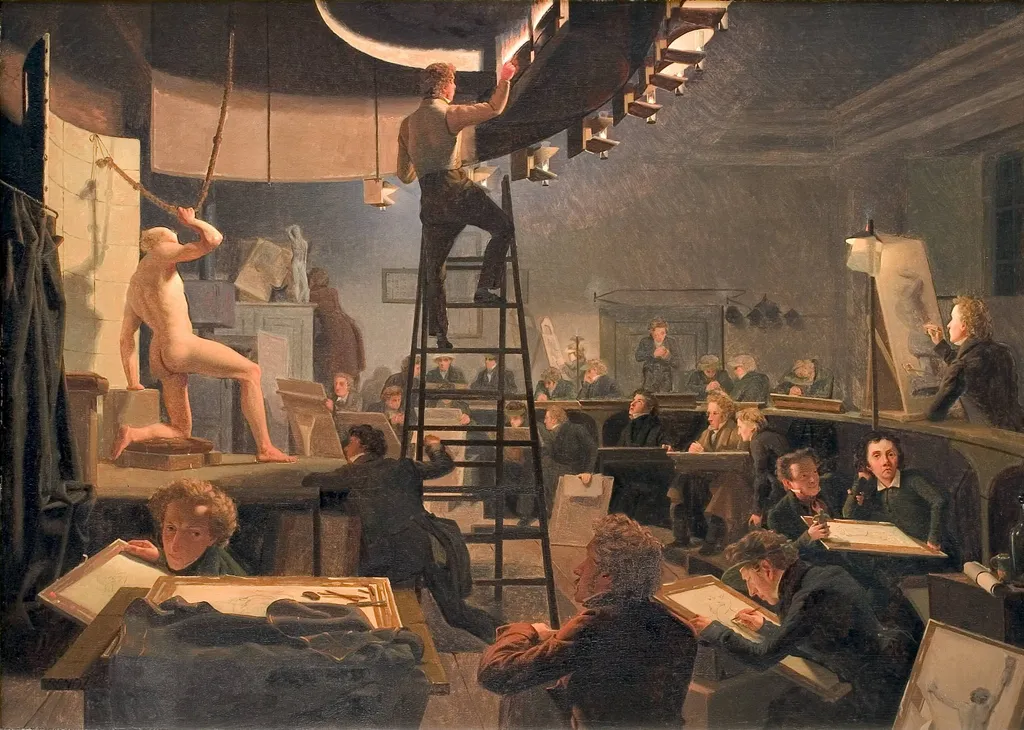
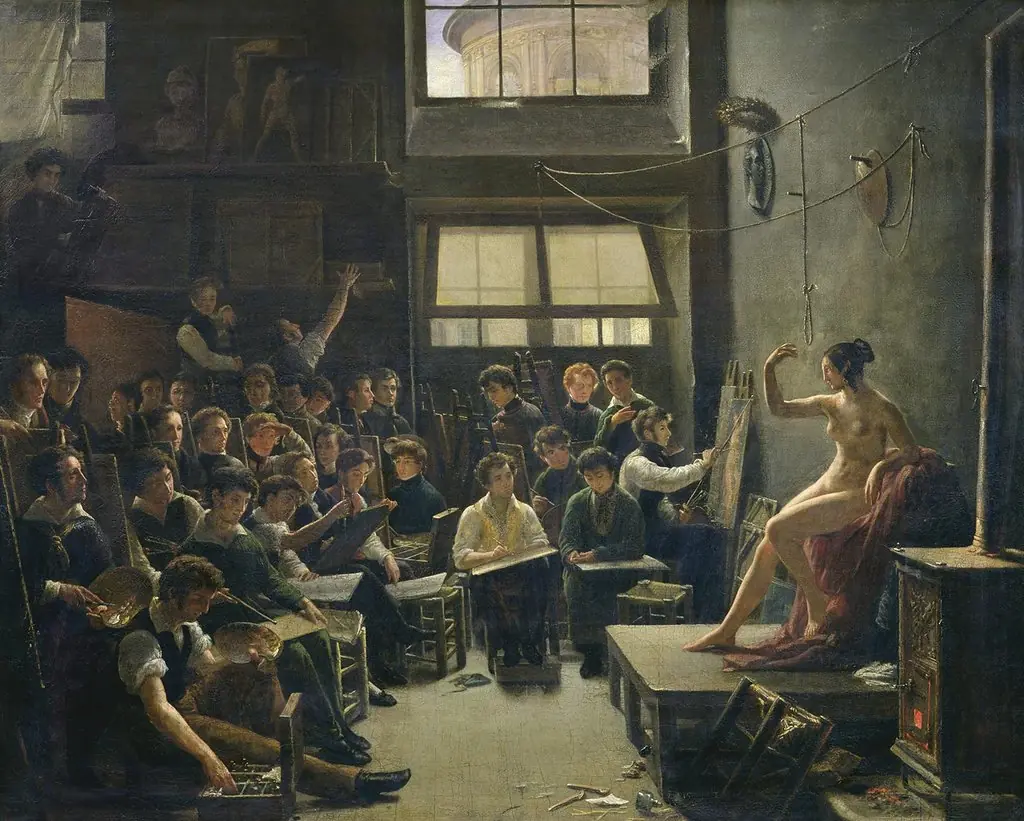
The Life Class at the Royal Academy of Fine Arts is a photography by the Romanticist artist Unknown. It dates from 1826 and is held in the collection of the Statens Museum for Kunst. Painted in 1826, this work depicts a life drawing session at the Royal Academy of Fine Arts.
About this work
Overview
The scene captures a group of students and instructors engaged in the disciplined practice of sketching a nude model.
Painted in 1826, this work depicts a life drawing session at the Royal Academy of Fine Arts. The scene captures a group of students and instructors engaged in the disciplined practice of sketching a nude model. The composition emphasizes the quiet intensity of observation, with figures arranged around a central platform. Tools, papers, and furniture clutter the space, reinforcing the routine nature of academic training in art.
Subject & Meaning
The painting centers on the act of studying the human form as a foundational element of artistic education. The model’s neutral pose invites focused attention on anatomy, proportion, and structure. Rather than dramatizing the figure, the artist highlights the collective effort of learners, suggesting that mastery arises through sustained, methodical practice rather than individual genius.
Technique & Style
Soft, diffused lighting creates subtle gradations of shadow and tone, enhancing the three-dimensionality of the model and surrounding objects. The brushwork is restrained, favoring clarity over flourish. The arrangement of figures and objects conveys spatial depth without theatrical perspective, aligning with the Academy’s emphasis on observational accuracy over dramatic effect.
History & Provenance
Created in 1826, the painting was likely made by a student or instructor affiliated with the Royal Academy. It entered the collection of the Museum of Ethnography at some point after its completion, possibly as part of a broader effort to document artistic pedagogy. Its presence in an ethnographic context suggests an interest in cultural practices of learning and discipline.
Context
In early 19th-century Europe, life drawing was a cornerstone of formal art training, particularly at institutions like the Royal Academy. The presence of a ladder and draped cloth indicates efforts to control natural light, a common practice in studios before electric illumination. The scene reflects the institutionalization of artistic education and the rigid protocols surrounding the study of the nude.
Legacy
The painting preserves a moment in the evolution of art education, documenting how generations of artists learned to see and render the human body. Its quiet realism contrasts with more romanticized depictions of artistic life, offering instead a grounded record of discipline, repetition, and shared purpose within the academy system.
Artist & collection

 Domestic Scene
 Giacomo and Cardinal Marco, investing Andrea, Abbot of San Zeno, with his Benefice
 The Nymph of Fontainebleau
 Portrait of a Woman
 Madonna and Child with Saints in the Enclosed Garden
 Venus and Minerva
 Family Group of Four on Sofa
 Wall painting from Room H of the Villa of P. Fannius Synistor at Boscoreale