Artwork
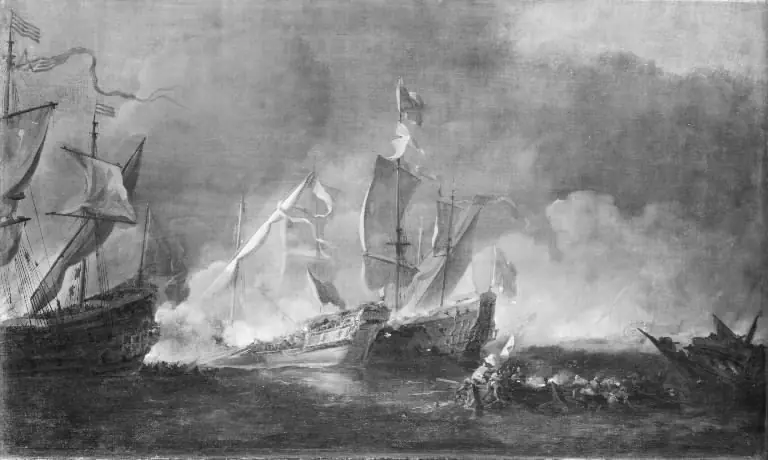
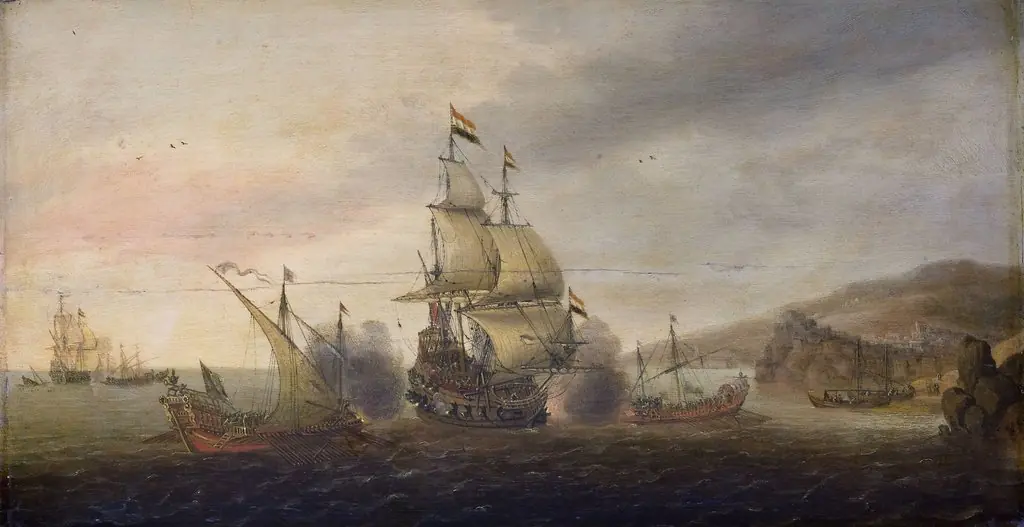
A Turkish Galley in an Encounter with two British Warships
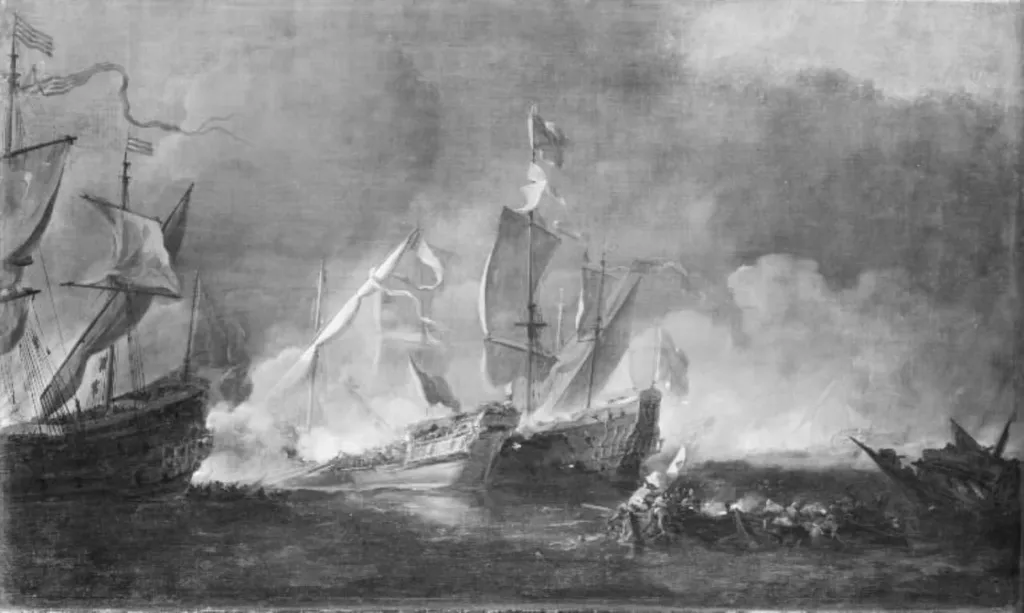
A Turkish Galley in an Encounter with two British Warships is a photography by Unknown. It dates from 1650 and is held in the collection of the Statens Museum for Kunst. This black-and-white image depicts a naval confrontation off the Mediterranean coast, likely from the mid-17th century.
About this work
Overview
The scene captures the violence of maritime conflict during a period of shifting naval power, rendered with dynamic movement and dense atmospheric detail.
This black-and-white image depicts a naval confrontation off the Mediterranean coast, likely from the mid-17th century. It portrays a Turkish galley under attack by two larger British warships. The scene captures the violence of maritime conflict during a period of shifting naval power, rendered with dynamic movement and dense atmospheric detail. The composition emphasizes imbalance in scale and firepower between the vessels.
Subject & Meaning
The image illustrates a moment of military engagement between Ottoman and English forces, reflecting broader tensions in Mediterranean trade and sovereignty. The galley, a traditional oared vessel, is overwhelmed by the sail-powered, cannon-armed British ships, symbolizing technological and tactical shifts in naval warfare. Figures in disarray suggest the human cost of such encounters, grounding the scene in visceral reality rather than heroic narrative.
Technique & Style
The artist uses stark contrasts of light and shadow to heighten the drama of smoke, spray, and flame. Loose, energetic lines convey motion—cannon smoke billows, water churns, and bodies tumble—while minimal detail on faces focuses attention on the chaos of the moment. The absence of color intensifies the sense of urgency and destruction, relying on tonal variation to structure the composition and guide the viewer’s eye through the turmoil.
History & Provenance
Created around 1650, the image likely originated as a documentary sketch or preparatory study, possibly by a sailor, artist, or military observer present at the event. It entered the collection of the Museum of Ethnography, where it is preserved as a record of cross-cultural naval conflict. Its survival suggests it was valued for its observational accuracy rather than artistic finish.
Context
In the mid-17th century, English naval expansion frequently brought it into contact with Ottoman vessels in the eastern Mediterranean. Trade routes, privateering, and territorial disputes fueled sporadic violence. This image reflects a time when galleys, though increasingly obsolete, still operated alongside emerging ship-of-the-line designs, capturing a transitional phase in maritime military history.
Legacy
Though not widely exhibited, the image remains a rare visual document of a specific type of naval encounter between European and Ottoman powers. It contributes to historical understanding of how non-official observers recorded wartime events, offering a raw, unidealized perspective distinct from formal battle paintings. Its preservation underscores the value placed on eyewitness accounts in early modern maritime archives.
Artist & collection

 Domestic Scene
 Giacomo and Cardinal Marco, investing Andrea, Abbot of San Zeno, with his Benefice
 The Nymph of Fontainebleau
 Portrait of a Woman
 Madonna and Child with Saints in the Enclosed Garden
 Venus and Minerva
 Family Group of Four on Sofa
 Wall painting from Room H of the Villa of P. Fannius Synistor at Boscoreale
 A Turkish Galley in an Encounter with two British Warships
 The Encounter of the Dutch and the English Fleet during the Voyage of the Dutch Flotilla to Boulogne, 1805
 Sea battle between English and Dutch ships
 Naval battle between Dutch men-of-war and Spanish galleys
 English Ships of War
 Fight between two Ships on Rough Sea