Artwork
Lilium candidum (madonna-lilje)
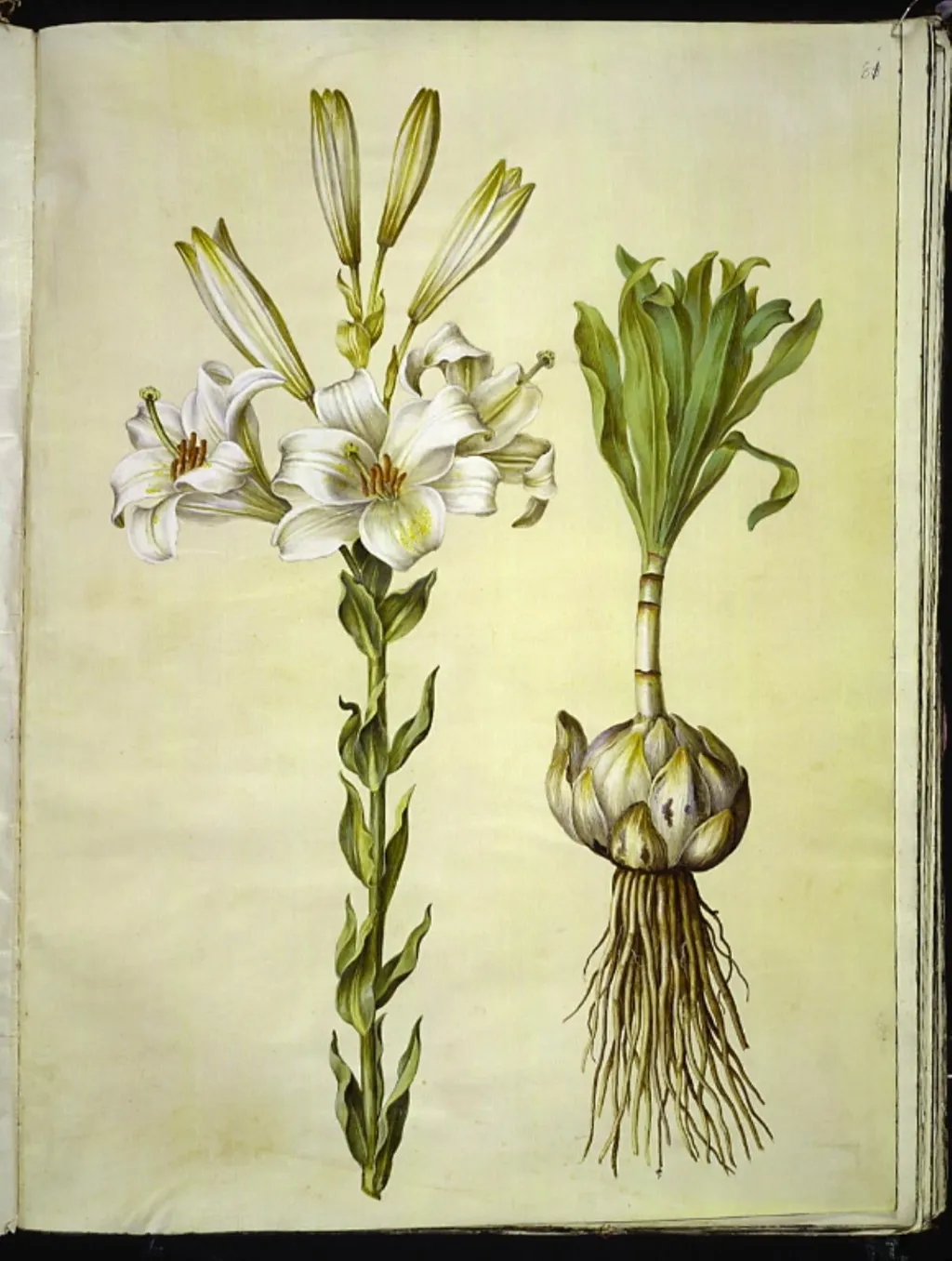
Lilium candidum (madonna-lilje) is an unspecified work on paper by Unknown. It dates from 1654 and is held in the collection of the Statens Museum for Kunst.
About this work
Overview
This work, dated around 1654, depicts two botanical specimens in precise detail: a blooming white lily and a bulb with emerging roots and leaves.
This work, dated around 1654, depicts two botanical specimens in precise detail: a blooming white lily and a bulb with emerging roots and leaves. Executed in watercolor, the painting emphasizes naturalistic observation rather than symbolic narrative. It is part of the collection at the Museum of Ethnography, where it is preserved as an example of early scientific illustration within a religious artistic context.
Subject & Meaning
The white lily, traditionally associated with purity in Christian iconography, is paired with its bulb, highlighting the plant’s life cycle. The inclusion of the bulb suggests an interest in botany beyond symbolism, possibly reflecting the era’s growing curiosity in plant physiology. Though framed within a religious visual tradition, the focus on biological structure implies a shift toward empirical study.
Technique & Style
Rendered in watercolor, the painting uses translucent layers to capture the delicate texture of petals and the subtle gradations of green in the leaves. Fine brushwork defines individual root fibers and vein patterns, demonstrating a methodical approach to botanical accuracy. The absence of background or narrative elements directs attention solely to the physical form of the plants.
History & Provenance
The painting is attributed to an artist identified as 35199_person, though little is known about their background. It entered the Museum of Ethnography’s collection in the early 20th century, likely as part of a broader acquisition of religious and ethnographic artifacts. Its origin and commission remain undocumented, but its precision suggests it may have been created for educational or devotional use.
Context
Created during a period when natural history illustration flourished in Europe, the work aligns with contemporary efforts to document flora with scientific rigor. While religious imagery remained dominant, artists increasingly integrated observational detail into devotional subjects. This piece reflects the intersection of faith, curiosity, and emerging botanical science in 17th-century visual culture.
Legacy
The painting stands as a quiet example of how religious art absorbed the values of empirical observation. It contributes to a broader understanding of how botanical accuracy became a visual language in both sacred and scientific contexts. Its preservation in an ethnographic museum underscores its role as a cultural artifact bridging spiritual tradition and natural inquiry.
Artist & collection

 Domestic Scene
 Giacomo and Cardinal Marco, investing Andrea, Abbot of San Zeno, with his Benefice
 The Nymph of Fontainebleau
 Portrait of a Woman
 Madonna and Child with Saints in the Enclosed Garden
 Venus and Minerva
 Family Group of Four on Sofa
 Wall painting from Room H of the Villa of P. Fannius Synistor at Boscoreale
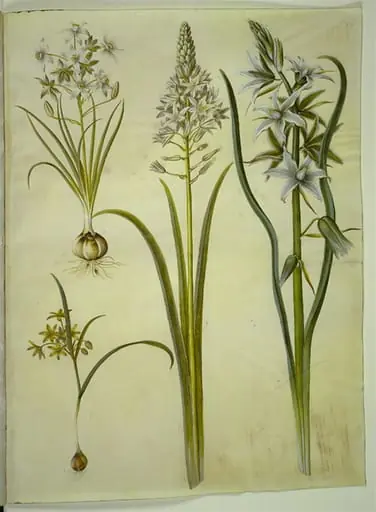 Ornithogalum umbellatum (kost-fuglemælk); Ornithogalum pyramidale (pyramide-fuglemælk); Gagea lutea (almindelig guldstjerne); Ornithogalum nutans (nikkende fuglemælk)
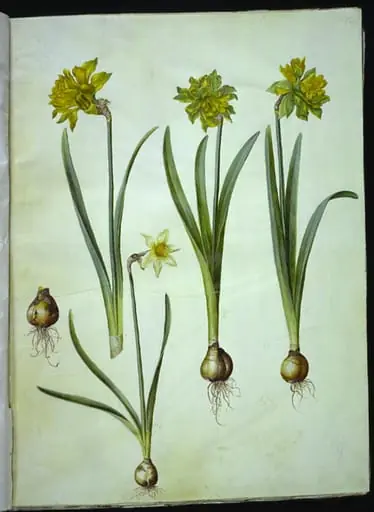 Narcissus pseudonarcissus; Narcissus ? ×incomparabilis (have-narcis)
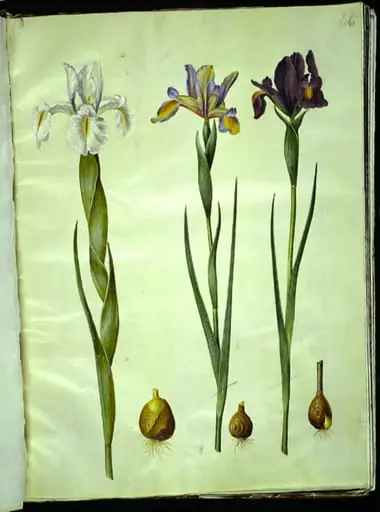 Iris latifolia (engelsk iris); Iris xiphium (spansk iris)
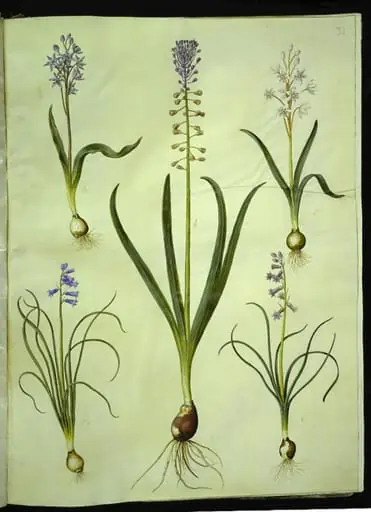 Scilla bifolia (tobladet skilla); Muscari comosum (duskhyacint); Brimeura amethystina (pyrenæisk hyacint)
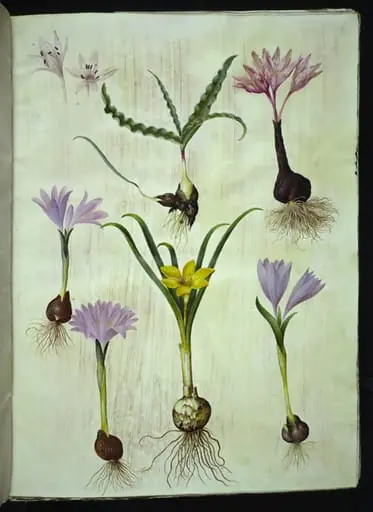 Colchicum variegatum (plettet tidløs); Bulbocodium vernum (vår-lysblomst); Sternbergia lutea (almindelig sternbergia)
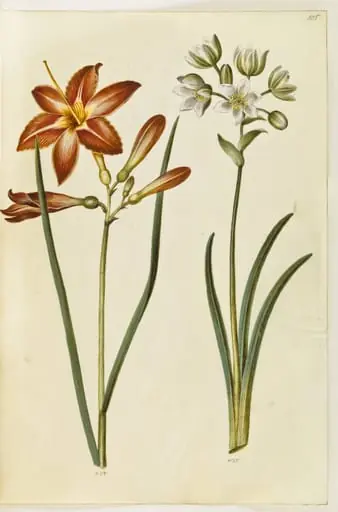 Hemerocallis fulva (brun daglilje); Ornithogalum arabicum (mælkestjerne)
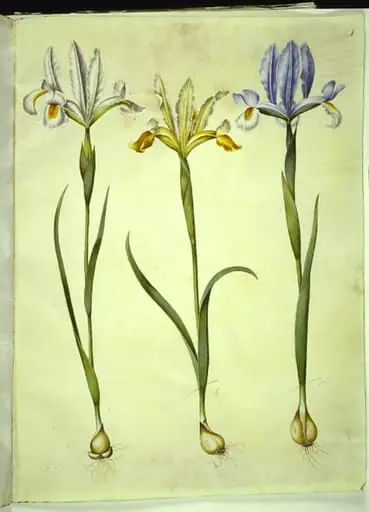 Iris xiphium (spansk iris) eller Iris latifolia (engelsk iris); Iris xiphium (spansk iris)
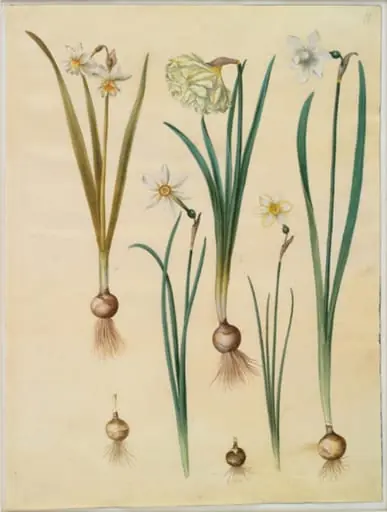 Narcissus ×medioluteus (toblomstret narcis); Narcissus pseudonarcissus; Narcissus (narcis); Narcissus poeticus (pinselilje); Narcissus ×tenuior