Artwork
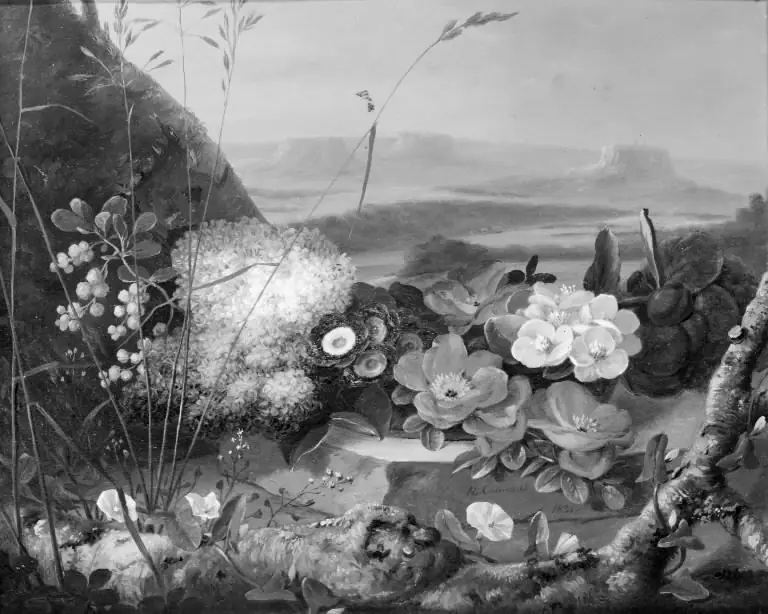
Blomster på en sten. I baggrunden et bjerglandskab
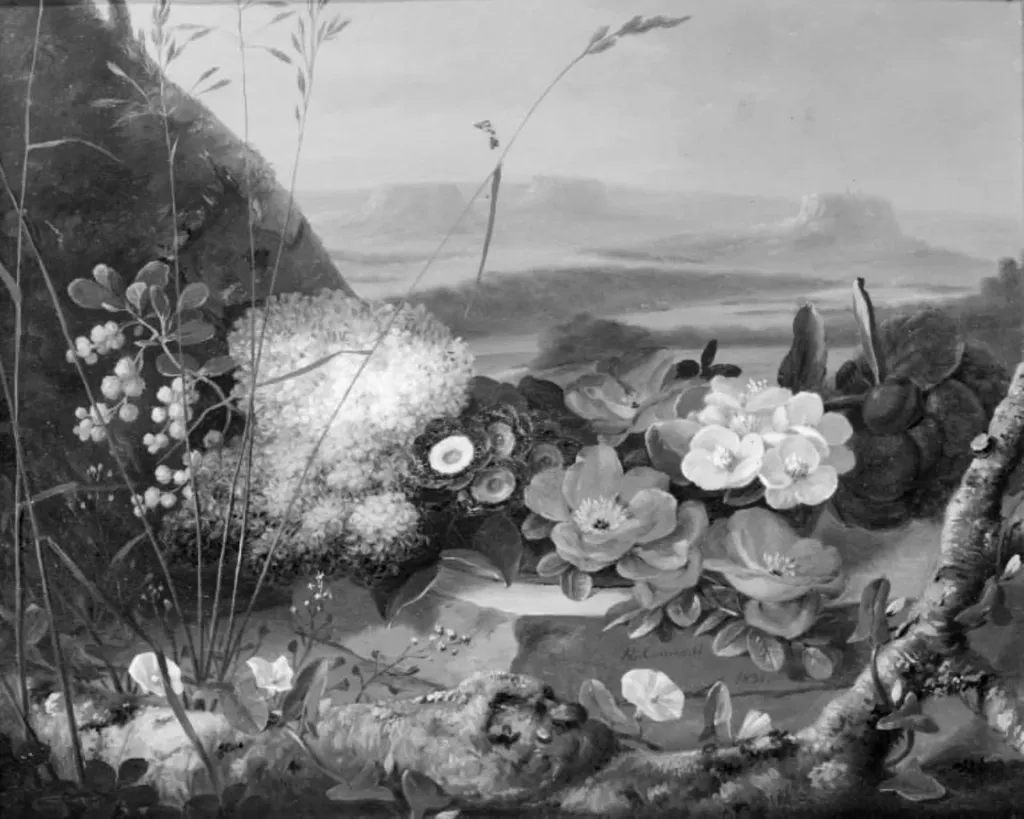
Blomster på en sten. I baggrunden et bjerglandskab is a photography by the Romanticist artist Unknown. It dates from 1831 and is held in the collection of the Statens Museum for Kunst.
About this work
Overview
Created in 1831 by 595_person, this image depicts a naturalistic scene of wildflowers growing on a stone, set against a distant mountain range.
Created in 1831 by 595_person, this image depicts a naturalistic scene of wildflowers growing on a stone, set against a distant mountain range. The work is part of the Museum of Ethnography’s collection and reflects a quiet, observational approach to landscape. Unlike idealized garden scenes, the composition embraces untamed vegetation and atmospheric depth, aligning with broader 19th-century interests in nature’s unmediated forms.
Subject & Meaning
The painting centers on a solitary rock adorned with blooming flowers, their forms rendered with close attention to detail. Smaller grasses and low plants fill the spaces between, suggesting ecological richness rather than ornamental arrangement. The looming, shadowed mountains in the background evoke isolation and the sublime, implying nature’s enduring presence beyond human intervention. The scene resists symbolism, instead offering a direct encounter with the wild.
Technique & Style
The artist employs precise, delicate brushwork to capture the texture of petals and foliage, lending the flowers a tactile realism. The background mountains are rendered in muted tones with loose, atmospheric strokes, creating spatial depth without sharp definition. Light falls naturally across the scene, enhancing the sense of immediacy. The style avoids theatricality, favoring quiet observation over dramatic effect.
History & Provenance
The work entered the Museum of Ethnography’s holdings at an early stage, likely through private acquisition or donation in the 19th century. Its origin as a standalone image, rather than part of a larger series, suggests it was valued for its intimate portrayal of nature. No records indicate public exhibition prior to its inclusion in the museum’s collection, where it has remained since.
Context
Produced during the height of Romanticism, the piece reflects a cultural shift toward valuing nature as a source of emotional and spiritual resonance. While many Romantic artists depicted grand vistas or dramatic storms, this work focuses on the modest and overlooked—wildflowers on a stone—offering a quieter, more personal interpretation of the movement’s ideals.
Legacy
Though not widely reproduced or studied, the image contributes to a lesser-known strand of Nordic Romanticism that emphasized quiet observation over spectacle. Its preservation in an ethnographic museum underscores its role as a document of natural detail rather than a celebrated artistic achievement. It remains a subtle example of how nature was perceived and recorded in early 19th-century visual culture.
Artist & collection

 Domestic Scene
 Giacomo and Cardinal Marco, investing Andrea, Abbot of San Zeno, with his Benefice
 The Nymph of Fontainebleau
 Portrait of a Woman
 Madonna and Child with Saints in the Enclosed Garden
 Venus and Minerva
 Family Group of Four on Sofa
 Wall painting from Room H of the Villa of P. Fannius Synistor at Boscoreale