Artwork
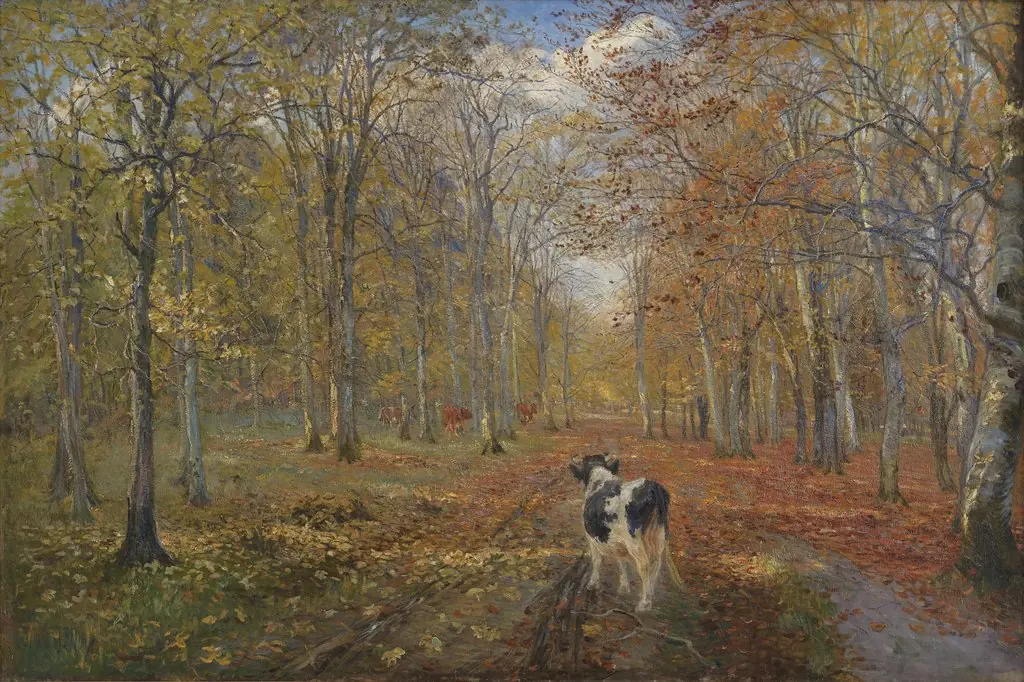
En vej i Dyrehaven. Efterår
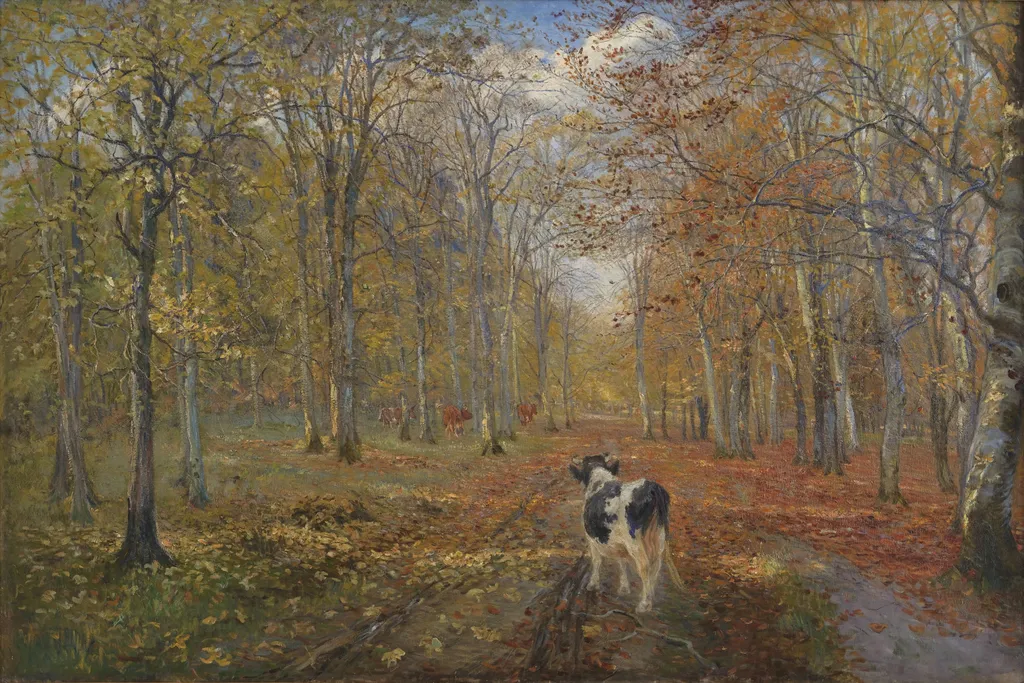
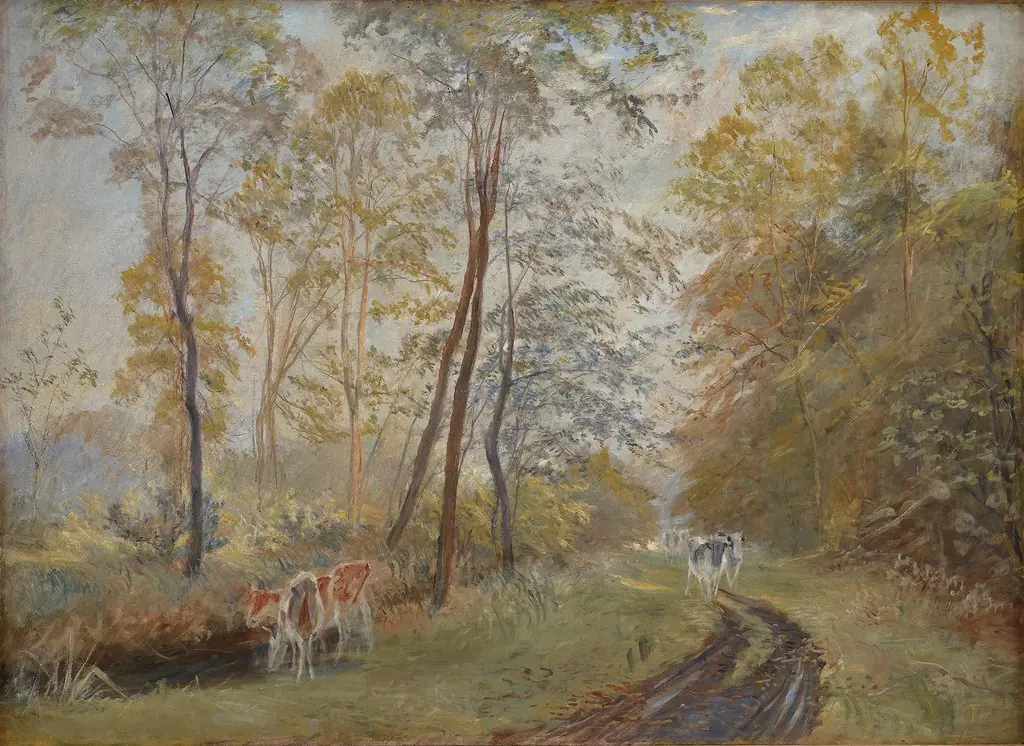
En vej i Dyrehaven. Efterår is a photography by the Impressionist artist Unknown. It dates from 1889 and is held in the collection of the Statens Museum for Kunst. Painted in 1889, this landscape depicts a quiet woodland path in Dyrehaven, a royal deer park north of Copenhagen.
About this work
Overview
A single cow stands near the center, while distant horses move along the trail, partially obscured by tall, slender trees.
Painted in 1889, this landscape depicts a quiet woodland path in Dyrehaven, a royal deer park north of Copenhagen. The scene captures the quiet transition of autumn, with fallen leaves blanketing the ground in warm hues. A single cow stands near the center, while distant horses move along the trail, partially obscured by tall, slender trees. The work reflects a contemplative engagement with nature, rendered in soft, naturalistic tones.
Subject & Meaning
The painting presents a tranquil, uneventful moment in a managed natural space. The cow, calm and grounded, contrasts with the subtle motion of the horses in the distance. The absence of human figures emphasizes solitude and the quiet rhythm of seasonal change. The scene suggests a harmony between domesticated animals and the wilder forest, reflecting late 19th-century Danish interest in pastoral serenity.
Technique & Style
Brushwork is loose yet deliberate, capturing the texture of fallen leaves and the play of light through thinning foliage. Color is muted but rich, with ochres, russets, and pale yellows dominating the palette. The composition guides the eye along the path into the depth of the forest, using atmospheric perspective to soften distant forms. The lighting suggests late afternoon, enhancing the warmth of the autumnal scene.
History & Provenance
The painting was created in 1889 and entered the collection of the Museum of Ethnography in Copenhagen. Its presence there, rather than in a fine arts institution, reflects early 20th-century curatorial practices that sometimes grouped nature studies with ethnographic material. The work has remained in the museum’s holdings since acquisition, with no documented public exhibitions until recent decades.
Context
Dyrehaven was a protected royal hunting ground, increasingly valued as a place of public recreation in the late 1800s. Artists of the period, influenced by French Impressionism, turned to such landscapes to explore light, seasonality, and quiet rural life. This work aligns with a broader Danish trend of depicting nature not as sublime, but as intimate and accessible — a daily refuge from urbanization.
Legacy
Though not widely reproduced or celebrated in major art histories, the painting remains a quiet example of Danish naturalist painting from the fin de siècle. It contributes to understanding how local landscapes were observed and valued outside urban centers. Its preservation in an ethnographic museum underscores shifting perceptions of nature as both cultural and ecological artifact.
Artist & collection

 Domestic Scene
 Giacomo and Cardinal Marco, investing Andrea, Abbot of San Zeno, with his Benefice
 The Nymph of Fontainebleau
 Portrait of a Woman
 Madonna and Child with Saints in the Enclosed Garden
 Venus and Minerva
 Family Group of Four on Sofa
 Wall painting from Room H of the Villa of P. Fannius Synistor at Boscoreale
 Efterår i Søndermarken
 Sunny Lane
 Boslandschap
 The River Sorteaa near Mejlgaard Manor, Jutland
 The River Sorteaa near Mejlgaard Manor, Jutland
 Late Autumn Day in the Jægersborg Deer Park, North of Copenhagen
 Sunny Lane
 The Forest of Fontainebleau - Autumn Evening
 The Scarecrow
 Reminiscence of the Beach of Naples
 The Gorge aux Loups in Fontainebleau
 En vej i Dyrehaven. Efterår