Artwork
Assumption of the Virgin
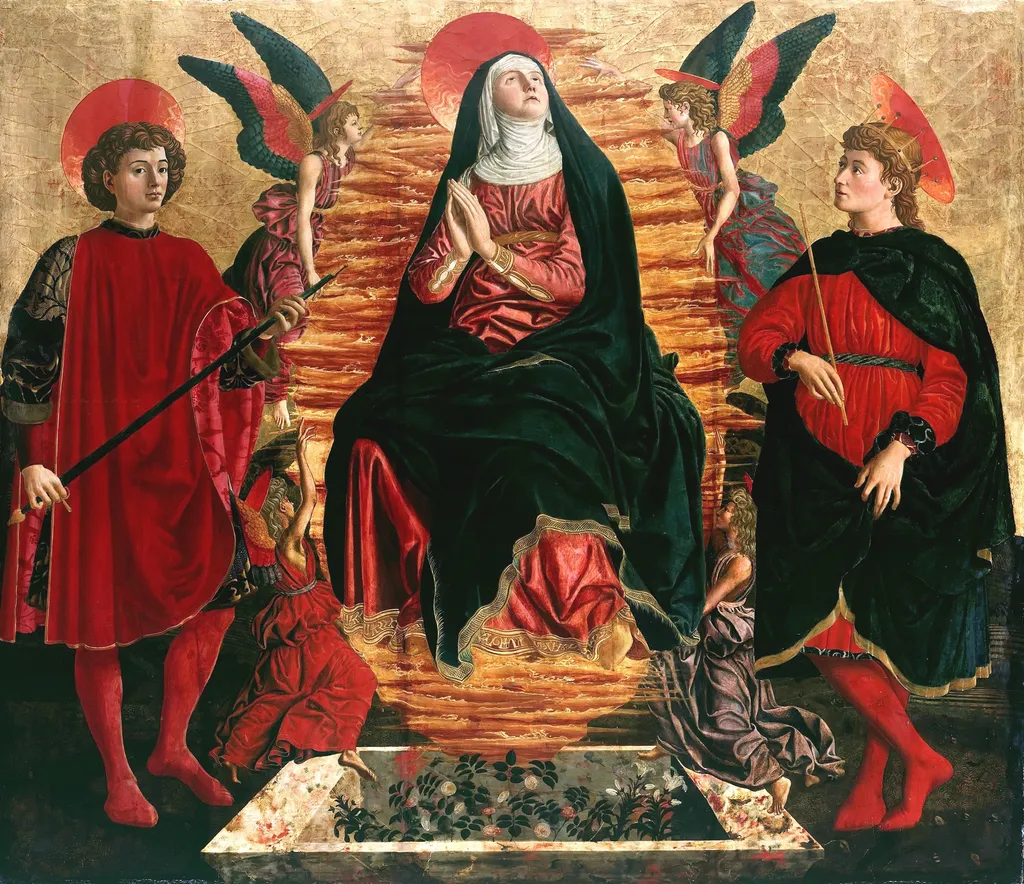
Assumption of the Virgin is a paint painting by the Early Renaissance artist Andrea del Castagno. It dates from 1449 and is held in the collection of the Gemäldegalerie Berlin.
About this work
Overview
Andrea del Castagno’s Assumption of the Virgin, painted circa 1449–1450, is an early Renaissance work executed in oil on panel. The composition presents the Virgin seated on a throne-like chair, encircled by four angels, against a backdrop of a rocky precipice and a luminous golden sky. The painting is part of the collection of the Gemäldegalerie in Berlin.
Subject & Meaning
The central figure is the Virgin Mary, depicted in a black cloak over a red robe trimmed with gold, her head covered by a white veil. She sits with folded hands and a modest ring, conveying a calm, solemn demeanor. The surrounding angels—two winged figures with halos standing beside her and two kneeling supporters—emphasize the sacred event of her assumption into heaven.
Technique & Style
Del Castagno employs a restrained palette of reds, blacks, and golds, creating strong contrasts through chiaroscuro. The figures are rendered with solid modeling, and the angels’ drapery shows careful attention to folds and weight. The rocky landscape recedes into a golden sky, providing a spatial depth that reflects the artist’s interest in linear perspective and atmospheric effects.
History & Provenance
Created in the mid‑15th century, the painting was likely intended for a devotional setting, possibly a chapel dedicated to St. Minias and St. Julian. It entered the Berlin Gemäldegalerie collection in the 20th century, where it remains on display as a representative example of del Castagno’s early Renaissance output.
Own this work as a print
Artist & collection

Artist
Andrea del Castagno had a quick, sharp career in 15th-century Florence. He wasn’t the most famous painter of his time, but he stood out for his bold, almost sculptural figures that looked ready to step off the wall. His…