Artwork
Mattias de' Medici
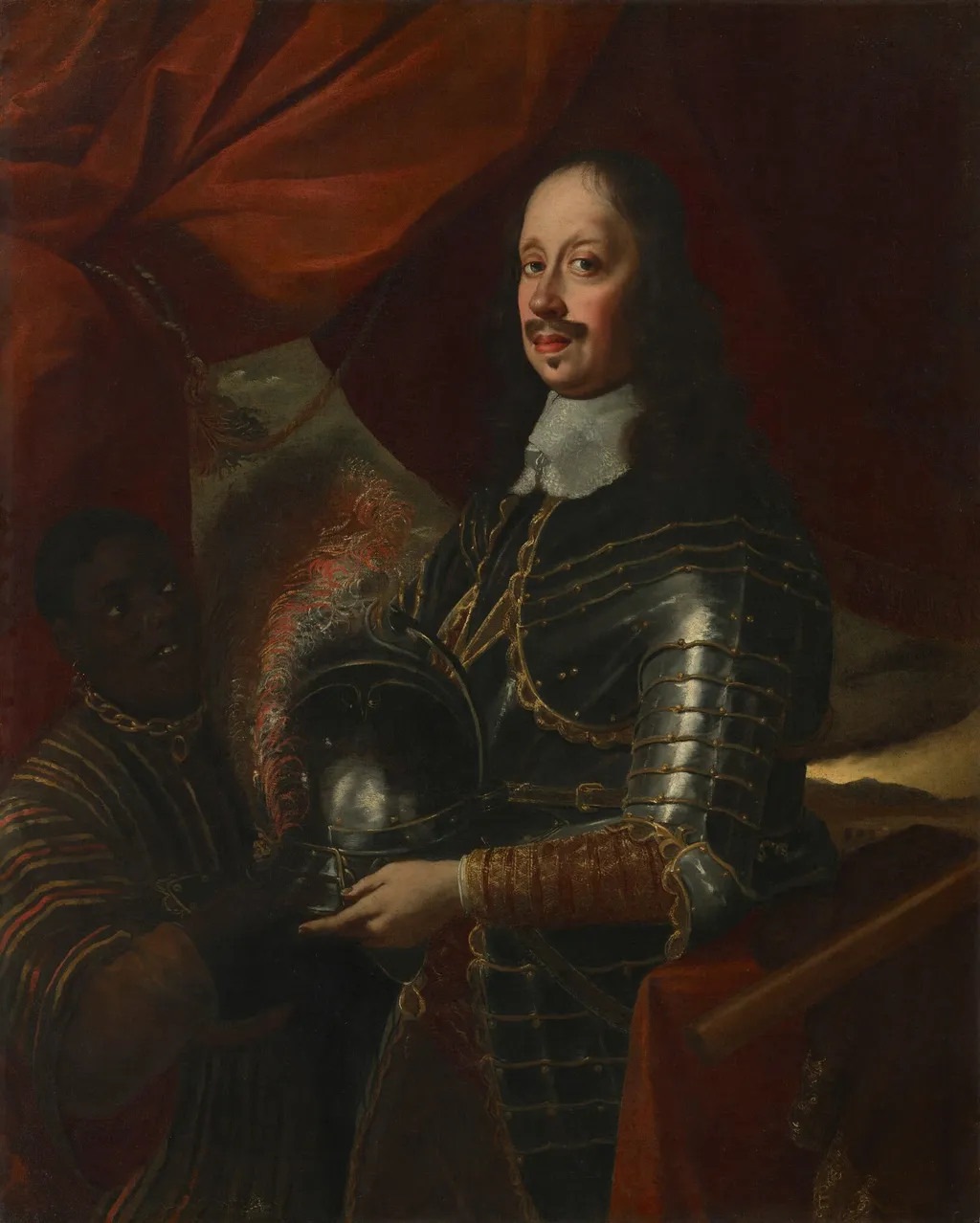
Mattias de' Medici is an oil painting. It dates from 1660 and is held in the collection of the National Gallery of Art. The canvas presents a Baroque composition centered on a heavily armored figure holding a helmet, accompanied by a kneeling attendant.
About this work
Overview
The canvas presents a Baroque composition centered on a heavily armored figure holding a helmet, accompanied by a kneeling attendant. The armored man is dressed in a black and gold cuirass with a white ruff, while the subordinate wears a striped robe accented by a gold chain. A deep red curtain forms the backdrop, opening onto a muted landscape.
Subject & Meaning
The dominant figure likely represents a noble or military commander, his armor and regal bearing indicating high rank. The presence of a kneeling attendant suggests a scene of homage or service, emphasizing hierarchical relationships typical of aristocratic portraiture in the early modern period.
Technique & Style
Executed in oil on canvas, the work employs the dramatic chiaroscuro and rich coloration characteristic of Baroque painting. The contrast between the gleaming metal, the luminous white collar, and the dark background heightens the three‑dimensionality of the figures, while the red drapery adds theatrical depth.
History & Provenance
No specific documentation of the painting’s commission or ownership is provided, and its title, "Mattias de' Medici," may refer to a patron or sitter whose identity remains uncertain. The work’s attribution to the Baroque period is based on stylistic analysis rather than recorded provenance.
Context
Baroque portraiture often emphasized power and status through elaborate costume and symbolic accessories. The inclusion of armor, a helmet, and a gold chain aligns with contemporary conventions for depicting military elites and their retinues, reflecting the social hierarchies of 17th‑century Europe.
Legacy
While the painting’s influence on later artists is not documented, its adherence to Baroque visual strategies contributes to the broader understanding of how portraiture communicated authority and patronage during the era.
Artist & collection