Artwork
Udfaldet på Amager under Københavns belejring 1659
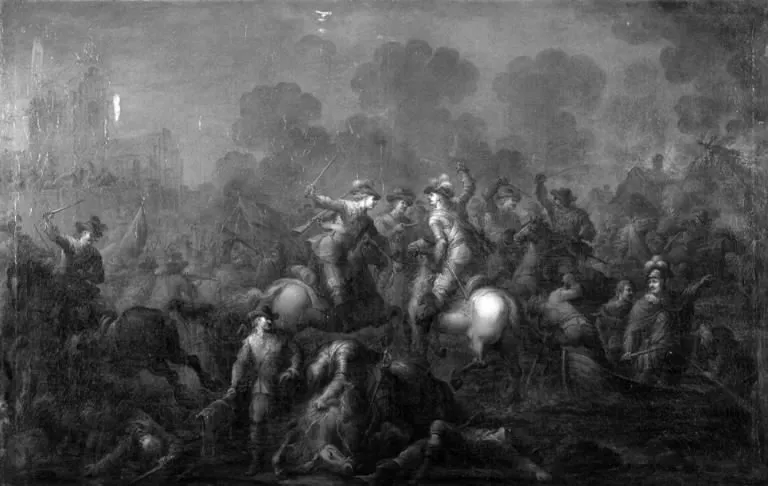
Udfaldet på Amager under Københavns belejring 1659 is an oil painting by the Rococo painting artist Anthon Christoffer Rüde. It dates from 1794 and is held in the collection of the Statens Museum for Kunst.
About this work
Overview
An oil painting completed in 1794 by Anthon Christoffer Rüde, titled *Udfaldet på Amager under Københavns belejring 1659*, portrays a violent clash on the Danish island of Amager during the 1659 siege of Copenhagen. The work is part of the collection of the Statens Museum for Kunst and measures the intensity of a historic military encounter through a densely packed composition.
Subject & Meaning
The canvas captures a moment of chaotic combat, with infantry in period dress and armor scrambling amid mud, some mounted on horses while others lie prone. A sword is visible in the foreground, emphasizing personal combat. The dark, storm‑laden sky and the faint outlines of a town under assault convey the desperation and turmoil of the siege.
Technique & Style
Rüde employs a dramatic chiaroscuro, using strong contrasts of light and shadow to model the figures and give depth to the tumultuous scene. The densely arranged bodies create a sense of movement, while the muted palette and heavy brushwork suggest the grim atmosphere of battle. The composition’s tight grouping intensifies the feeling of immediacy.
History & Provenance
Created in the late 18th century, the painting reflects a retrospective interest in Denmark’s 17th‑century military history. It entered the national collection of the Statens Museum for Kunst, where it remains on display. The work has been referenced in scholarly discussions of Danish historical painting and the visual representation of the 1659 siege.
Context
The 1659 siege of Copenhagen was a pivotal episode in the Dano‑Swedish wars, and Amager, an island close to the capital, suffered heavily. Rüde’s depiction aligns with contemporary Enlightenment‑era efforts to document national events through art, providing a visual narrative that complements written accounts of the conflict.
Artist & collection
Artist
Anthon Christoffer Rüde (1744–1815) was an artist, born in Copenhagen.
