Artwork
Christ in Emmaus
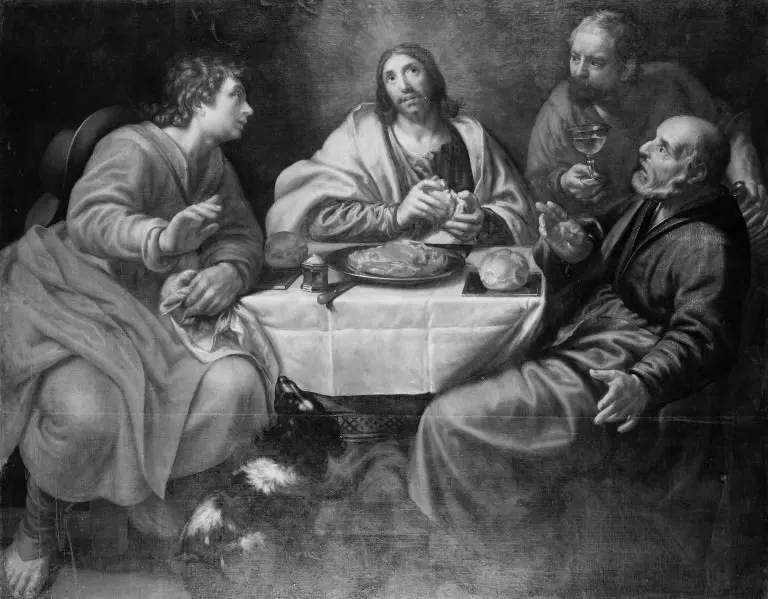
Christ in Emmaus is an oil painting by the Early Baroque Italian artist Antonio Circignani. It dates from 1607 and is held in the collection of the Statens Museum for Kunst.
About this work
Overview
Created in 1607, this oil painting portrays the biblical episode of the Supper at Emmaus, where a group of four men share a meal and a piece of bread. The composition is set within a dimly lit interior, with a focused light source illuminating the faces of the figures, emphasizing their interaction.
Subject & Meaning
The work visualizes the moment described in the Gospel of Luke when the risen Christ reveals himself to travelers during a shared dinner. The central gesture of a man holding bread alludes to the recognition of Christ through the breaking of the loaf, a key theological symbol of the Eucharist.
Technique & Style
Executed in the early Baroque idiom, the painting employs chiaroscuro to model the figures against a dark background, creating a dramatic contrast between light and shadow. The use of oil allows for rich coloration and subtle gradations, enhancing the three‑dimensional presence of the seated men and the table setting.
History & Provenance
The artist, Antonio Circignani (also known as Antonio Pomarancio), was born in 1560 in Città della Pieve and trained under his father, Niccolò Circignani, before establishing an independent workshop in Rome. The painting entered the collection of Denmark’s Statens Museum for Kunst, where it remains on display.
Artist & collection
Artist
Antonio Circignani (1560–1620) was an Italian painter of the late-Renaissance (Mannerism) period and early Baroque.
