Artwork
Portrait of Adriaan van Veverland (1651-ca.1712), writer of theological works and satires, with a wanton woman
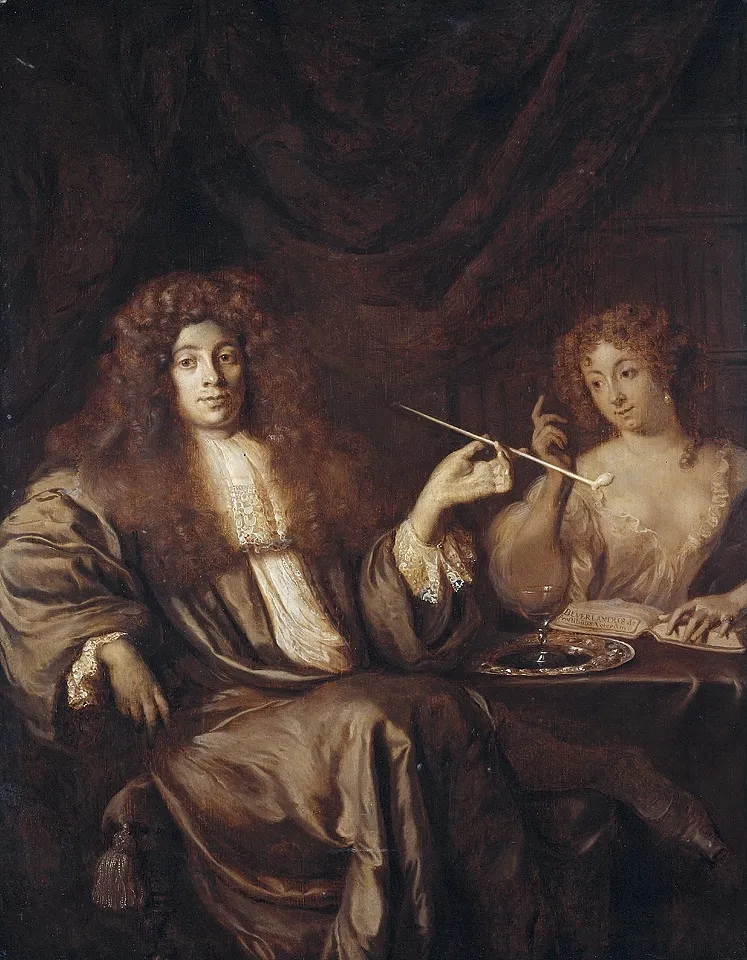
Portrait of Adriaan van Veverland (1651-ca.1712), writer of theological works and satires, with a wanton woman is an oil painting by the Dutch Golden Age artist Ary de Vois. It is held in the collection of the Rijksmuseum.
About this work
The man, dressed in dark attire with lace cuffs, holds a stick in his right hand, while the woman, wearing a light-colored dress, holds a book in her left hand.
This painting depicts a man and a woman seated together at a table. The man, dressed in dark attire with lace cuffs, holds a stick in his right hand, while the woman, wearing a light-colored dress, holds a book in her left hand.
The man's attire and the woman's dress suggest a formal setting, possibly from the 17th century. The woman's book bears an inscription, adding a layer of depth to the scene.
This painting, created by Ary de Vois, showcases the artist's skill in capturing the subtleties of human interaction. For more on the artist's use of chiaroscuro, explore the works of Ary de Vois.
Overview
Ary de Vois painted this oil portrait in 1688, now part of the Rijksmuseum’s collection. It shows the Dutch author Adriaan van Veverland, noted for theological treatises and satirical writings, seated beside a woman whose demeanor contrasts with his solemnity.
Subject & Meaning
The male figure is dressed in dark clothing with lace‑trimmed cuffs, holding a staff, suggesting authority or scholarly status. Opposite him, the woman in a light dress clutches a book bearing an inscription, hinting at a narrative or moral juxtaposition between the learned man and the seemingly frivolous companion.
Technique & Style
De Vois employs a restrained palette and careful modeling of fabrics, using chiaroscuro to give depth to the figures against a muted background. The brushwork renders textures—lace, leather, and the glossy surface of the book—with a quiet realism characteristic of late‑seventeenth‑century Dutch portraiture.
History & Provenance
Created in the Dutch Golden Age, the work entered the Rijksmuseum’s holdings through acquisition in the early twentieth century. Its documentation links directly to de Vois’s known output for private patrons, reflecting the period’s practice of commemorating intellectuals with personalized portraiture.
Context
Portraits of scholars accompanied by allegorical or domestic figures were common in the Netherlands, serving both as personal commemoration and as visual commentary on the sitter’s virtues or vices. The inclusion of a ‘wanton’ woman may allude to contemporary debates about morality, a theme present in Veverland’s own satirical writings.
Artist & collection