Artwork
The Virgin and Child Enthroned and St. Homobonus, Francis of Assisi, Catherine of Alexandria and the Donor Bernadino da Feltre (Death 1494)
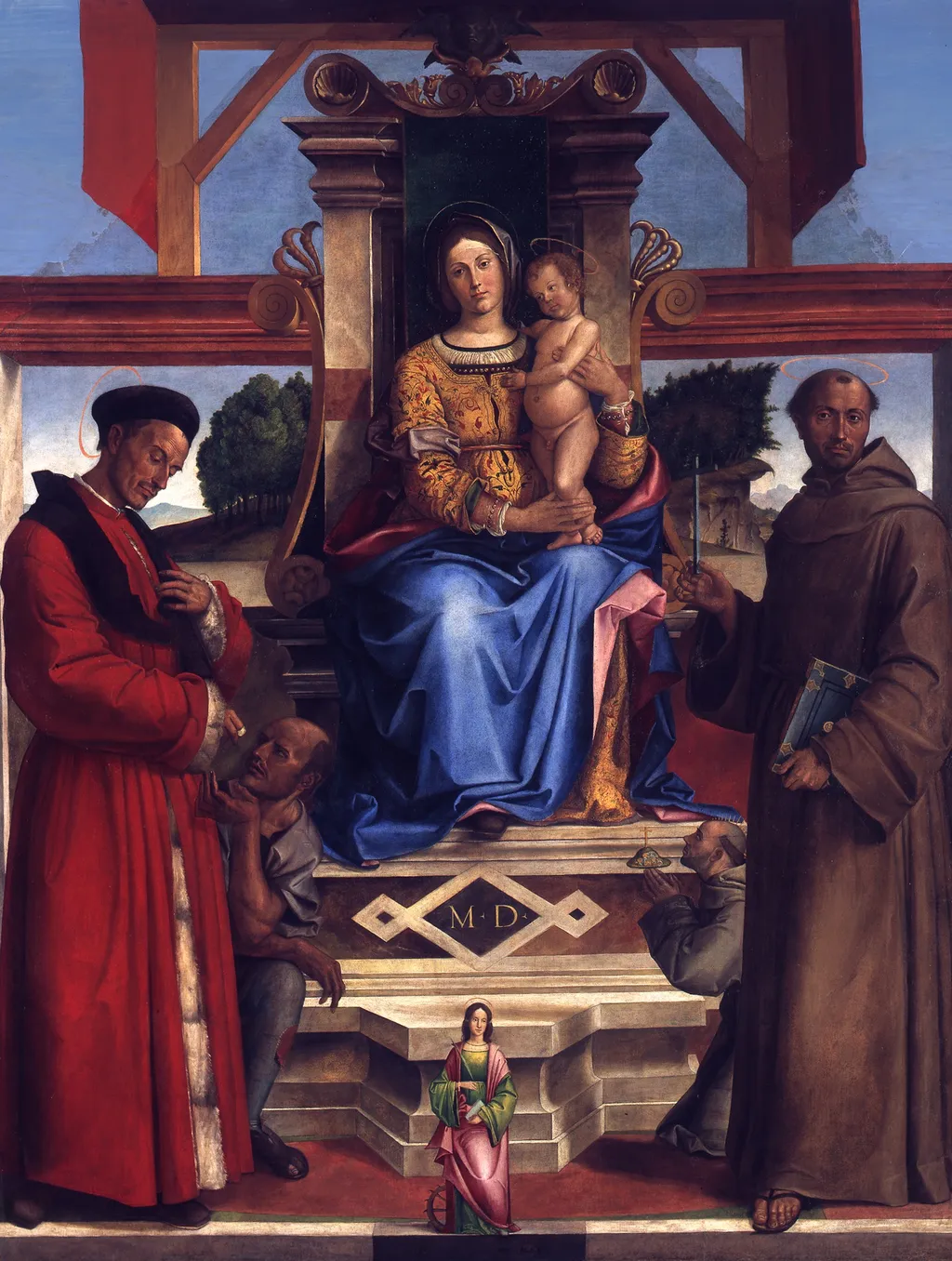
The Virgin and Child Enthroned and St. Homobonus, Francis of Assisi, Catherine of Alexandria and the Donor Bernadino da Feltre (Death 1494) is an oil painting by the Early Renaissance artist Bartolomeo Montagna. It dates from 1515 and is held in the collection of the Bode Museum.
About this work
Overview
Created in 1515, this early Renaissance panel presents the Virgin Mary seated on a throne with the infant Christ, flanked by a small group of saints and the patron donor. The composition balances a central sacred pair with surrounding figures, set against a modest landscape that recedes into a blue sky, establishing a harmonious spatial depth.
Subject & Meaning
The local saint Bernardino of Feltre, patron of the donor, is also present, underscoring the donor’s piety and civic identity.
At the heart of the work the Virgin holds the naked Christ, symbolizing divine motherhood. To her left stands Saint Francis of Assisi, identifiable by his humble habit, while Saint Catherine of Alexandria appears on the right, her traditional martyr’s wheel hinted in the background. The local saint Bernardino of Feltre, patron of the donor, is also present, underscoring the donor’s piety and civic identity.
Technique & Style
Montagna employs a clear, layered color palette—blue and yellow for the Virgin’s garments, reds and browns for the attendant figures—creating a calm yet vibrant visual field. The modeling of forms relies on subtle chiaroscuro, giving volume to the figures while maintaining the smooth surface typical of northern Italian painting of the period.
History & Provenance
The work is attributed to Bartolomeo Montagna, a Vicentine painter whose career was shaped by contact with Giovanni Bellini’s workshop in the late 1460s. After remaining in private collections for centuries, the panel entered the Gemäldegalerie in Berlin, where it is currently displayed.
Context
Montagna’s painting reflects the early 16th‑century devotional practices of northern Italy, where patrons often commissioned altarpieces that combined the Virgin and Child with locally revered saints. The inclusion of the donor, Bernadino da Feltre, exemplifies the era’s intertwining of personal devotion, civic pride, and artistic patronage.
Artist & collection
Artist
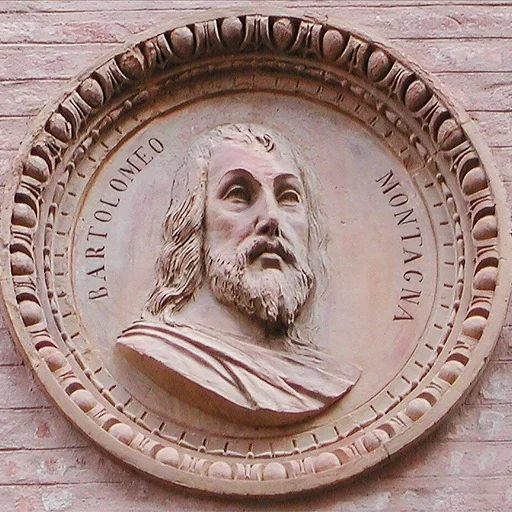
Bartolomeo (or Bartolommeo) Montagna (UK: , US: , Italian: ; 1450?– 11 October 1523) was an Italian Renaissance painter who mainly worked in Vicenza.