Artwork
Rock, Bamboo, and Orchids
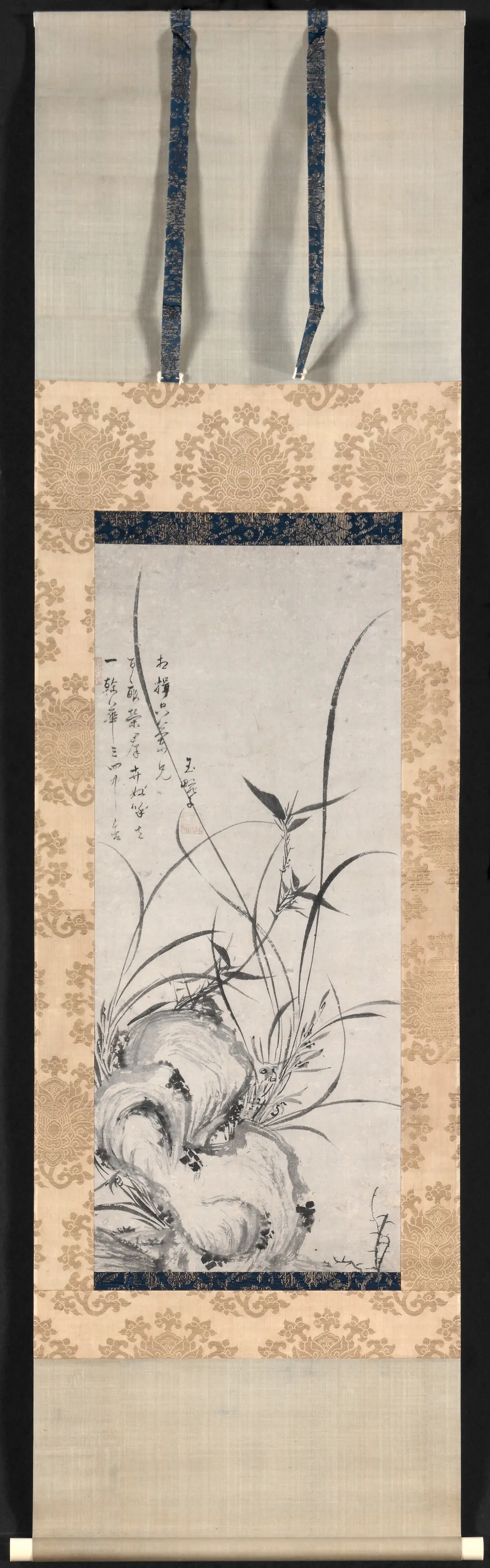
Rock, Bamboo, and Orchids is an unspecified painting by the Ming dynasty painting artist Bompō. It dates from 1406 and is held in the collection of the Cleveland Museum of Art.
About this work
Overview
Rock, Bamboo, and Orchids is an ink painting executed by the Japanese artist Bompō in 1406. The work is part of the collection of the Cleveland Museum of Art, where it is displayed as an example of early Muromachi-period brushwork.
Subject & Meaning
The composition presents a modest grouping of bamboo shoots emerging from a rocky base, accompanied by delicate orchid blossoms. The sparse setting and the inclusion of calligraphic inscriptions suggest a contemplative atmosphere, reflecting traditional Chinese literati ideals of simplicity and harmony with nature.
Technique & Style
Bompō employs monochrome ink on paper, using varied tonal washes and fine brushstrokes to render the bamboo’s three‑dimensional form. Subtle gradations of dark and light create a sense of volume, while the minimal background of pale gray and white enhances the spatial depth of the scene.
History & Provenance
Created in the early 15th century, the painting has remained in private hands before being acquired by the Cleveland Museum of Art. Its provenance records trace a lineage of ownership that underscores its value as a representative work of Japanese ink painting from the period.
Context
During the Muromachi era, Japanese artists increasingly looked to Chinese Song and Yuan models, especially in the depiction of bamboo, a symbol of resilience and moral integrity. Bompō’s work aligns with this cross‑cultural exchange, integrating Chinese brush techniques with Japanese aesthetic sensibilities.
Artist & collection