Artwork
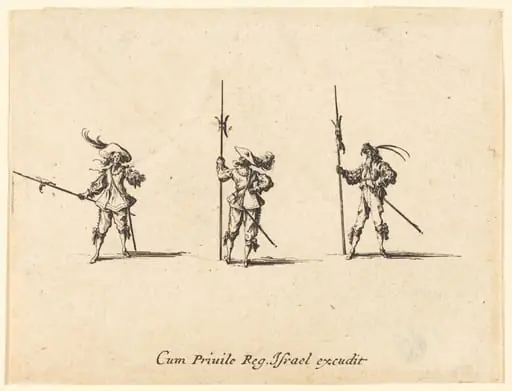
Drill with Halberds
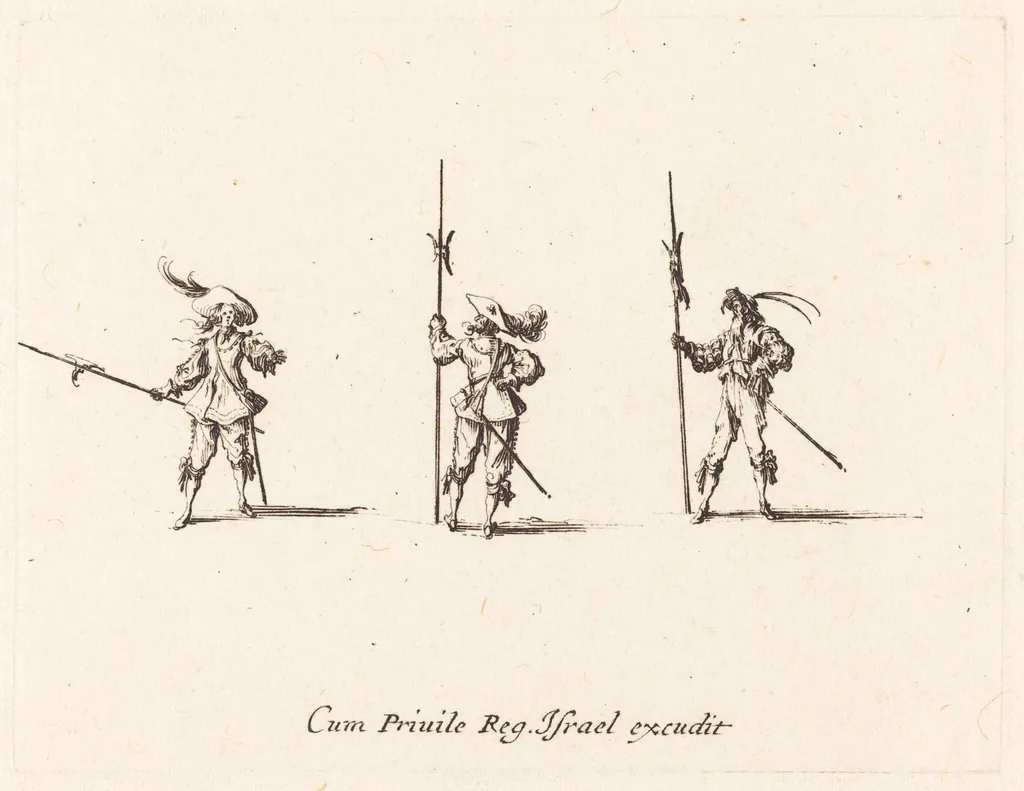
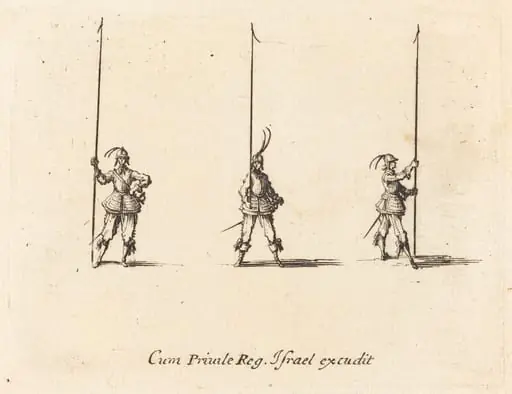
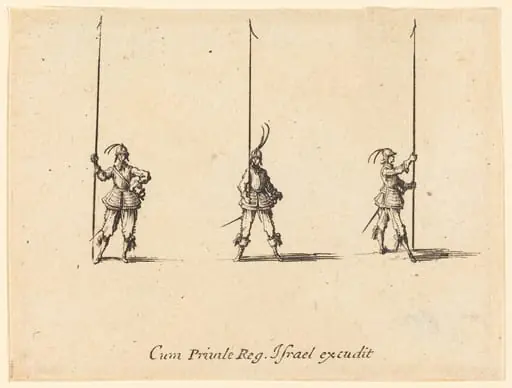
Drill with Halberds is an ink print by the Baroque artist Jacques Callot. It dates from 1634 and is held in the collection of the National Gallery of Art.
About this work
Overview
Jacques Callot, a French printmaker active in the early seventeenth century, produced the etching *Drill with Halhalds* in 1634. Executed on laid paper, the work measures a modest size and belongs to Callot’s extensive catalog of more than a thousand prints that record contemporary life.
Subject & Meaning
The image depicts three figures dressed in period military attire, each wielding a halberd—a pole weapon combining a spear point and an axe blade—alongside a sword. Their broad-brimmed hats and attentive posture suggest a drill or training exercise, reflecting the artist’s interest in the routines of soldiers.
Technique & Style
Callot employed the etching process, incising fine, controlled lines into a copper plate before transferring the design onto laid paper. The resulting marks are both delicate and exacting, characteristic of his precise handling of line and his ability to render texture, from the weave of the paper to the details of the weapons.
History & Provenance
Created in the Duchy of Lorraine, the print circulated among collectors of the period and later entered museum holdings. It is documented in several catalogues of Callot’s oeuvre, confirming its date of 1634 and its place among his series of military subjects.
Context
During the Baroque era, military drills were a common motif for artists who sought to illustrate the discipline and organization of contemporary armies. Callot’s focus on such scenes aligns with his broader practice of portraying the social and martial aspects of early‑modern Europe.
Artist & collection

Artist
Jacques Callot was a baroque printmaker and draftsman from the Duchy of Lorraine.

 Holy Family at supper
 Restoration of the Aqueduct at Pisa
 Restoration of the Aqueduct at Pisa
 Square in Paris with Many Figures
 Square in Paris with Many Figures
 Horsemen Attacked by Robbers
 HOW WILL A COVERED PART BE CORRECTED?HOW WIKA A COVERED HEART DEED CORRECTED?
![Christ Walking on the Water [second plate], by Jacques Callot](https://artifactworldgallery.com/img/jacques-callot--christ-walking-on-the-water-second-plate--2069f3bfe4cb2126-w320.webp) Christ Walking on the Water [second plate]
Christ Walking on the Water [second plate]