Artwork
Taking the Firing Position with the Musket
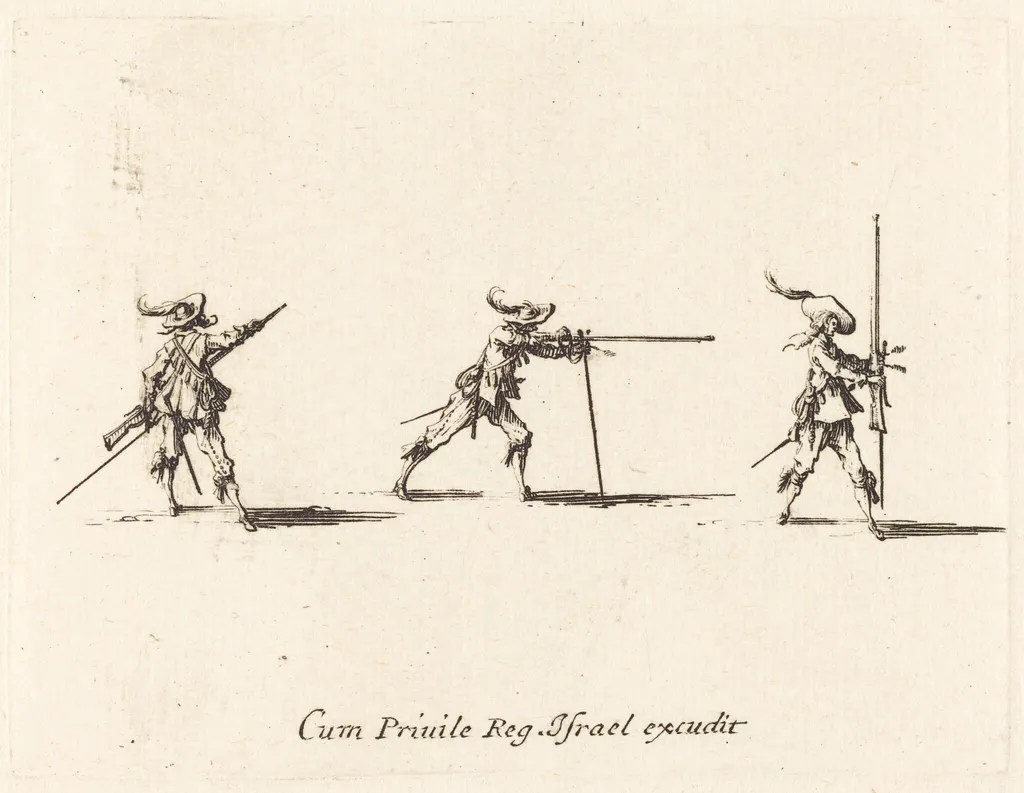
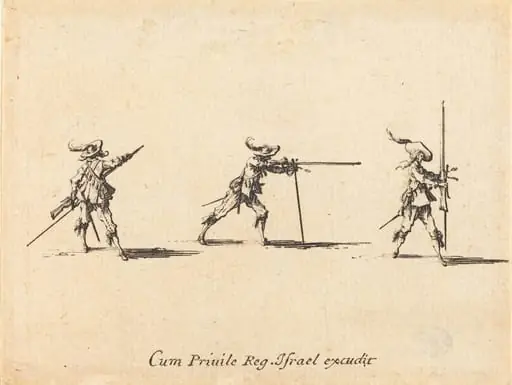
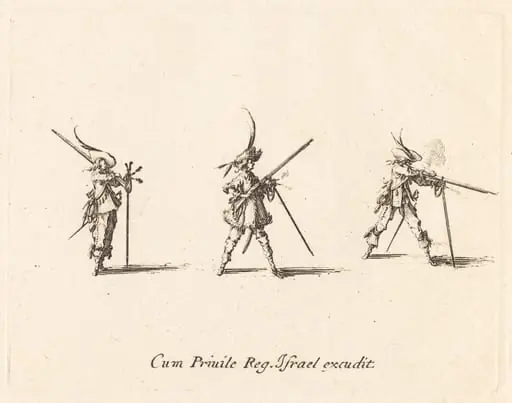
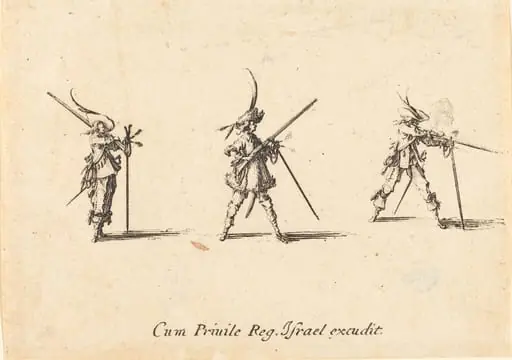
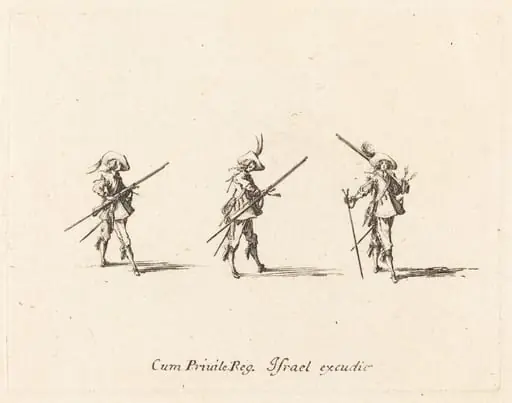
Taking the Firing Position with the Musket is an ink print by the Baroque artist Jacques Callot. It dates from 1634 and is held in the collection of the National Gallery of Art.
About this work
Overview
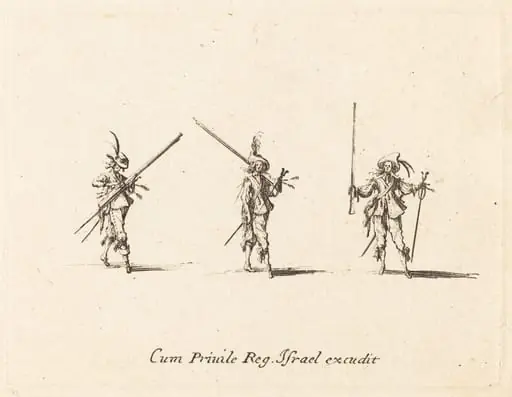
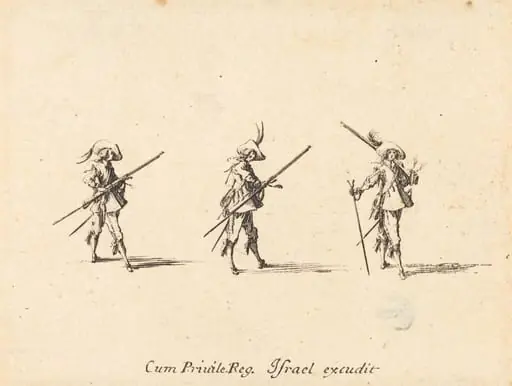
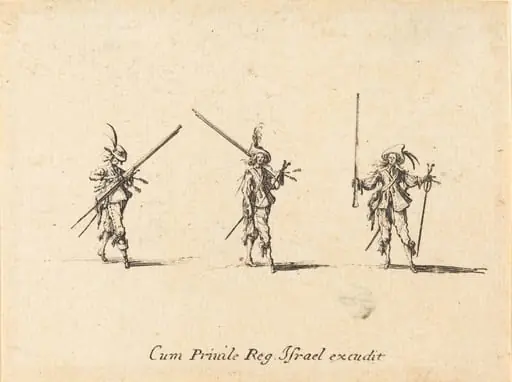
Created in 1634 by Jacques Callot, this etching on laid paper captures a moment of military drill with three soldiers preparing to fire their muskets.
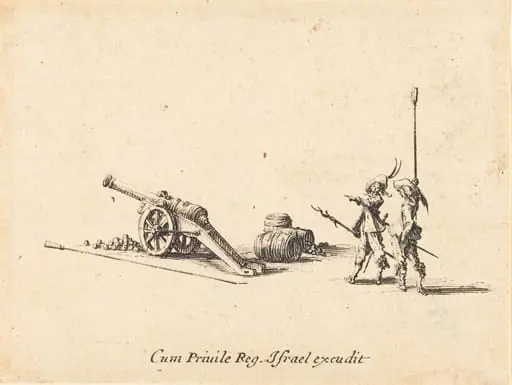
Created in 1634 by Jacques Callot, this etching on laid paper captures a moment of military drill with three soldiers preparing to fire their muskets. As part of a larger series documenting armed forces, the work exemplifies Callot’s interest in the routines of soldiering. Executed in fine, controlled lines, the print lacks color and background detail, focusing instead on posture and gesture. Its modest scale and unembellished style suggest a functional, observational purpose rather than decorative intent.
Subject & Meaning
The image depicts three soldiers in period uniforms, each adopting a standardized stance for firing a musket—foot forward, weapon raised, body angled. The repetition of posture implies instruction or training, possibly intended as a reference for military personnel or artisans. Callot’s focus on technique over drama underscores a documentary impulse, reflecting the growing institutionalization of early modern armies. The absence of conflict or emotion shifts attention to discipline and procedure.
Technique & Style
Callot employed etching to achieve precise, linear clarity, using a needle to draw through a wax ground on a metal plate before acid biting the exposed lines. The print’s economy of stroke—clean, unshaded, and deliberate—conveys motion without ornament. The paper’s laid texture subtly enhances the tactile quality of the lines. Signed discreetly at the base, the work bears the hallmarks of a study: direct, unpolished, and focused on anatomical accuracy in motion.
History & Provenance
This print belongs to a series of military scenes Callot produced during his time in France, where he was active in the court of Louis XIII. While the exact provenance of this individual impression is undocumented, similar works from the period were circulated among military academies and print collectors. Callot’s reputation as a chronicler of soldier life ensured the continued reproduction and preservation of such images, though many were later separated from their original contexts.
Context
In the early 17th century, European armies increasingly relied on standardized drills and written manuals. Callot’s prints, including this one, aligned with this trend by visually codifying infantry procedures. His work intersected with emerging military science and the rise of professional standing armies. Unlike idealized battle scenes, these studies emphasized the mundane mechanics of warfare, offering a counterpoint to heroic narratives common in contemporary painting.
Legacy
Callot’s etchings of soldiers influenced later generations of printmakers and military illustrators by establishing a precedent for observational accuracy in depicting armed forces. Though not widely exhibited in his lifetime as standalone works, these images contributed to the visual lexicon of military training and were referenced in 18th-century manuals. Their enduring value lies in their unembellished record of everyday soldierly behavior during a period of institutional transformation.
Artist & collection

Artist
Jacques Callot was a baroque printmaker and draftsman from the Duchy of Lorraine.

 Holy Family at supper
 Restoration of the Aqueduct at Pisa
 Restoration of the Aqueduct at Pisa
 Square in Paris with Many Figures
 Square in Paris with Many Figures
 Horsemen Attacked by Robbers
 HOW WILL A COVERED PART BE CORRECTED?HOW WIKA A COVERED HEART DEED CORRECTED?
![Christ Walking on the Water [second plate], by Jacques Callot](https://artifactworldgallery.com/img/jacques-callot--christ-walking-on-the-water-second-plate--2069f3bfe4cb2126-w320.webp) Christ Walking on the Water [second plate]
Christ Walking on the Water [second plate]