Artwork
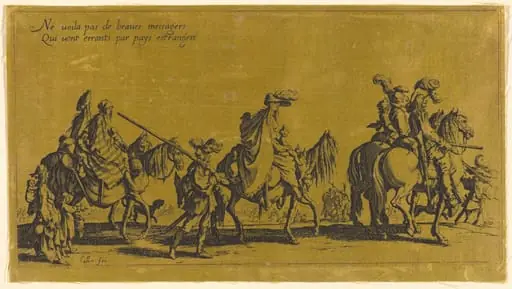
The Bohemians Marching: The Rear Guard
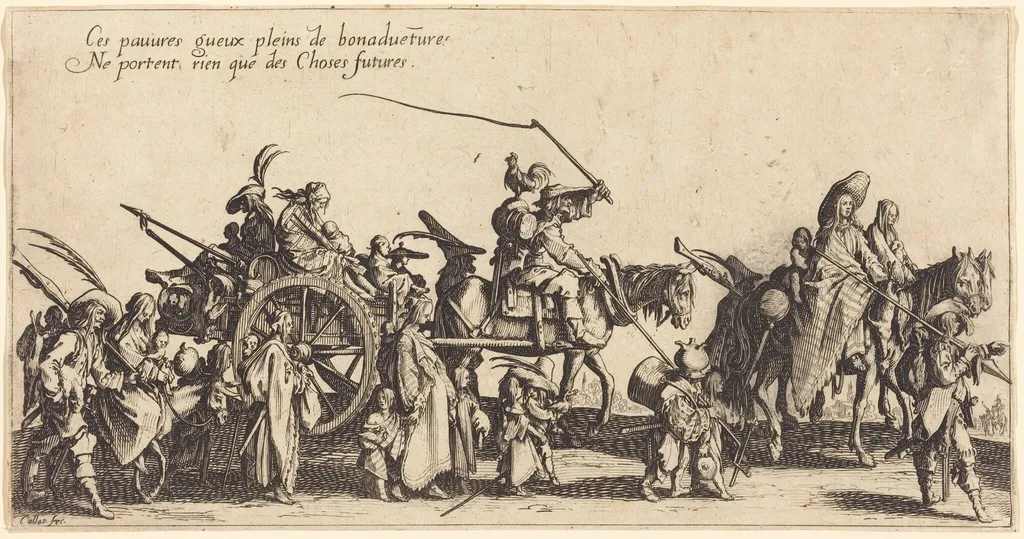
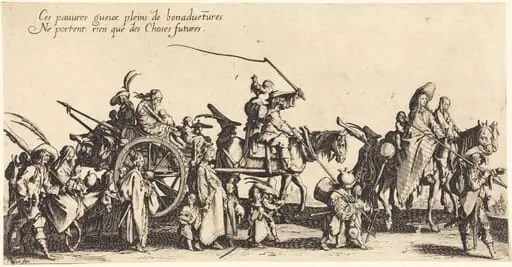
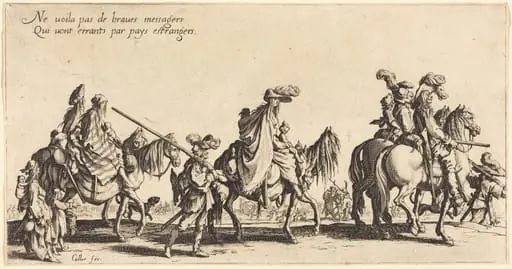
The Bohemians Marching: The Rear Guard is an ink print by the Baroque artist Jacques Callot. It dates from 1621 and is held in the collection of the National Gallery of Art.
About this work
Overview
Callot’s precise line work and attention to individual posture convey movement and tension without relying on environmental detail.
Created in 1621 by Jacques Callot, this etching and engraving on laid paper depicts a column of figures moving in a single file. Part of a larger series on military life, the work captures a moment of transition within a group of itinerant people, likely associated with transient or marginalized communities. Callot’s precise line work and attention to individual posture convey movement and tension without relying on environmental detail.
Subject & Meaning
The figures, dressed in long robes and wide-brimmed hats, appear to be a mixed group of soldiers and civilians, possibly deserters or camp followers. Their staggered formation and glances backward suggest vigilance or exhaustion. The absence of a defined setting shifts focus to the human condition—movement without destination, order amid disorder. The bundle on one figure’s back hints at displacement, reinforcing themes of transience common in Callot’s depictions of wartime society.
Technique & Style
Callot employed fine etching lines and subtle engraving to model form and texture, achieving depth through controlled cross-hatching. The figures are rendered with sharp, expressive contours, while the plain background eliminates distraction, emphasizing rhythm and gesture. The Baroque emphasis on movement is evident in the diagonal alignment of bodies and the dynamic tension between forward motion and backward glances, all rendered with meticulous draftsmanship.
History & Provenance
This print belongs to a suite of works Callot produced during his time in Florence, where he documented the chaos of the Thirty Years’ War. Though originally circulated among collectors and military observers, the exact early provenance of this specific plate is undocumented. It survives in multiple institutional collections, reflecting its status as a representative example of early 17th-century Northern European printmaking.
Context
Callot’s prints emerged during a period of widespread military upheaval in Europe. His focus on non-elite figures—soldiers, beggars, refugees—offered an alternative to heroic battle imagery. This work reflects a growing interest in social observation among printmakers, aligning with broader trends in Northern European art that valued documentary precision over idealized narrative.
Legacy
Callot’s technical innovations in etching influenced generations of printmakers, particularly in their ability to render complex scenes with clarity. While not widely exhibited as a standalone image, this piece contributes to the understanding of how print culture documented the lived realities of war. Its restrained composition and psychological nuance continue to inform scholarly analysis of early modern visual narratives.
Artist & collection

Artist
Jacques Callot was a baroque printmaker and draftsman from the Duchy of Lorraine.

 Holy Family at supper
 Restoration of the Aqueduct at Pisa
 Restoration of the Aqueduct at Pisa
 Square in Paris with Many Figures
 Square in Paris with Many Figures
 Horsemen Attacked by Robbers
 HOW WILL A COVERED PART BE CORRECTED?HOW WIKA A COVERED HEART DEED CORRECTED?
![Christ Walking on the Water [second plate], by Jacques Callot](https://artifactworldgallery.com/img/jacques-callot--christ-walking-on-the-water-second-plate--2069f3bfe4cb2126-w320.webp) Christ Walking on the Water [second plate]
Christ Walking on the Water [second plate]