Artwork
Title Page for "The Large Miseries of War"
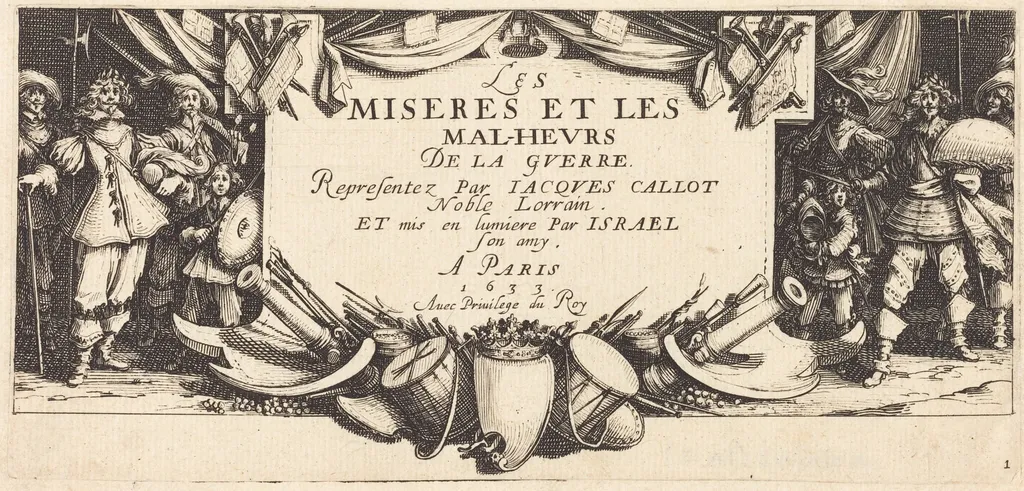
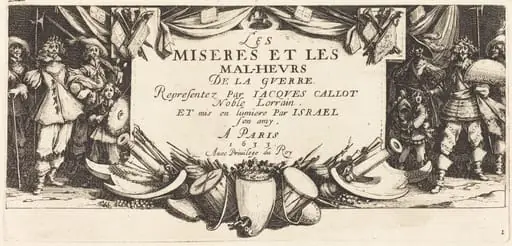
Title Page for "The Large Miseries of War" is an ink print by the Baroque artist Jacques Callot. It dates from 1633 and is held in the collection of the National Gallery of Art.
About this work
Overview
Central text identifies the work in French and attributes it to Callot, framing the subsequent plates as a systematic record of wartime suffering.
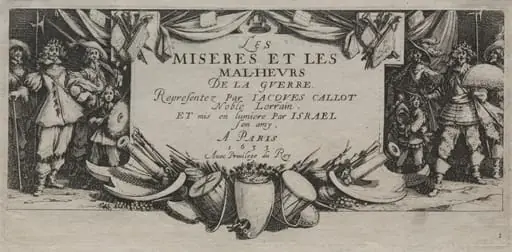
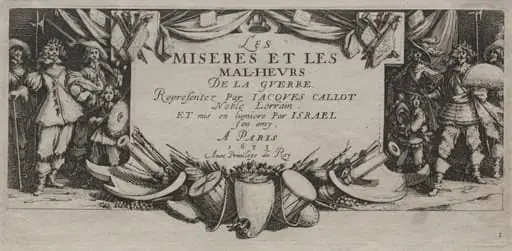
Created around 1633, this etching on laid paper serves as the introductory plate for Jacques Callot’s series titled *The Large Miseries of War*. The image functions as a visual preface, presenting a densely populated tableau that foregrounds the devastation of armed conflict. Central text identifies the work in French and attributes it to Callot, framing the subsequent plates as a systematic record of wartime suffering.
Subject & Meaning
The composition juxtaposes marching soldiers at the upper edge with a litter of broken armor, discarded weapons, and fleeing civilians below. Figures in ragged attire clutch at their belongings or beg, their expressions contorted in anguish. This stark contrast underscores the human cost of battle, emphasizing both the aggressor’s presence and the victims’ plight within a single, chaotic scene.
Technique & Style
Callot employed fine, sharply cut lines characteristic of his etching practice, creating intricate detail in both figures and background elements. The high contrast between dark inked areas and the white of the laid paper heightens the drama, while the somewhat sketchy rendering conveys immediacy and emotional urgency. Such precision allowed Callot to populate the scene with numerous individualized characters.
History & Provenance
Jacques Callot, a French printmaker from the Duchy of Lorraine, produced this title page as part of a larger series documenting the horrors of war. The series circulated among collectors and patrons interested in moralizing depictions of conflict. Surviving impressions are held in several European museum collections, reflecting the work’s continued relevance as a historical document.
Context
The early 1630s were marked by the Thirty Years’ War, a period of extensive violence across Central Europe. Callot’s series responded to contemporary anxieties about the widespread devastation, aligning with a broader baroque interest in dramatic, didactic imagery. By focusing on the everyday suffering of soldiers and civilians, the print participates in a visual discourse that critiques the glorification of war.
Artist & collection

Artist
Jacques Callot was a baroque printmaker and draftsman from the Duchy of Lorraine.

 Holy Family at supper
 Restoration of the Aqueduct at Pisa
 Restoration of the Aqueduct at Pisa
 Square in Paris with Many Figures
 Square in Paris with Many Figures
 Horsemen Attacked by Robbers
 HOW WILL A COVERED PART BE CORRECTED?HOW WIKA A COVERED HEART DEED CORRECTED?
![Christ Walking on the Water [second plate], by Jacques Callot](https://artifactworldgallery.com/img/jacques-callot--christ-walking-on-the-water-second-plate--2069f3bfe4cb2126-w320.webp) Christ Walking on the Water [second plate]
Christ Walking on the Water [second plate]