Artwork
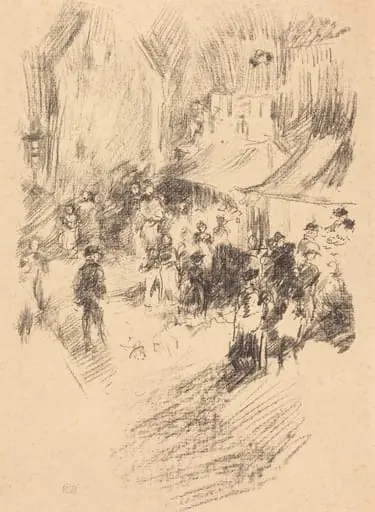
At the Market
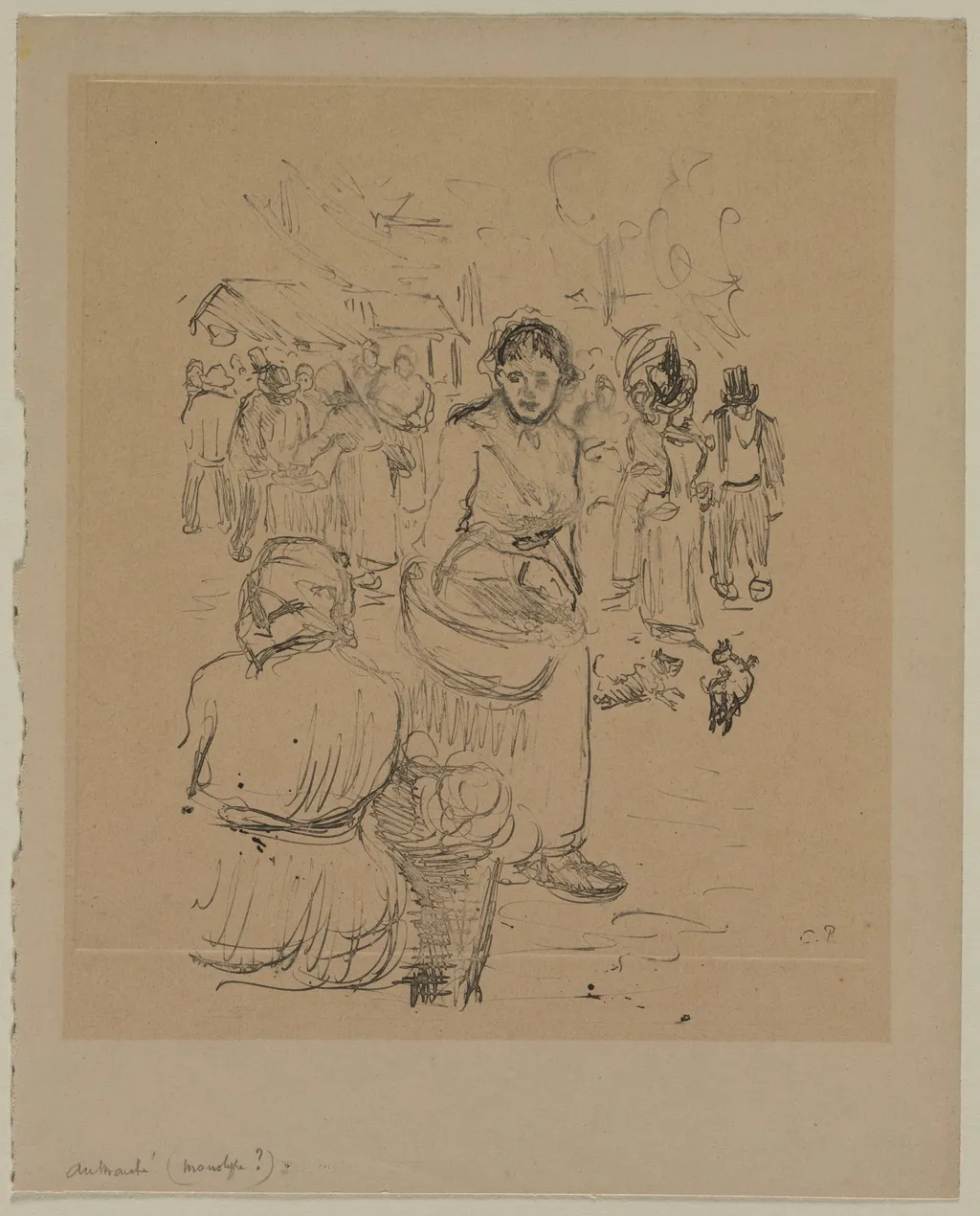
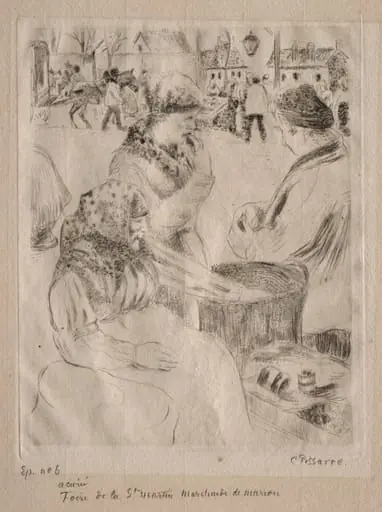
At the Market is a print by the Impressionist artist Camille Pissarro. It dates from 1804 and is held in the collection of the Cleveland Museum of Art.
About this work
Pissarro made this with a quick, one-off print called a monotype—ink rolled onto a plate, then pressed once.
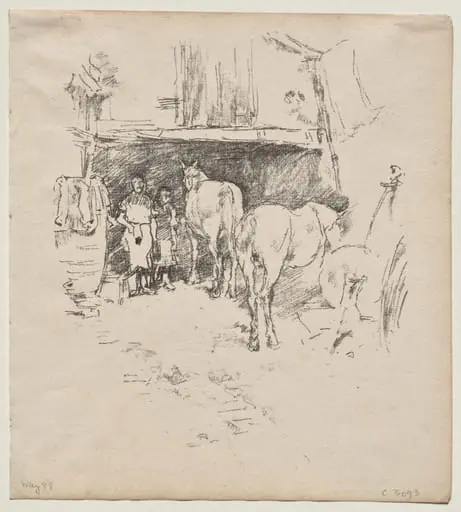
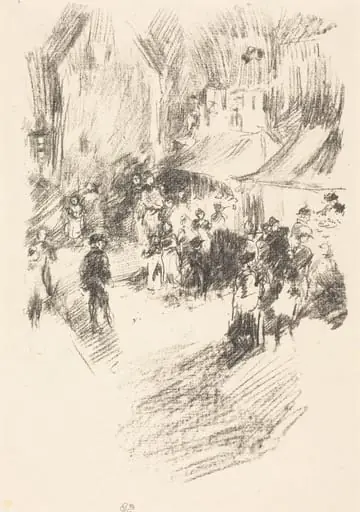
You see a busy market square in France: stalls, shoppers, and a horse-drawn cart under a cloudy sky.
Pissarro made this with a quick, one-off print called a monotype—ink rolled onto a plate, then pressed once. It gives the scene a soft, smudgy look, almost like a watercolor. He borrowed the idea from his friend Degas but kept it simple.
Look up other paintings of France, 19th century to see how artists showed daily life.
Overview
This monotype by Camille Pissarro captures a bustling French market scene, rendered in a single, ephemeral impression. Unlike his more numerous paintings and etchings, this work belongs to a rare experimental phase in his career. He adopted the technique from Edgar Degas, using ink rolled onto a smooth plate and transferred once onto paper, resulting in a soft, blurred effect that suggests movement and atmosphere rather than precise detail.
Subject & Meaning
The scene depicts ordinary urban life in 19th-century France: vendors at stalls, pedestrians navigating the square, and a horse-drawn cart moving through the crowd. There is no idealization or narrative climax—only the quiet rhythm of daily commerce. Pissarro’s focus on common activity reflects his broader interest in the dignity of labor and the rhythms of public space, rendered without sentimentality.
Technique & Style
Pissarro employed the monotype process—applying ink to a metal plate and pressing it once onto paper—to achieve a fluid, painterly texture. The resulting image is inherently unique and unrepeatable, with edges softened by smudging and ink bleeding into the paper. This method favored spontaneity over precision, aligning with his interest in capturing transient moments, though he rarely returned to the medium after this period.
History & Provenance
Created during Pissarro’s engagement with experimental printmaking in the 1870s and 1880s, this work emerged from his close association with Degas, who championed monotype as a tool for informal observation. Few monotypes by Pissarro survive, and this one is among the more clearly documented examples. Its provenance traces back to private collections in France before entering institutional holdings in the 20th century.
Context
In the late 19th century, French artists increasingly turned to scenes of everyday life as a subject worthy of serious attention. Pissarro’s market scene aligns with broader Realist and Impressionist interests in urban and rural labor, but his use of monotype distinguishes it from the oil paintings of contemporaries like Caillebotte or Renoir. The technique’s impermanence mirrored the fleeting nature of the moment he sought to record.
Legacy
Though Pissarro did not pursue monotype extensively, this work stands as a quiet testament to his openness to new methods and his commitment to observing ordinary life. It influenced later artists exploring the expressive potential of printmaking outside traditional etching or lithography. Its modest scale and transient quality remind viewers that not all significant art requires repetition or grandeur.
Artist & collection
Artist
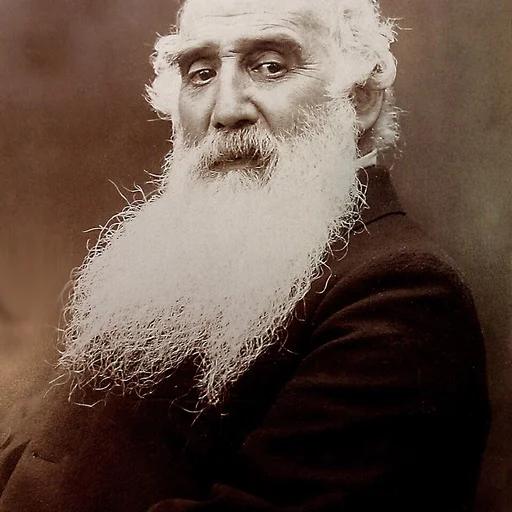
Jacob Abraham Camille Pissarro ( piss-AR-oh; French: ; 10 July 1830 – 13 November 1903) was a Danish-French Impressionist and Neo-Impressionist painter born on the island of Saint Thomas (now in the US Virgin Islands, but then in the…