Artwork
Myosotis
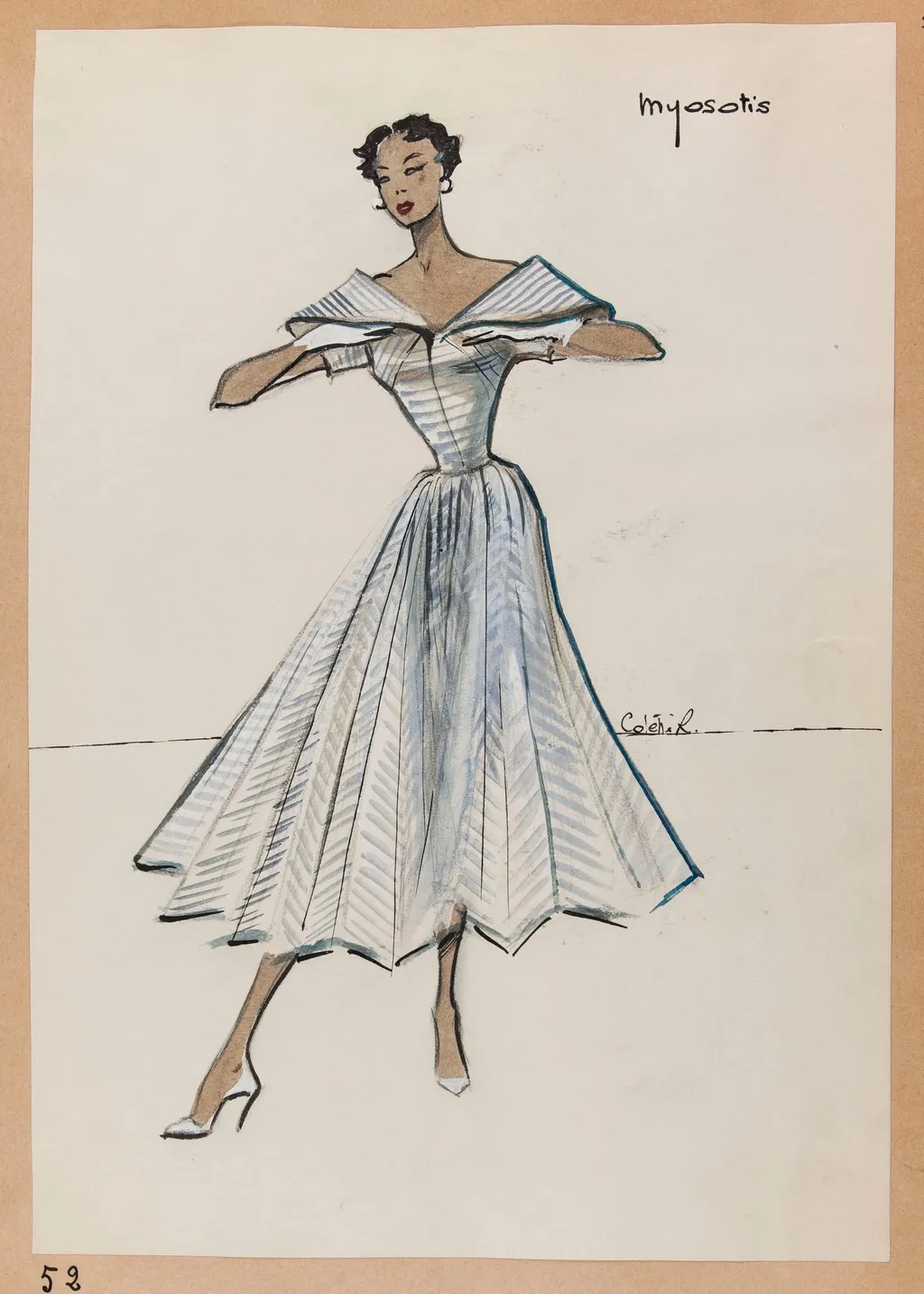
Myosotis is a drawing by Carven. It dates from 1951 and is held in the collection of the Palais Galliera - Musée de la Mode de la Ville de Paris.
About this work
Overview
Executed in ink or pencil, the drawing captures a female figure in motion, suggesting a garment in development rather than a finished portrait.
Created around 1951, Myosotis is a fashion sketch by the designer Carven, currently held in the collection of the Museum of Ethnography. Executed in ink or pencil, the drawing captures a female figure in motion, suggesting a garment in development rather than a finished portrait. The inclusion of the French word for forget-me-not at the top and the artist’s signature in the corner indicate its function as a design study within a couture house context.
Subject & Meaning
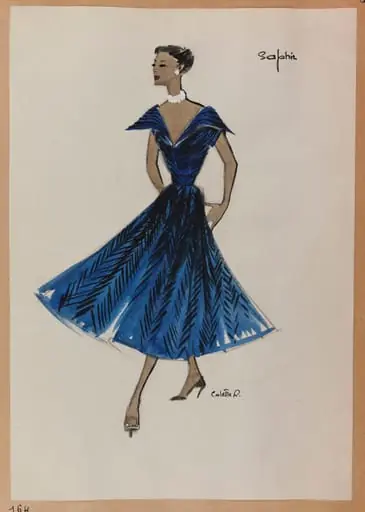
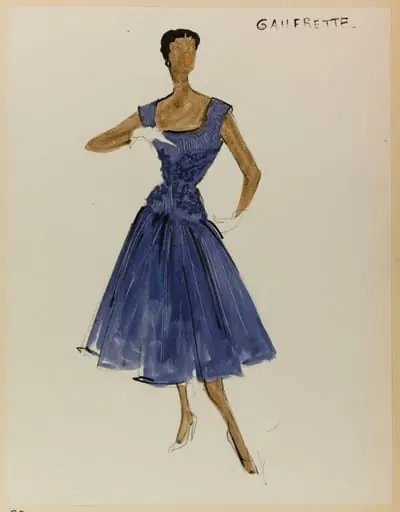
The figure depicted wears a dress with diagonal stripes and a deep V-neck, its silhouette emphasizing a narrow waist and full skirt. Her arms are gently extended, implying a pose for fitting or display. The title, Myosotis, evokes the delicate blue flower associated with remembrance, possibly signaling a thematic thread in Carven’s seasonal collection—subtle, poetic, and rooted in natural imagery rather than overt symbolism.
Technique & Style
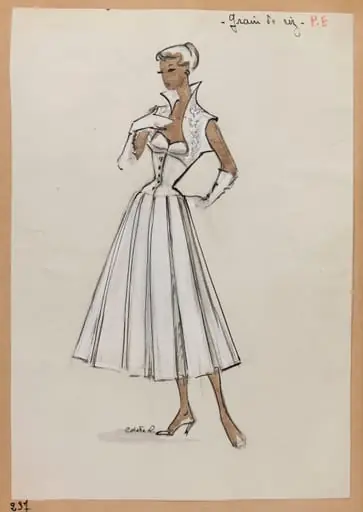
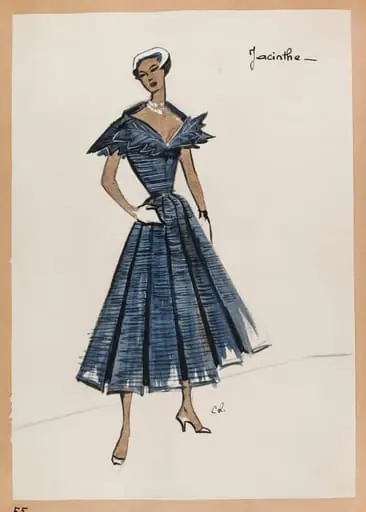
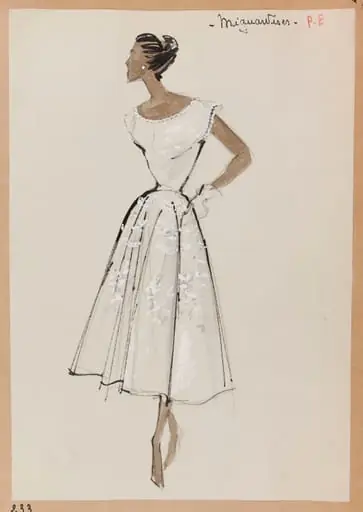
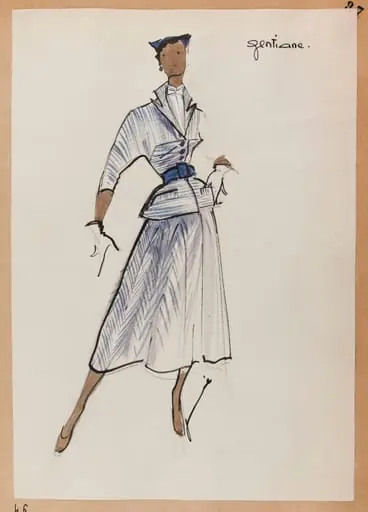
The drawing employs fluid, economical lines to suggest fabric movement and structure. Diagonal stripes are rendered with rhythmic precision, while the soft waves of the hair and the curve of the heels add quiet detail. The absence of color and the sketch-like quality point to its preparatory nature, typical of fashion illustrations meant to communicate form and drape to ateliers rather than to the public.
History & Provenance
The work entered the Museum of Ethnography’s collection as part of a broader acquisition of mid-century fashion materials. Its provenance traces back to Carven’s Parisian atelier, where such sketches were used internally during design development. Unlike finished garments, these drawings were often retained as archival records, offering insight into the creative process behind postwar French fashion.
Context
In the early 1950s, Paris remained the epicenter of haute couture, and Carven was among the few female designers shaping its aesthetic with refined, wearable elegance. Myosotis reflects a trend toward softer silhouettes and floral motifs following wartime austerity. The drawing aligns with contemporaneous designs that balanced structure with lyrical detail, distinguishing Carven’s approach from more rigid contemporaries.
Legacy
Though not widely exhibited, Myosotis contributes to the understanding of how fashion houses documented their creative labor. It exemplifies the role of the sketch as both a technical tool and a cultural artifact. Today, such drawings help scholars trace the evolution of postwar femininity in dress, preserving the quiet craftsmanship behind garments now lost to time.
Artist & collection
Artist
These delicate ink-on-paper drawings capture the quiet poetry of everyday things: pinecones, reeds, apples.
Museum
Palais Galliera - Musée de la Mode de la Ville de Paris
Continue through works from the same source collection.