Artwork
The Duke of Bordeaux presented to the people and the army by the Duchess of Berry in the presence of the king, surrounded by the royal family and the main figures of the State
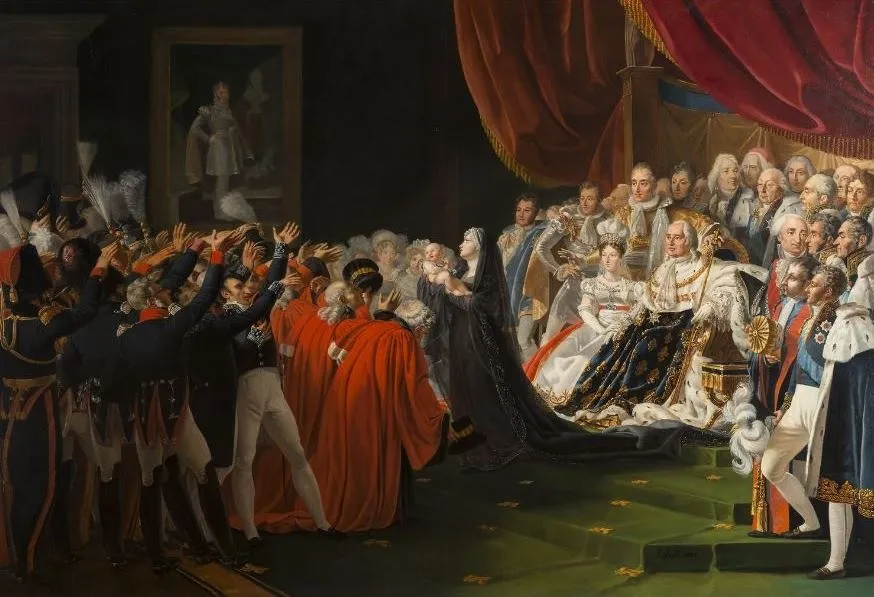
The Duke of Bordeaux presented to the people and the army by the Duchess of Berry in the presence of the king, surrounded by the royal family and the main figures of the State is an oil painting by Charles Nicolas Lafond. It dates from 1821 and is held in the collection of the Museum of the History of France. Charles‑Nicolas Lafond’s 1821 oil on canvas records a ceremonial introduction at the French court.
About this work
It shows the Duchess of Berry introducing her young son to the French court.
This big painting is a history scene by Charles Nicolas Lafond. It shows the Duchess of Berry introducing her young son to the French court. The boy is the Duke of Bordeaux. The king and royal family are there too, all reacting to the moment.
It was painted in 1821, right after the boy’s father was killed. People saw him as a “miracle baby” who saved the Bourbon family’s future.
The painting hangs at the Palace of Versailles.
Overview
Charles‑Nicolas Lafond’s 1821 oil on canvas records a ceremonial introduction at the French court. The widowed Duchess of Berry presents her infant son, the Duke of Bordeaux, before the king, the royal family and leading officials, capturing the moment of public acknowledgment.
Subject & Meaning
The work commemorates the birth of the Duke of Bordeaux, hailed as a “miracle baby” after the assassination of his father, the Duke of Berry, in 1820. By placing the child before the monarch and senior ministers, the painting underscores the hope placed in his succession to secure the Bourbon line.
Technique & Style
Lafond employs a conventional history‑painting format, arranging figures in a balanced composition that directs attention to the infant at the centre. The palette is restrained, with chiaroscuro modelling that highlights the faces of the king and the Duchess, while the surrounding courtiers are rendered in softer tones to suggest a collective, yet secondary, presence.
History & Provenance
Completed shortly after the Duke of Berry’s murder, the canvas was likely commissioned for a public display of dynastic continuity. It entered the royal collection and is now exhibited at the Palace of Versailles, where it remains part of the museum’s narrative of the Restoration period.
Context
The painting belongs to the Restoration era’s visual culture, which sought to legitimize the restored Bourbon monarchy after the Napoleonic wars. By celebrating the newborn heir, the work aligns with contemporary propaganda that emphasized stability and the divine right of the royal house.
Legacy
Although the Duke of Bordeaux spent most of his life in exile following the 1830 July Revolution, the painting endures as a visual record of the brief moment when the Bourbon court publicly embraced its prospective successor, offering insight into the political anxieties of early nineteenth‑century France.
Artist & collection
Artist
Charles-Nicolas Lafond (1773–1835) was a French artist painting in the neoclassical style.
