Artwork
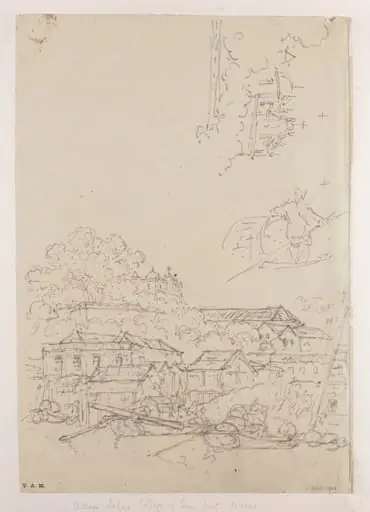
A steep hill in Macau, with buildings below it and on its summit
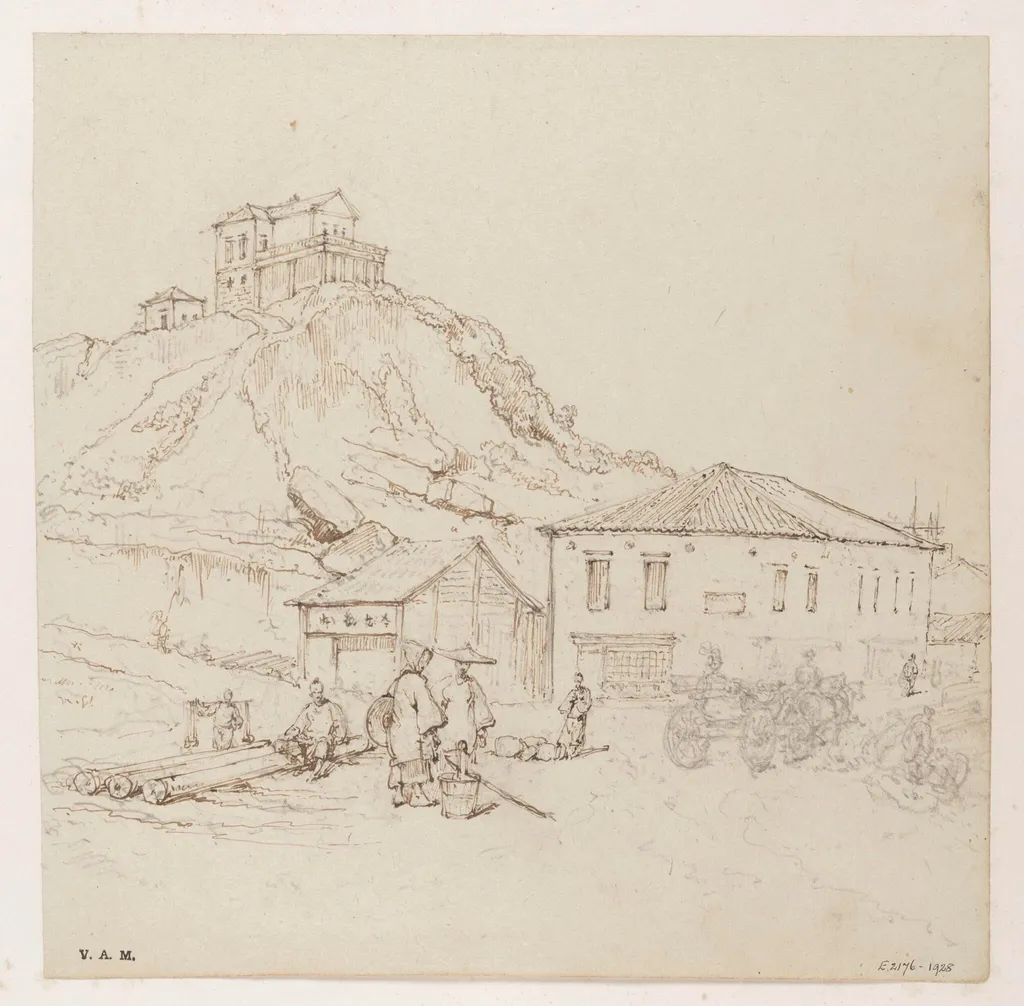
A steep hill in Macau, with buildings below it and on its summit is a drawing by the Romanticist artist George Chinnery. It dates from 19 and is held in the collection of the Victoria and Albert Museum.
About this work
This drawing shows a steep hill in Macau. At the top sits a small building. Below, houses cluster near the water. A Chinese man rests on wooden masts. A woman rides in a horse-drawn carriage by the docks.
George Chinnery drew this in 1852. He lived in Macau for years and sketched its streets often. The scene feels quiet but full of life.
See it in person at the Victoria and Albert Museum.
Overview
This 1852 drawing by George Chinnery captures a steep hill in Macau, crowned by a small structure likely associated with the Convent of Penha.
This 1852 drawing by George Chinnery captures a steep hill in Macau, crowned by a small structure likely associated with the Convent of Penha. The slope descends to a waterfront settlement where clustered dwellings meet the harbor. Figures populate the lower scene: a man lounges atop stacked wooden masts, while a woman in a horse-drawn carriage moves along the dockside. The composition reflects Chinnery’s habit of observing daily life in Macau during his decades-long residence there.
Subject & Meaning
The scene presents a quiet moment of coexistence between local and foreign elements in 19th-century Macau. The seated Chinese man amid maritime tools and the Western woman in a carriage suggest intersecting cultural spheres. The hilltop building, possibly religious, looms above the bustling waterfront, hinting at spiritual or institutional presence amid commerce and labor. No dramatic action occurs, yet the arrangement implies a layered social landscape.
Technique & Style
Chinnery rendered the scene in ink and wash, using loose, fluid lines to suggest form and movement. The hill’s slope is indicated by subtle tonal gradations, while figures are simplified yet distinct in posture and attire. The architecture is rendered with minimal detail, prioritizing spatial relationships over precision. The sketch’s immediacy reflects its origin as an on-site observation, capturing transient moments with observational clarity.
History & Provenance
Created during Chinnery’s extended stay in Macau, the drawing belongs to a large body of works he produced between the 1820s and 1850s. It entered the Victoria and Albert Museum’s collection as part of a broader acquisition of his sketches, which document Macau’s urban and social fabric during a period of intense international trade. The drawing’s survival reflects its value as a firsthand record of colonial-era life in southern China.
Context
In 1852, Macau was a Portuguese enclave and a hub for trade between Europe, China, and the wider Asian region. The presence of both Chinese laborers and Western residents in the scene reflects its hybrid character. Chinnery’s focus on ordinary figures—rather than grand monuments—aligns with a growing 19th-century interest in ethnographic observation, offering a counterpoint to more formal colonial imagery.
Legacy
Chinnery’s drawings remain among the most detailed visual records of Macau’s daily life in the early colonial period. This sketch, like others in his oeuvre, provides insight into the physical and social geography of a port city shaped by cross-cultural exchange. Though not widely exhibited, it continues to inform scholarly understanding of 19th-century urban life in southern China.
Artist & collection
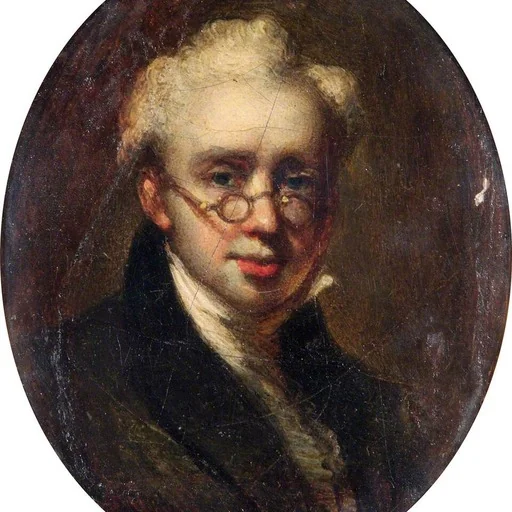
Artist
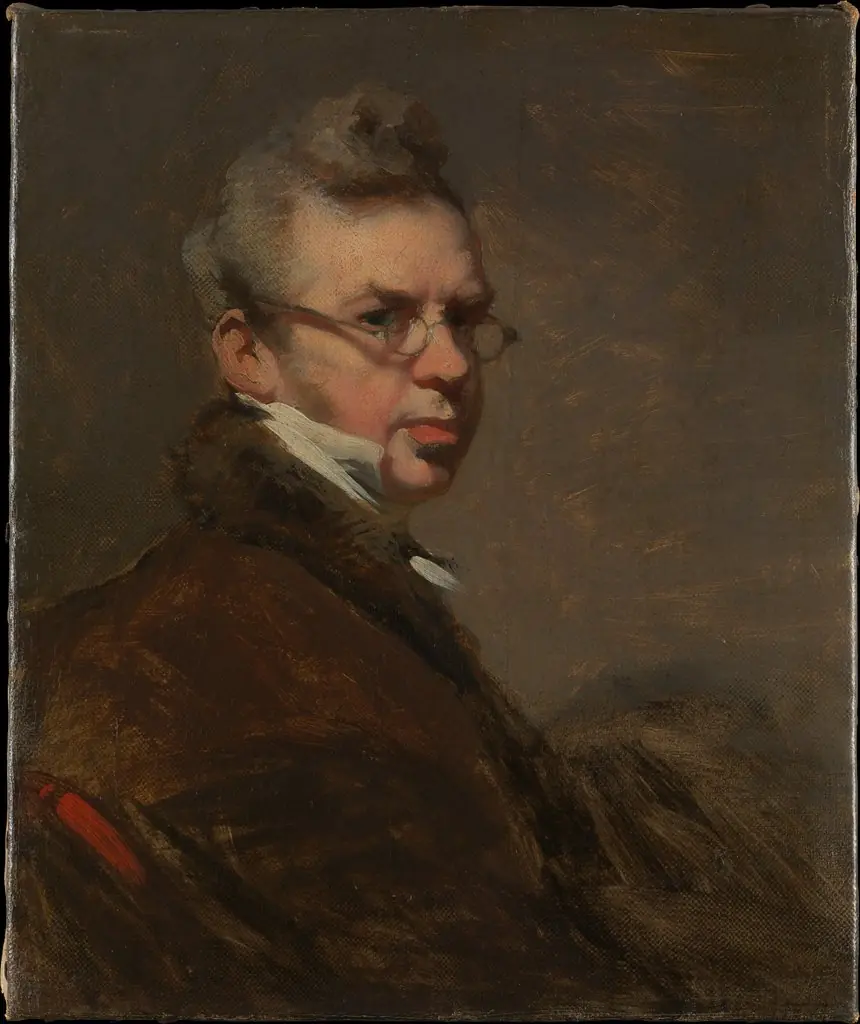
George Chinnery (Chinese: 錢納利; 5 January 1774 – 30 May 1852) was an English painter who spent most of his life in Asia, especially India and southern China.

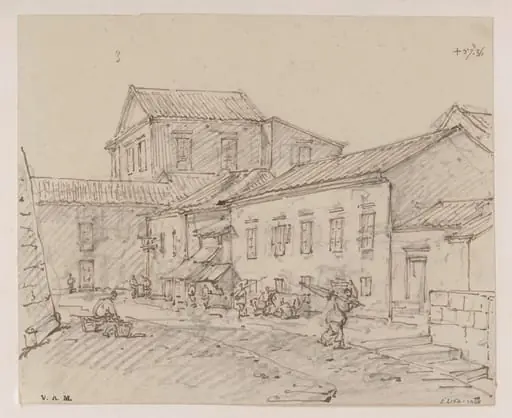 A street in Macau
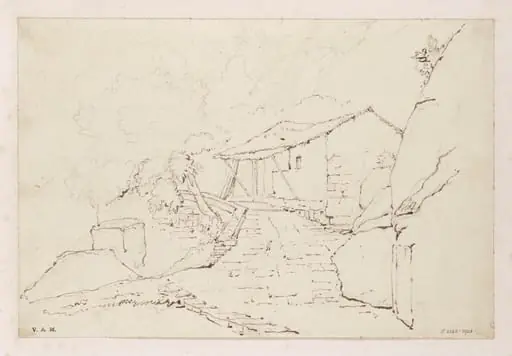 A small building on a rocky hillside, Macau
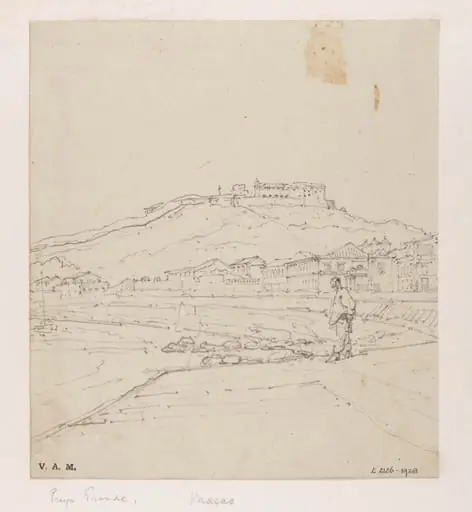 Part of the Praya Grande, Macau
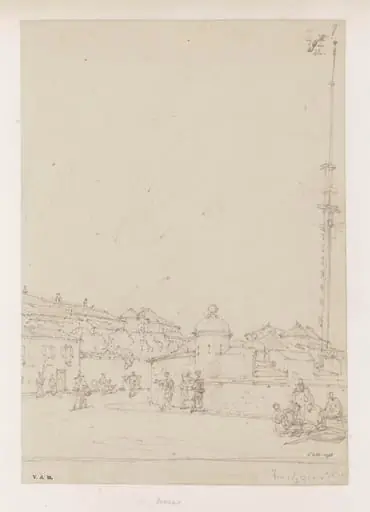 The fort of S. Pedro, Macau
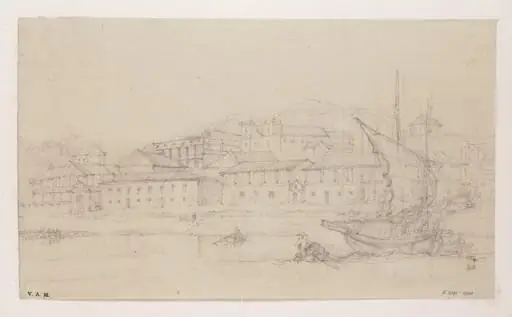 Macau with the church of S. Lourenço
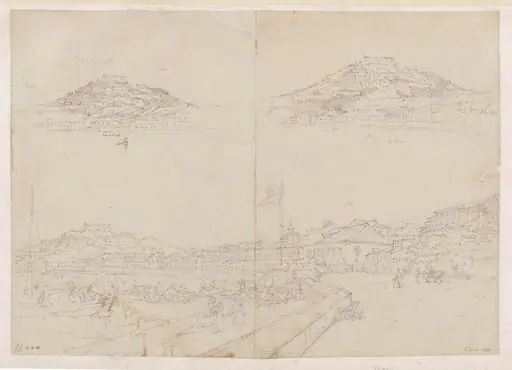 Penha Hill and the Praya Grande, Macau
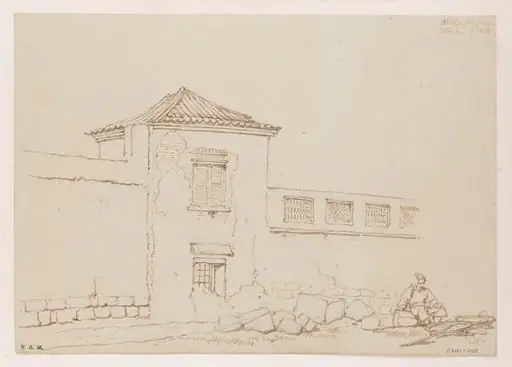 A building in Macau
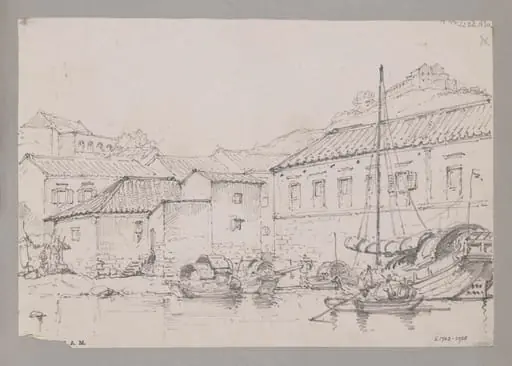 Waterside houses below Penha Hill, Macau
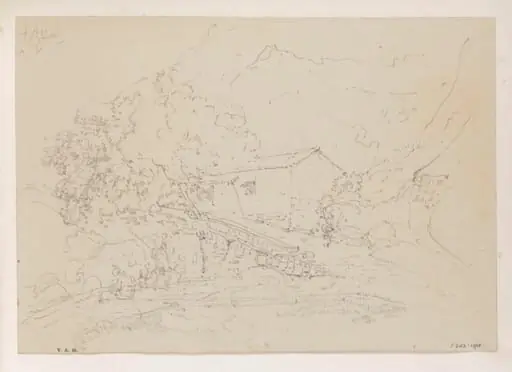 A small building and trees on a hillside, Macau
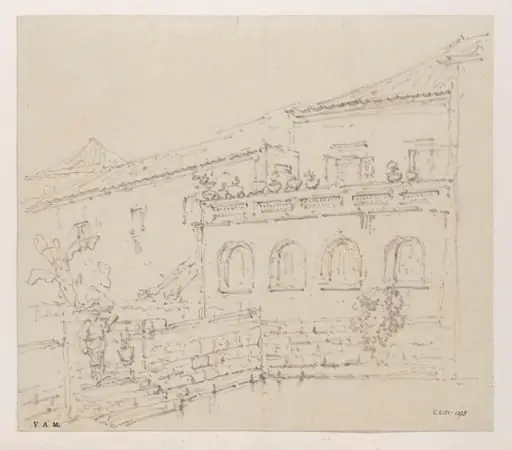 Adjacent houses, Macau
 Buildings below the College of S. José, Macau