Artwork
The Princess of Orange Receiving Alexander II (1818-1881), Grand Duke and Heir to the Throne of Russia, in the Czar Peter's House in Zaandam, 17 April 1839
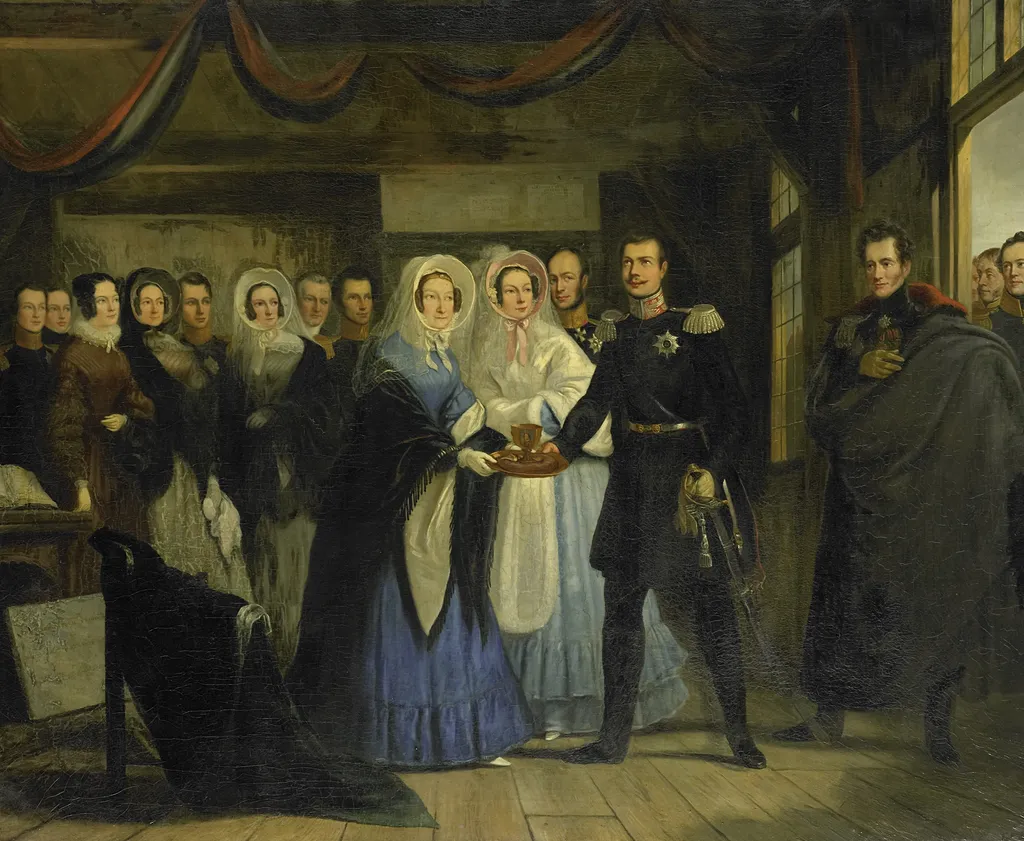
The Princess of Orange Receiving Alexander II (1818-1881), Grand Duke and Heir to the Throne of Russia, in the Czar Peter's House in Zaandam, 17 April 1839 is an oil painting by Christiaan Julius Lodewijk Portman. It dates from 1839 and is held in the collection of the Rijksmuseum.
About this work
Overview
The composition is anchored by a central female figure in a white dress, surrounded by attendants in period attire, all rendered within a dimly lit interior.
Christiaan Julius Lodewijk Portman’s oil painting, executed in 1839, records a diplomatic encounter that took place on 17 April of that year. The work captures a formal reception inside the historic Czar Peter’s House in Zaandam, where a Dutch princess welcomes the Russian Grand Duke, the future Alexander II. The composition is anchored by a central female figure in a white dress, surrounded by attendants in period attire, all rendered within a dimly lit interior.
Subject & Meaning
The central scene presents the Princess of Orange, identified by her white garment and blue shawl, extending a small tray toward the Russian dignitary, who stands in a dark uniform adorned with medals. Their interaction suggests a ceremonial exchange, likely reflecting the political alliances between the Netherlands and Russia in the early nineteenth century. The surrounding figures, dressed in elaborate nineteenth‑century clothing, reinforce the event’s official and aristocratic character.
Technique & Style
Portman employs a muted palette dominated by earth tones and subdued lighting to evoke the interior’s stone walls and wooden floor. The oil medium allows for subtle modeling of faces and fabrics, while the brushwork remains relatively restrained, emphasizing the formality of the gathering. Details such as lace collars, military insignia, and the modest furnishings contribute to a realistic yet composed historical narrative typical of Dutch academic painting of the period.
History & Provenance
Created for a commemorative purpose, the painting entered the Rijksmuseum’s collection, where it remains on display. Its provenance traces back to the original commission by Dutch authorities to document the 1839 reception, and the work has been referenced in museum inventories as a visual record of Dutch‑Russian diplomatic relations in the early nineteenth century.
Own this work as a print
Artist & collection
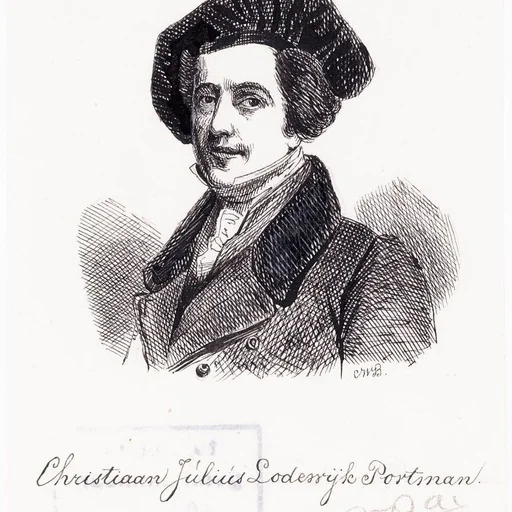
Artist
Christiaan Julius Lodewijk Portman
Christiaan Julius Lodewijk Portman (1799–1868) was an artist, born in Amsterdam.
