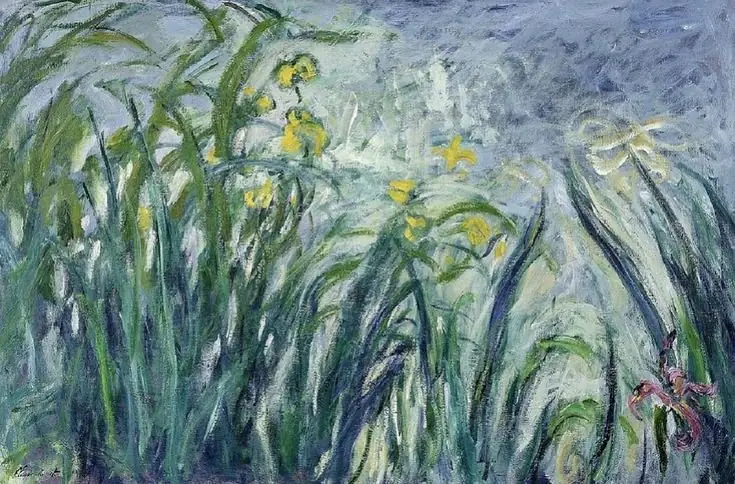
Artwork
Iris
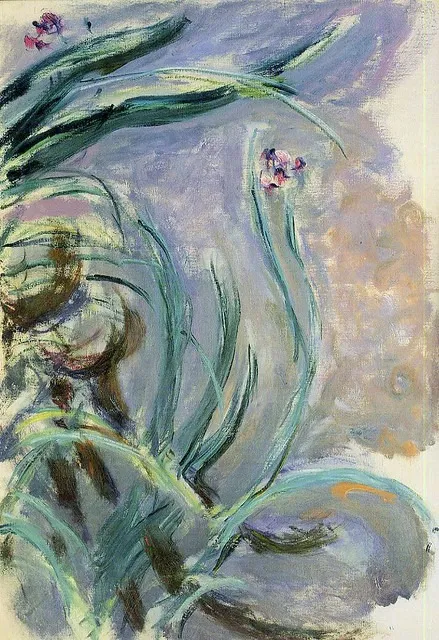
Iris is an oil painting by the Impressionist artist Claude Monet. It dates from 1924 and is held in the collection of the Musée Marmottan Monet.
About this work
Overview
The painting captures a dense cluster of irises in intimate scale, emphasizing botanical detail over landscape context.
Painted in 1924, Iris is an oil-on-canvas work by Claude Monet, part of his late series focusing on garden flora. It resides in the Musée Marmottan Monet in Paris, where it is displayed among other works from his final decades. The painting captures a dense cluster of irises in intimate scale, emphasizing botanical detail over landscape context. Its subdued palette and tactile surface reflect Monet’s evolving approach to color and texture in his later years.
Subject & Meaning
The subject is a close view of iris plants, their slender green leaves and delicate purple blooms rendered without spatial depth or background context. Monet isolates the flowers to concentrate on their form and color relationships. This intimate framing suggests a meditative engagement with nature, consistent with his garden at Giverny, where he cultivated irises and other plants as subjects for sustained observation and repeated study.
Technique & Style
Monet applied oil paint in layered, visible brushstrokes, building texture through impasto and glazing. The soft transitions between purple, blue, and brown in the background result from thin, translucent layers of pigment, allowing underlying tones to subtly influence the surface. The leaves and petals are defined by broken color and directional strokes, avoiding sharp outlines. This method prioritizes optical blending and sensory impression over precise definition.
History & Provenance
Created during Monet’s final years, Iris was painted at his home in Giverny, where he devoted increasing attention to his water garden and flower beds. The work remained in his possession until his death in 1926 and was later inherited by his son Michel. It entered the Musée Marmottan Monet’s collection through the family’s donation, becoming part of the museum’s core holdings of late Monet works.
Context
Iris belongs to a group of late paintings in which Monet turned inward, focusing on small-scale botanical subjects as his vision declined. These works reflect a shift from expansive landscapes to intimate, almost abstract studies of color and form. Painted near the end of his life, they reveal a preoccupation with perception itself—how light, pigment, and memory interact to convey the essence of a plant rather than its literal appearance.
Legacy
Iris exemplifies Monet’s enduring commitment to observing nature through paint, even as physical limitations grew. Its emphasis on texture and muted tonality influenced later artists exploring abstraction through organic forms. While not widely exhibited outside the Marmottan, it remains a quiet testament to his lifelong practice: painting not what he saw, but how he experienced it.
Artist & collection
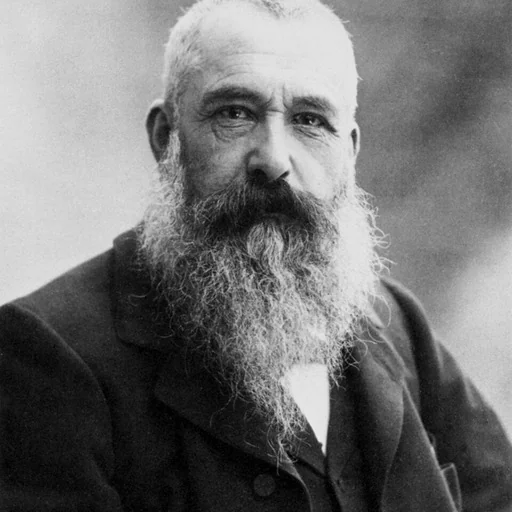
Artist
Oscar-Claude Monet was born in Paris on November 14, 1840, and raised from the age of five in Le Havre, where he began selling charcoal caricatures as a teenager.