Artwork
The Red Cross Knight
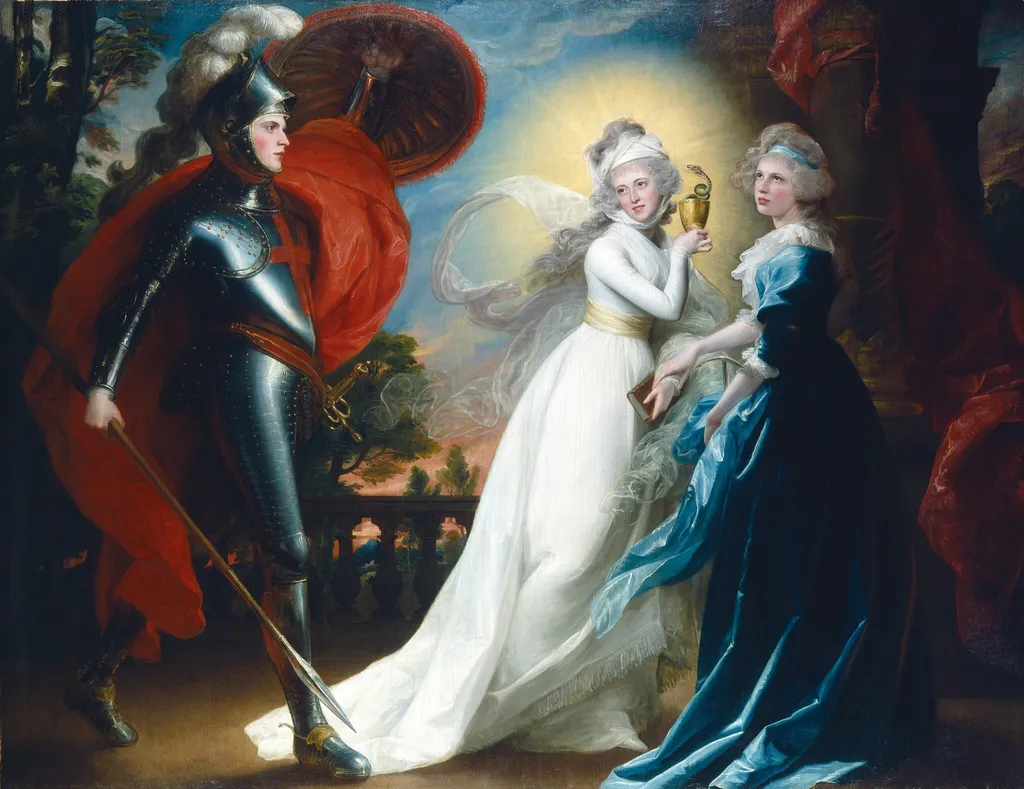
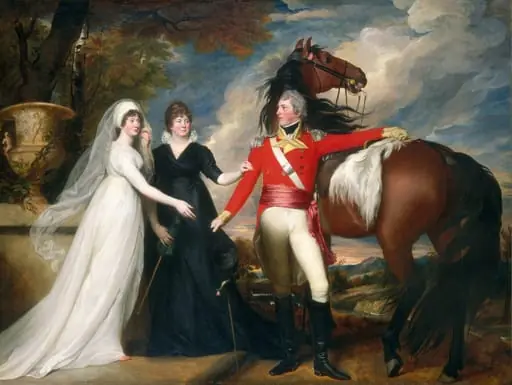
The Red Cross Knight is an oil painting by the American Impressionist artist John Singleton Copley. It dates from 1793 and is held in the collection of the National Gallery of Art.
About this work
Overview
John Singleton Copley’s 1793 oil on canvas, titled The Red Cross Knight, presents a staged historical scene. A fully armored knight in a red cape stands on the left, while two women—one in white holding a trophy and another in blue—occupy the central and right portions of the composition. The backdrop consists of a pastoral landscape with trees beneath a clear blue sky.
Subject & Meaning
The central figure, the Red Cross Knight, is depicted as a chivalric hero, his spear poised as a symbol of martial virtue. The woman in white, positioned between the knight and the figure in blue, appears to celebrate his triumph by presenting a trophy, suggesting themes of honor, reward, and the recognition of noble deeds.
Technique & Style
Copley employs pronounced chiaroscuro, using contrasts of light and shadow to model the figures and give them a three‑dimensional presence. The handling of oil paint renders the metallic sheen of armor and the texture of fabrics, while the luminous sky and foliage provide atmospheric depth.
History & Provenance
Created in 1793, The Red Cross Knight belongs to the later period of Copley’s career, after his return to England from America. The work reflects his continued interest in historical and allegorical subjects, though specific details of its early ownership remain undocumented.
Context
The painting emerges at a time when European art was moving toward Romantic sensibilities, emphasizing dramatic lighting and emotive storytelling. While Copley’s earlier oeuvre focused on portraiture, this work illustrates his engagement with narrative history painting, a genre gaining prominence in the late eighteenth century.
Own this work as a print
Artist & collection

Artist
John Singleton Copley (July 3, 1738 – September 9, 1815) was an American-born British painter active in both the Thirteen Colonies and England.