Artwork
Study for "Breton Women at a Pardon"
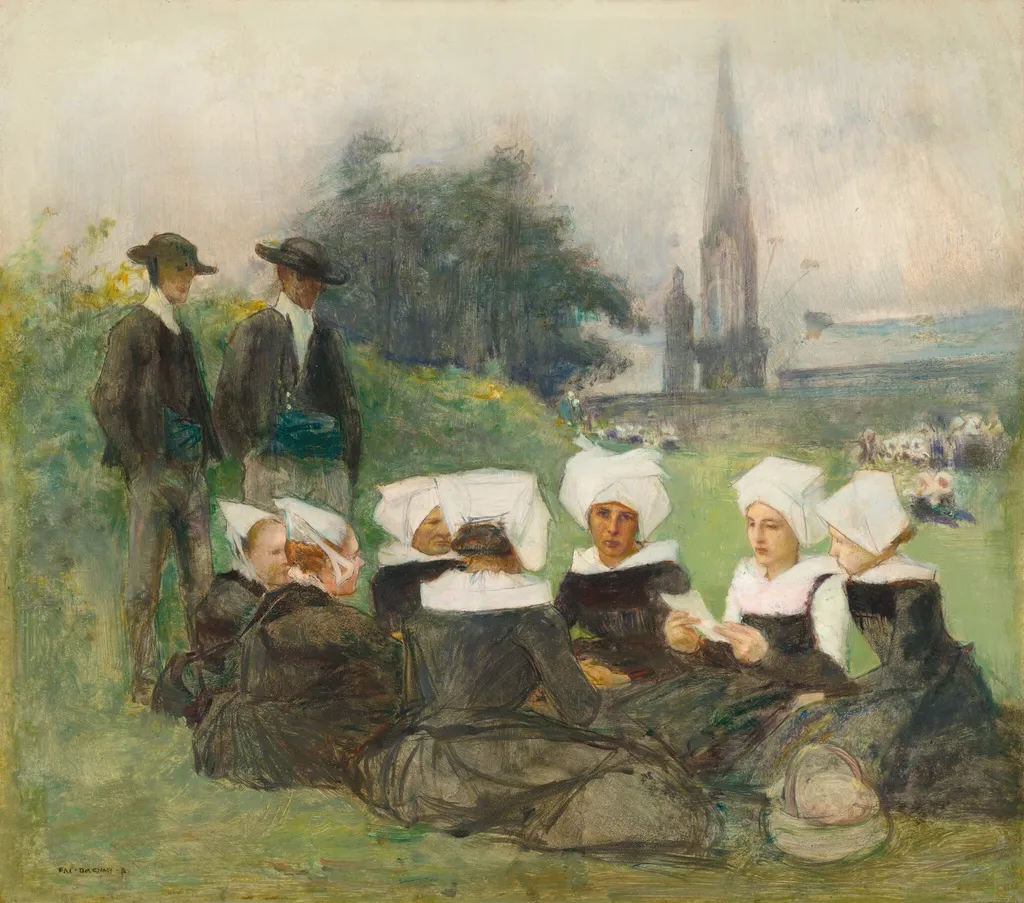
Study for "Breton Women at a Pardon" is an oil painting by the Impressionist artist Pascal-Adolphe-Jean Dagnan-Bouveret. It dates from 1887 and is held in the collection of the National Gallery of Art.
About this work
Overview
Pascal‑Adolphe‑Jean Dagnan‑Bouveret produced this oil on wood around 1887 as a preparatory study for a larger composition depicting a Breton religious ceremony. The work captures a moment of quiet observation among villagers gathered in a rural landscape.
Subject & Meaning
A cluster of women seated on the grass, each shaded by a wide white hat, dominate the foreground. They hold baskets and appear at ease, while a few men stand nearby, observing the scene. In the background, grazing sheep and a distant church tower suggest a communal pilgrimage or pardon.
Technique & Style
The painting is rendered with rapid, almost sketch‑like brushwork, emphasizing gesture over detail. A restrained palette of greens, browns, and whites conveys the natural setting, while the loose handling of paint hints at the artist’s exploratory approach before committing to the final canvas.
History & Provenance
Created as a study for the larger work "Breton Women at a Pardon," the piece remained in the artist’s studio before entering private collections. Its documentation traces back to the late 19th century, aligning with Dagnan‑Bouveret’s interest in regional French customs.
Context
During the 1880s, French painters frequently turned to provincial life for subject matter, seeking authenticity in rural rituals. Dagnan‑Bouveret’s focus on Breton attire and religious gatherings reflects this broader trend toward naturalism and ethnographic observation.
Own this work as a print
Artist & collection

Artist
Pascal-Adolphe-Jean Dagnan-Bouveret
Pascal-Adolphe-Jean Dagnan-Bouveret (1887–1887) was an artist.