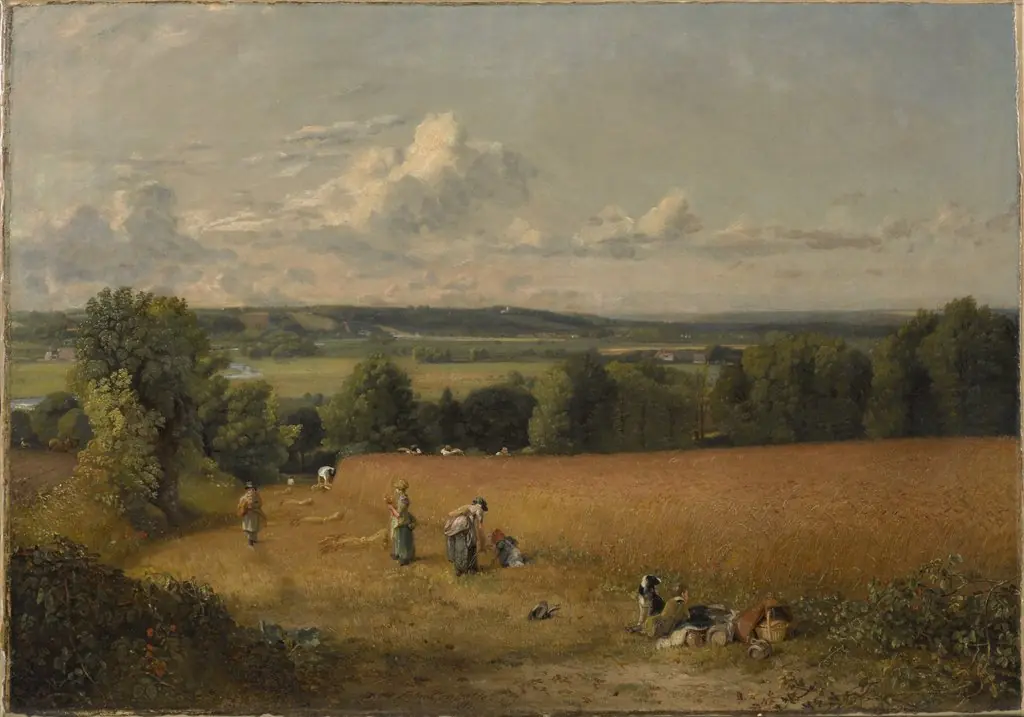
Artwork
A Cornfield
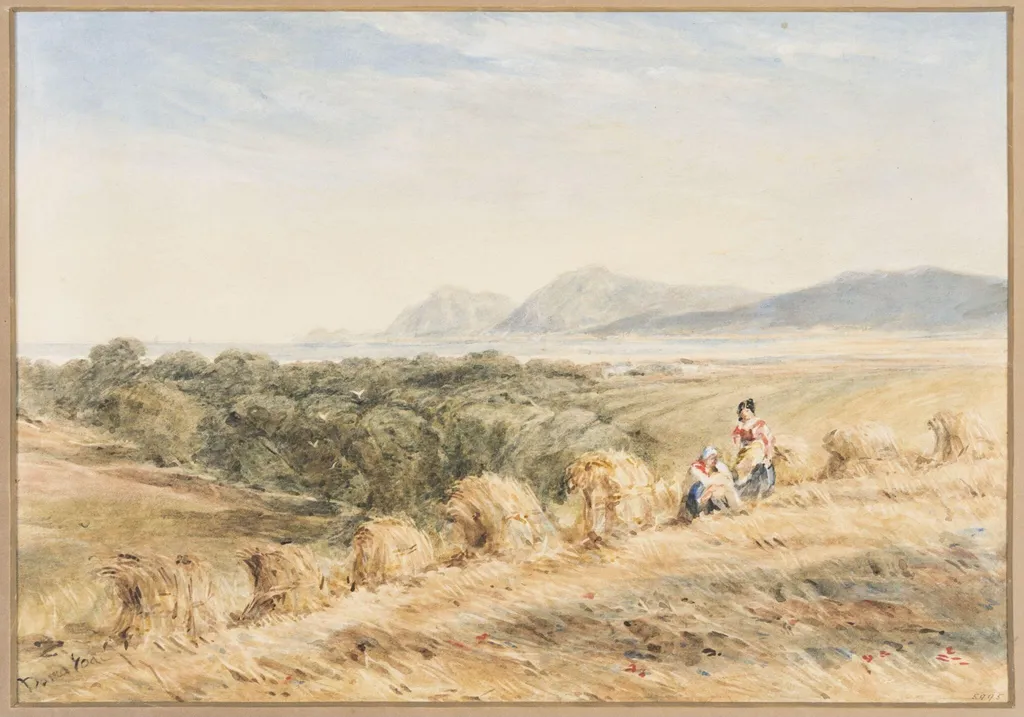
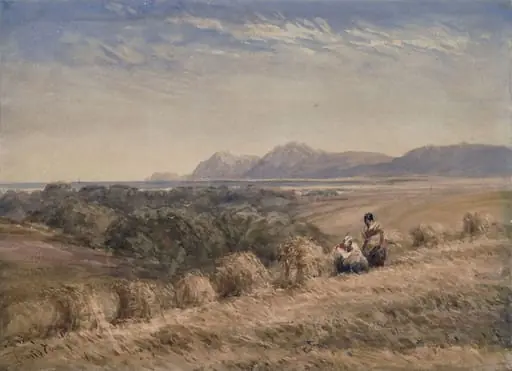
A Cornfield is a watercolor work on paper by David Cox. It dates from 1850 and is held in the collection of the Victoria and Albert Museum.
About this work
Overview
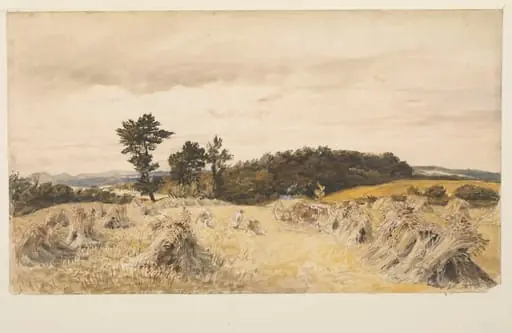
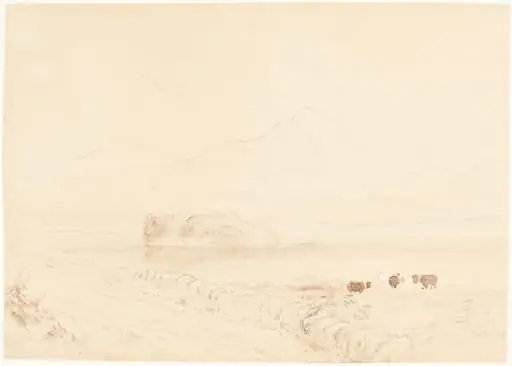
The composition centers on a ripening cornfield, rendered in delicate washes that suggest the movement of wind through the stalks.
Created in 1850, this watercolour by David Cox captures a rural English landscape with quiet precision. The composition centers on a ripening cornfield, rendered in delicate washes that suggest the movement of wind through the stalks. Beyond, a coastal horizon emerges, softened by atmospheric perspective, with distant mountains fading into a pale sky. The work exemplifies Cox’s mastery of watercolour’s translucency to evoke natural light and spatial depth.
Subject & Meaning
Two figures, likely laborers, are present in the foreground, their small scale emphasizing the vastness of the land. The scene reflects the quiet rhythm of agricultural life, unembellished and untheatrical. There is no narrative drama—only the enduring presence of the land and its workers. The painting conveys a sense of stillness, not as an idealized escape, but as an observation of everyday rural existence.
Technique & Style
Cox employed loose, layered watercolour washes to build form without heavy outlines. The cornfield’s texture is suggested through subtle tonal shifts and dry-brush strokes, while the distant mountains are rendered with diluted pigments to simulate atmospheric haze. The sky, painted with minimal intervention, allows the paper’s white to suggest cloud volume. His method prioritizes immediacy and naturalism over detail, aligning with the emerging British watercolour tradition.
History & Provenance
Painted during the final decade of Cox’s life, this work belongs to his mature period, when he increasingly favored outdoor sketching and simplified compositions. It likely originated from his travels in southern England, where coastal landscapes and cultivated fields were common subjects. The piece remained in private collections after his death, with no public exhibition record until the 20th century.
Context
In mid-19th century Britain, landscape painting was gaining recognition beyond portraiture and history scenes. Cox’s work stood apart from the romanticized vistas of his contemporaries, favoring unadorned rural views. His watercolours responded to growing interest in naturalism and the everyday, paralleling literary movements that celebrated rural life without sentimentality.
Legacy
Cox’s approach influenced later British watercolourists who valued spontaneity and tonal harmony over precision. This painting, though not widely reproduced, exemplifies his contribution to elevating watercolour as a medium for serious landscape study. Its restrained composition and quiet observation continue to inform perceptions of 19th-century English landscape art.
Artist & collection
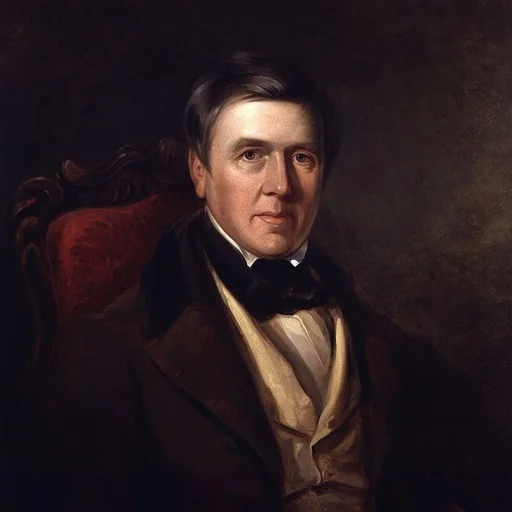
Artist
David Cox (29 April 1783 – 7 June 1859) was an English landscape painter, one of the most important members of the Birmingham School of landscape artists and an early precursor of Impressionism.

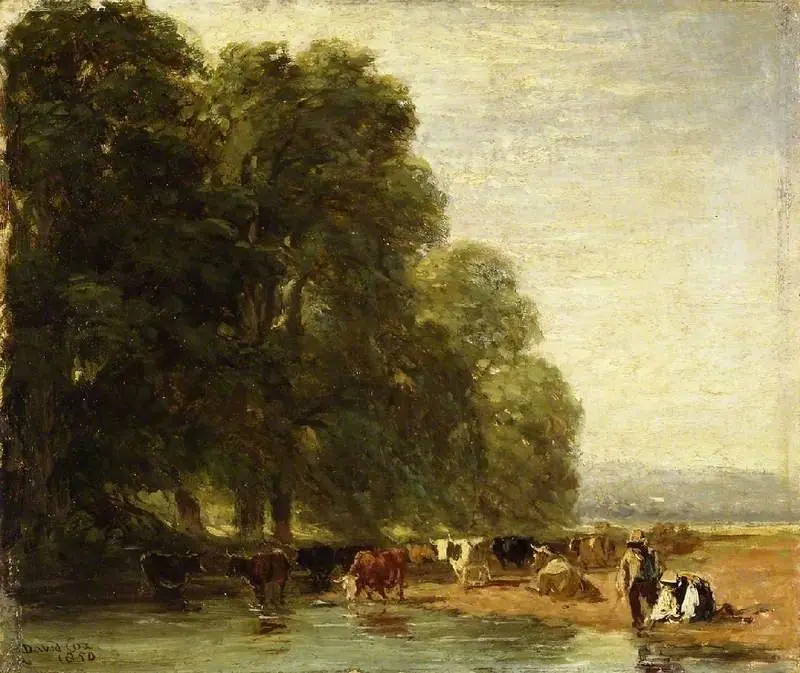
![Trees [verso], by David Cox](https://artifactworldgallery.com/img/david-cox--trees-verso--2f59ba73e183df09-w320.webp)
![Chatsworth [recto], by David Cox](https://artifactworldgallery.com/img/david-cox--chatsworth-recto--3f4d97adb21a8333-w320.webp)