Artwork
The Sculptor Jens Adolph Jerichau in his Studio in Rome
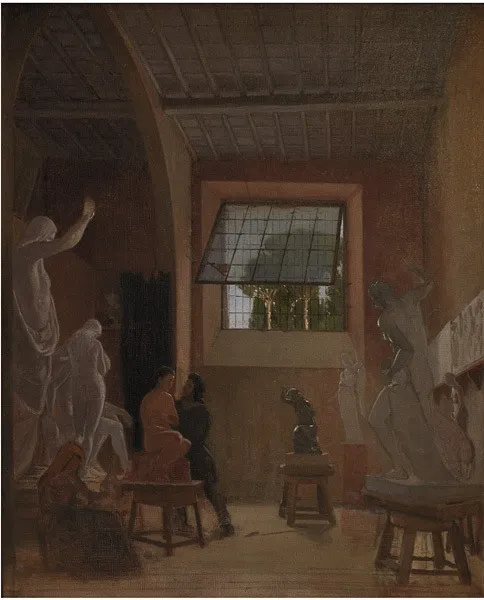
The Sculptor Jens Adolph Jerichau in his Studio in Rome is an oil painting by the Realist artist David Jacobsen. It dates from 1871 and is held in the collection of the Statens Museum for Kunst.
About this work
Overview
David Jacobsen’s 1871 oil painting, titled *The Sculptor Jens Adolph Jerichau in his Studio in Rome*, presents a dimly lit artist’s workshop. The canvas captures a moment of concentrated creation, with a lone figure shaping a small bronze work amid a clutter of unfinished marble forms. The work is part of the collection of Denmark’s Statens Museum for Kunst.
Subject & Meaning
Surrounding him are partially completed statues—some upright, others fragmented—suggesting the simultaneous development of multiple projects.
The central figure is the Danish sculptor Jens Adolf Jerichau, shown bent over a diminutive bronze piece. Surrounding him are partially completed statues—some upright, others fragmented—suggesting the simultaneous development of multiple projects. The composition emphasizes the intimate, labor‑intensive nature of sculptural practice, highlighting the contrast between the emerging detail of the bronze and the larger, unfinished forms.
Technique & Style
Jacobsen employs a restrained palette of muted earth tones, allowing the warm daylight filtering through a high window to illuminate the studio’s tools and materials. The brushwork is fine in the foreground, rendering the bronze’s texture with clarity, while broader strokes convey the shadowed bulk of the surrounding statues, creating depth and a sense of organized disorder.
History & Provenance
Executed in 1871, the painting entered the holdings of the Statens Museum for Kunst, Denmark’s national gallery, where it remains on display. Its acquisition reflects the museum’s interest in documenting 19th‑century artistic life and the cross‑national connections between Danish artists and the Italian art scene.
Context
The work belongs to a broader 19th‑century trend of studio interiors that celebrated the creative process. Set in Rome, a hub for artists on the Grand Tour, the scene underscores the cultural exchange between Denmark and Italy, illustrating how Danish sculptors like Jerichau engaged with classical traditions while working abroad.
Artist & collection