Artwork
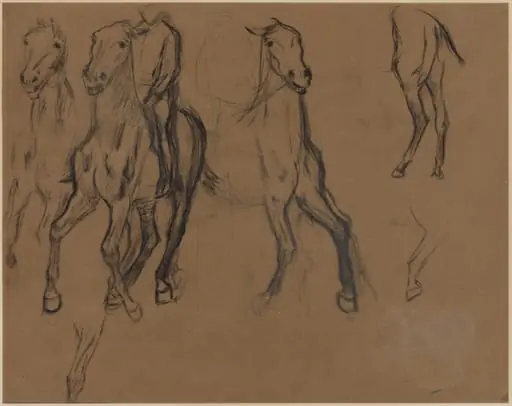
Racehorses (study for "Scene from the Steeplechase: The Fallen Jockey")
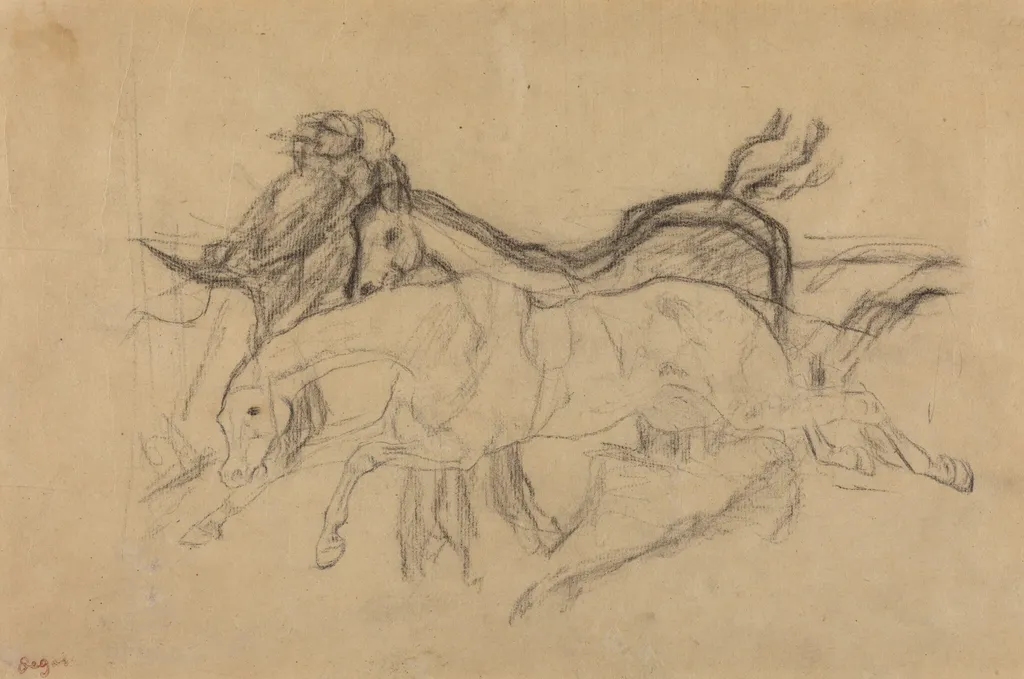
Racehorses (study for "Scene from the Steeplechase: The Fallen Jockey") is a charcoal drawing by the Impressionist artist Edgar Degas. It dates from 1881 and is held in the collection of the National Gallery of Art.
About this work
Overview
Created around 1881, this charcoal drawing by Edgar Degas served as a preparatory study for his larger work, “Scene from the Steeplechase: The Fallen Jockey.
Created around 1881, this charcoal drawing by Edgar Degas served as a preparatory study for his larger work, “Scene from the Steeplechase: The Fallen Jockey.” Executed on light brown paper, it captures the energy of a racehorse in motion with minimal, urgent strokes. Unlike many of his contemporaries, Degas worked primarily in his studio, relying on memory and observation rather than outdoor sketching to capture movement.
Subject & Meaning
The drawing depicts two galloping horses and a jockey struggling to maintain balance, suggesting a moment of peril mid-race. The rider’s precarious posture and the horses’ straining limbs convey tension and physical strain. Degas was drawn to the raw, unglamorous reality of sport, emphasizing human vulnerability against the power of animals rather than romanticizing the spectacle.
Technique & Style
Degas used charcoal with rapid, layered strokes to suggest motion and weight. Hard pressure created deep smudges, while lighter lines defined form without detail. The loose, almost spontaneous handling reflects his interest in capturing fleeting moments. Cross-hatching and selective erasure modulate light and shadow, enhancing the sense of speed without relying on finished rendering.
History & Provenance
This study belongs to a series Degas produced in the early 1880s exploring horse racing, a subject he revisited throughout his career. While the final painting was exhibited in 1882, this drawing remained in his personal collection until his death. It later entered a public collection, where it is now recognized as a key example of his preparatory process and analytical approach to movement.
Context
During the 1880s, horse racing was a popular urban pastime in France, attracting spectators from all classes. Degas, though not a fan of the sport’s social scene, was fascinated by its kinetic energy. His studies of horses and riders were part of a broader investigation into anatomy and motion, paralleling his work with dancers and reflecting contemporary scientific interest in locomotion.
Legacy
This drawing exemplifies Degas’s method of using quick studies to dissect motion, influencing later artists interested in dynamic form. Its rawness and focus on transient action contrasted with academic traditions, helping redefine the role of sketching in artistic practice. Today, it stands as a testament to his commitment to observing reality through disciplined, repeated study.
Own this work as a print
Artist & collection
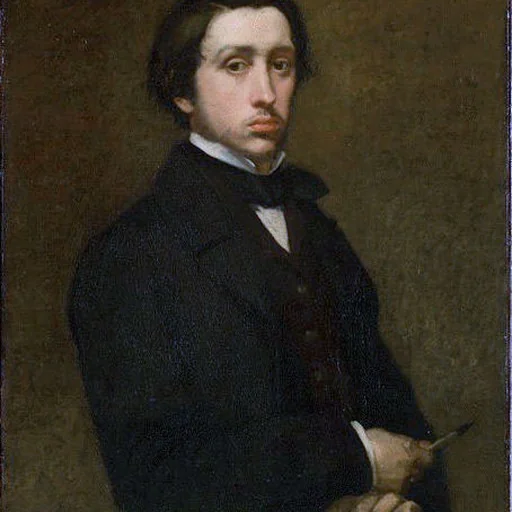
Artist
Born Hilaire-Germain-Edgar De Gas on 19 July 1834 in Paris, Edgar Degas came from an affluent banking family with aristocratic roots and spent his childhood among the cultivated circles of the French capital.

![Study of a Horse [verso], by William Etty](https://artifactworldgallery.com/img/william-etty--study-of-a-horse-verso--cb7cd0a7be190de2-w320.webp)
![Studies of Horses [recto], by Jacques Callot](https://artifactworldgallery.com/img/jacques-callot--studies-of-horses-recto--e2af3b1e857eae0e-w320.webp)