Artwork
landscape with fighting bulls
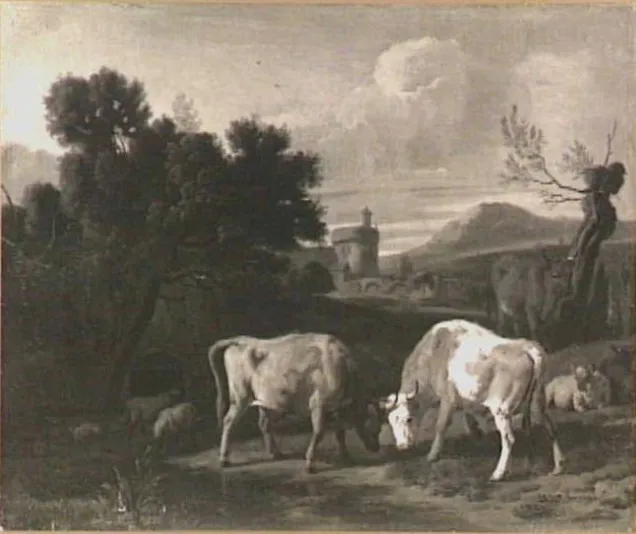
landscape with fighting bulls is an oil painting by the Dutch Golden Age artist Dirck van der Bergen. It dates from 1675 and is held in the collection of the Rijksmuseum.
About this work
Overview
‘Landscape with Fighting Bulls’ is an oil painting executed in 1675 by Dutch artist Dirck van der Bergen. The work is part of the collection of the Rijksmuseum in Amsterdam. It presents a rural scene rendered in a calm, naturalistic manner, typical of mid‑seventeenth‑century Dutch landscape painting.
Subject & Meaning
Although the title suggests a struggle between bulls, the animals appear tranquil, inviting viewers to consider the contrast between title and visual content.
The canvas portrays a pastoral setting where three cows graze on a meadow, two light‑brown with white markings and a darker companion. A modest village with a church rises on a hill behind them, while a solitary figure with a staff stands at the right edge. Although the title suggests a struggle between bulls, the animals appear tranquil, inviting viewers to consider the contrast between title and visual content.
Technique & Style
Van der Bergen employs a subdued palette and soft illumination, allowing shadows to merge gently into the surrounding fields. The handling of light reflects a chiaroscuro approach, creating depth without stark contrasts. Brushwork is fine and controlled, delineating foliage, architecture, and the figures with a modest level of detail characteristic of Dutch Golden Age landscape conventions.
History & Provenance
Created in 1675, the painting entered the Rijksmuseum’s holdings as part of its Dutch Golden Age collection, though the precise acquisition path is not recorded in the available sources. Its presence in the museum underscores the institution’s commitment to preserving representative works of lesser‑known Dutch artists such as van der Bergen.
Context
During the latter half of the seventeenth century, Dutch painters frequently depicted bucolic scenes that combined agricultural activity with modest settlements, reflecting the prosperity and stability of the Republic. Van der Bergen’s work aligns with this tradition, offering a quiet snapshot of countryside life while subtly engaging the viewer through the paradoxical title.
Artist & collection