Artwork
A Child's Nosegay: Wild Flowers in a Jug
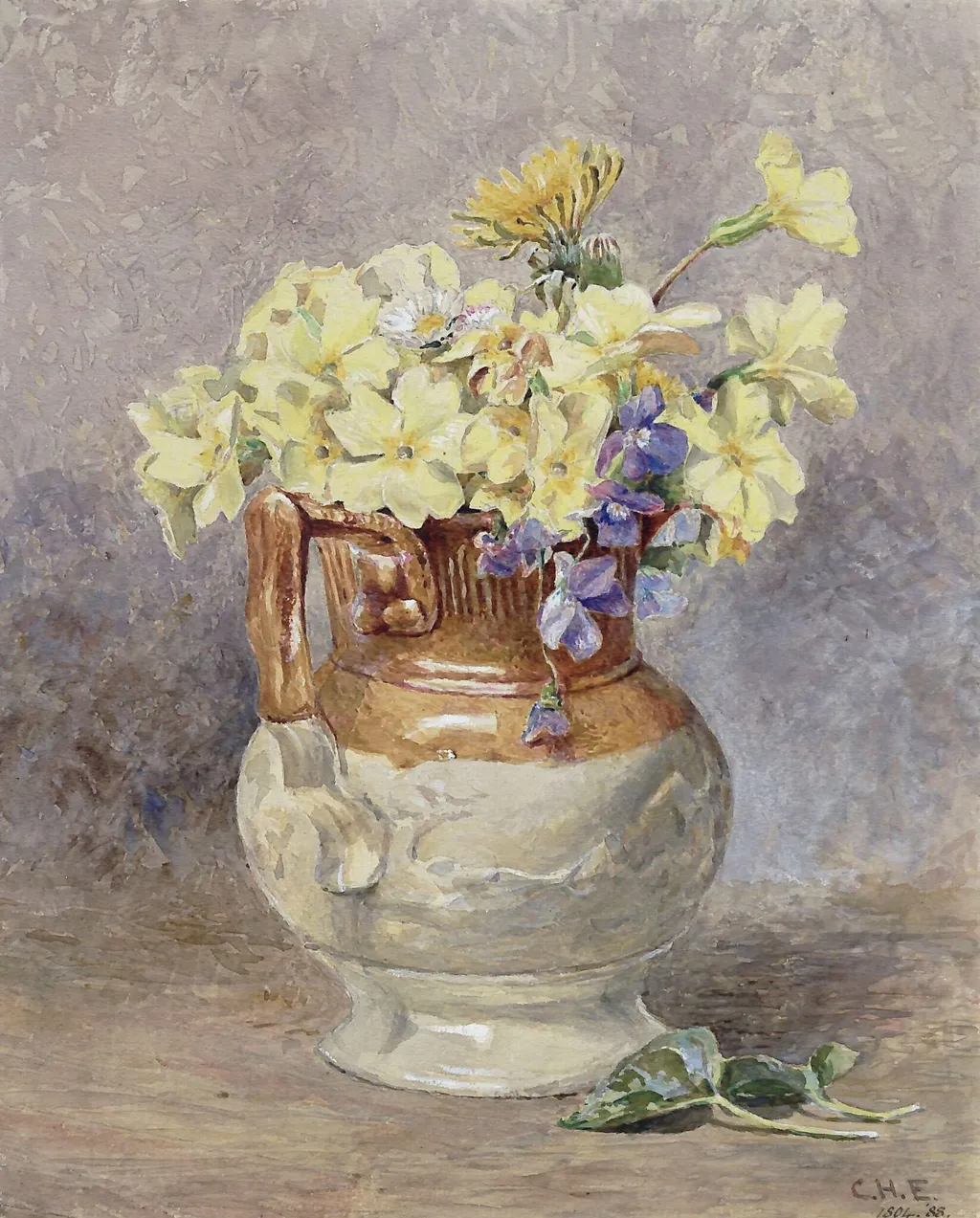
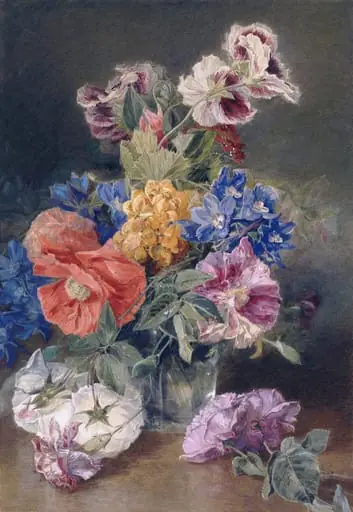
A Child's Nosegay: Wild Flowers in a Jug is a watercolor work on paper by the British Romanticist artist Caroline H. Eastlake. It dates from 1868 and is held in the collection of the Victoria and Albert Museum. Painted in 1868, this watercolor by Caroline H.
About this work
Overview
Painted in 1868, this watercolor by Caroline H. Eastlake captures a modest arrangement of wildflowers in a clay jug. The work is signed and dated, reflecting the artist’s attention to quiet, domestic subjects. Rendered in loose, fluid brushwork, the piece avoids ornamental detail in favor of spontaneous observation, aligning with mid-Victorian interests in natural forms and unadorned beauty.
Subject & Meaning
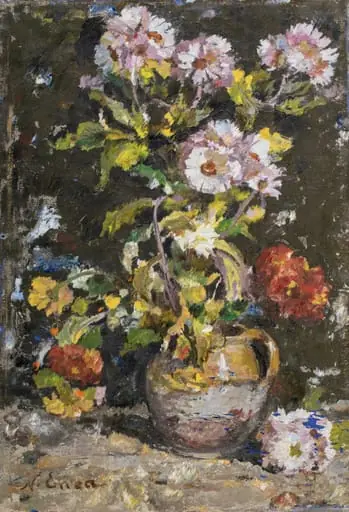
The composition centers on a humble gathering of field blooms—yellow and white petals, accented with touches of purple—gathered without pretense. Placed in a rough-hewn jug with two small handles, the flowers suggest a child’s spontaneous offering. The absence of context or narrative invites contemplation of transience and the quiet dignity of ordinary moments in rural life.
Technique & Style
Eastlake employed transparent watercolor washes with minimal underdrawing, allowing the paper’s texture to contribute to the work’s tactility.
Eastlake employed transparent watercolor washes with minimal underdrawing, allowing the paper’s texture to contribute to the work’s tactility. Brushstrokes are swift and uneven, mimicking the irregularity of wild growth. The light gray background isolates the bouquet, enhancing the vibrancy of the petals while preserving a sense of atmospheric softness characteristic of watercolor’s inherent delicacy.
History & Provenance
The painting is documented as completed in 1868 and bears the artist’s signature. Its early ownership remains unrecorded, but it likely remained within Eastlake’s circle or private collections. Unlike her more public works, this piece was not exhibited widely, suggesting it was intended as a personal study or gift rather than a commercial venture.
Context
In the late 1860s, British artists increasingly turned to everyday subjects as a counterpoint to academic grandeur. Eastlake’s work reflects this shift, aligning with the Realist impulse to find beauty in the unremarkable. Similar floral studies by contemporaries like Kate Greenaway and the Pre-Raphaelite circle reveal a broader cultural fascination with nature’s fleeting forms.
Legacy
Though not widely reproduced or critically analyzed, the painting endures as a quiet example of Victorian watercolor practice. It exemplifies how women artists, often excluded from formal institutions, cultivated intimate, observational modes to express aesthetic sensitivity. Its preservation underscores the value placed on domestic artistry in private collections of the era.
Own this work as a print
Artist & collection
Artist
Caroline H. Eastman painted delicate watercolors of everyday subjects like flowers in jugs. Her *A Child's Nosegay: Wild Flowers in a Jug* (ca. 1863-73) shows a simple bouquet in a clear glass jar, capturing soft petals…