Artwork
Self portrait at the easel
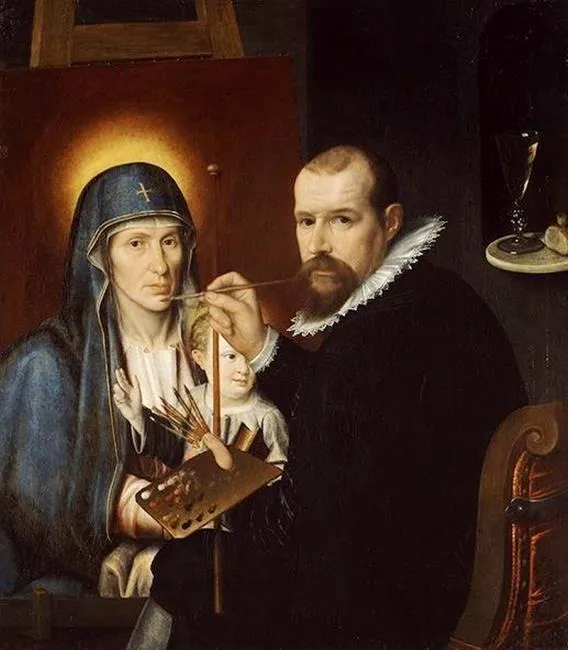
Self portrait at the easel is an oil painting by the Dutch Golden Age artist Engelhard de Pee. It dates from 1601 and is held in the collection of the Bavarian State Painting Collections.
About this work
Overview
Engelhard de Pee’s *Self‑portrait at the Easel* (1601) is an oil painting that places the artist within his own studio. The composition shows a bearded man in a ruff, brush in hand, working on a tiny figure that mirrors his own face. A woman in dark attire stands nearby, cradling an infant, while a mirror reflects another figure, adding depth to the scene.
Subject & Meaning
The work functions as a visual statement on artistic identity: the painter captures himself in the act of creation, emphasizing the link between artist and subject. The presence of the woman and child, along with the reflected figure, suggests a domestic or workshop environment, hinting at the social networks that surrounded a court painter in early‑modern Bavaria.
Technique & Style
De Pee employs a chiaroscuro scheme, using a strong contrast between a warm, luminous glow behind the woman and the surrounding shadows to model the figures. The precise handling of light delineates the textures of the ruff, the polished surface of the easel, and the reflective mirror, demonstrating the artist’s command of spatial illusion and surface detail.
History & Provenance
Born in Brussels, de Pee served as court painter to William V and later Maximilian I of Bavaria. The painting, created in 1601, entered the collection of the Alte Pinakothek, where it is displayed among works of the Dutch Golden Age, reflecting the cross‑regional artistic currents of the period.
Artist & collection
Artist
Engelhard de Pee (1560s – 1605) was a German court painter to William V, Duke of Bavaria.
